Islamabad/ Pakistan: 08 March 2022 – 12 days ago, February 24, 2022 Russia unleashed a full-scale military aggression against Ukraine violating bilateral agreements between two countries as well as basic principles of international law.
The goal of the Russian invasion is to destroy the Ukrainian state, to seize by force Ukrainian territory, and to establish occupational control over all territory of Ukraine.
Despite the use of its best military units, Russia failed to reach its key goals. Ukraine have not not surrendered, as Kremlin was expecting. In the towns temporarily under control of Russian troops, Ukrainian population is actively protesting against them. No one greets Russia in Ukraine.
HUMANITARIAN SITUATION
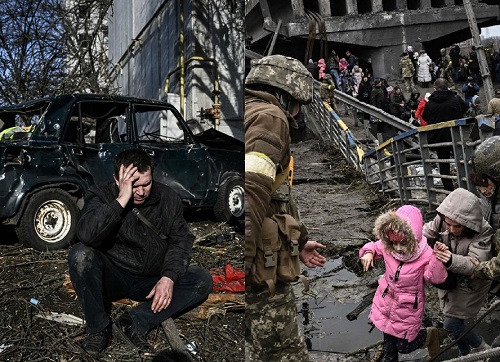
Humanitarian situation in Ukraine is rapidly deteriorating. There is mounting evidence that Russia`s military is committing war crimes with deadly attacks on civilians and the use of prohibited munitions. Faced with military defeats, losses of personnel and vigorous resistance on the ground, the Russian troops began indiscriminate attacks on Ukrainian cities with missile strikes and heavy artillery.
Documents and maps seized by Ukrainian troops from Russian prisoners of war confirm that bombardments of residential areas had been planned in advance.
These are crimes against humanity:
Kindergartens and schools, universities and hospitals, airports and fuel stations, bridges and water reservoirs are targeted. 202 schools, 34 hospitals and more than 1500 residential buildings were damaged or destroyed (as of 7 March);
Thousands of Ukrainian civilian citizens were killed and wounded;
Many people have lost their homes. Nearly 875 thousand Ukrainians were forced to leave Ukraine. Hundreds of thousands became IDPs;
Such towns as Schastya and Stanytsia Luhanska near Luhansk, or Volnovakha in the Donetsk region, are now nearly destroyed;
The residential areas of such cities as Kharkiv, Chernihiv and many others, are intensively shelled, leaving daily dozens of innocent civilians killed and wounded;
Almost the entire city of Mariupol and several towns near Kyiv have been left without heat, light and water. No humanitarian assistance can reach the destination due to Russian shellings.
The Russian troops do not allow civilians to leave, using them as a human shield;
Humanitarian corridors, planned for 5, 6 and 7 March, failed due to Russia’s continued fire. So called “green corridors” proposed by the aggressor for sending people to Russia and Belarus could be considered as forcible deportation of protected persons.
By exposing cities to indiscriminate shelling and creating a dire humanitarian situation, Russia is forcing civilians to flee their homes and providing only a corridor to its territory.
26 February, Ukraine submitted its application against Russia to the International Court of Justice, requesting the Court to issue an order that Russia must cease its unlawful attack on Ukraine. On the eve of the first hearing on 7 March, Russia has notified the ICJ that it does not intend to participate in the process. Still, Russia’s refusal does not prevent the hearing
OPERATIVE SITUATION
The Russian troops continue attacking Ukraine from the territory of Russia, Belarus and the temporarily occupied parts of Ukraine’s Donetsk, Luhansk regions and Crimea.
The main directions of Russia’s invasion remain Kyiv (with the key goal to change Government to a pro-Russian one), Kharkiv (second largest city of Ukraine close to the border with Russia), southern regions of Ukraine adjacent to Russia-occupied Crimea, the Black Sea and the Sea of Azov, as well as the Donetsk and Luhansk regions;
Russia fires hundreds of cruise and operational-tactical missiles at military positions and cities, attacks with aviation, tanks and artillery, and sends subversion and reconnaissance groups to attack civilian infrastructure. Amphibious landing is being prepared to the coastal regions of Ukraine (the city of Odesa is the main target).
Several towns were occupied, and several cities are attacked and besieged, with severe damage to residential areas and numerous casualties among civilians (Kharkiv, Mariupol, Mykolaiv, Chernihiv);
Almost all Russian troops prepared for invasion (111 out of 117 battalion tactical groups) have already been sent to Ukraine. They face severe logistical challenges;
The Russian troops are suffering heavy losses. As of morning 8 March, they constitute more than 12.000 personnel, 48 aircrafts, 80 helicopters, 303 tanks, 1036 armored vehicles, 120 artillery systems, 56 MLRS, 474 trucks, 60 fuel cisterns, 27 anti-aircraft systems, 7 UAVs, 3 boats.
DIPLOMATIC TRACK
2 March, the UN General Assembly adopted — by an overwhelming majority of 141 against 5 — a resolution “Aggression against Ukraine” rejecting the Russian Federation’s brutal invasion of Ukraine and demanding that Russia immediately withdraw its forces and abide by international law. The vote clearly reaffirmed of the 193-member world body’s commitment to Ukraine’s sovereignty, independence, unity and territorial integrity.
Deploring in the strongest terms its aggression against Ukraine in violation of the Charter of the United Nations, the Assembly demanded that the Russian Federation immediately cease its unlawful use of force against Ukraine and refrain from any further threat or use of force against any United Nations Member State, while also deploring Belarus’ involvement in this illegal action and calling on that country to abide by its international obligations.
The Resolution urged the immediate peaceful resolution of the conflict through political dialogue, negotiations, mediation and other peaceful means, calling upon the parties to abide by the Minsk agreements and to work constructively in relevant international frameworks, including the Normandy Format and Trilateral Contact Group, towards their full implementation.
Any war inevitably ends with negotiations. Ending the war, launched by Russia, remains Ukraine’s key priority. Ukraine is ready to consider any options, which would not cross such red lines as Ukraine’s sovereignty and territorial integrity within the internationally recognized borders.
Three rounds of Ukrainian-Russian negotiations were held on 28 February, 3 and 7 March. As a result, the humanitarian corridors were agreed for Mariupol and Volnovakha for 5 March. The evacuation of civilians on 5 and 6 March were interrupted, as Russia broke ceasefire and resumed shelling the city of Mariupol and its suburbs, as well as of the city of Volnovakha using the heavy weapons. At the third round of negotiations on 7 March the delegations of Ukraine and Russia clarified the details of the functioning of humanitarian corridors to provide more effective assistance to people in the cities most affected by the Russian shelling.
SANCTIONS
Unprecedented sanctions both on international as well as national levels are being adopted daily basis, isolating Russia’s economy and severely undermining its economic and financial capacities to continue aggression.
The restrictive measures cover financial, energy, transport, dual-use goods, export control and export financing, visa policy and other sectors of Russian economy and target Russian entities and individuals.
These sanctions will target 70% of the Russian banking market, and key state-owned companies. They will increase Russia’s borrowing costs, raise inflation and gradually erode Russia’s industrial base.
39 countries have already closed their skies to Russia (USA, Great Britain, Canada, Norway, North Macedonia and all EU countries).
As a result,
Russian currency has drastically depreciated;
Russian companies go bankrupt;
Many international corporations are leaving Russia;
Doing business with Russia becomes increasingly toxic;
Russia’s sovereign ratings are downgraded, leading to default.
Russia’s economy will fall by 20% due to sanctions in the second quarter according to JPMorgan’s estimates. As well as Russia risks default on public debt. Economists at JPMorgan Chase & Co. expect Russia’s GDP to decline by 7% in 2022, while Bloomberg Economics forecasts a decline of 9%.
FOOD SECURITY
According to the latest Ukrainian stats, in 2021 Ukraine exported to Pakistan 1,344 million tons of wheat, 334 thousand tons of oil seeds.
Since the 5 March, the Government of Ukraine have suspended exports of some food products due the war conditions. Exports of meat, rye, oats, buckwheat, sugar, millet and salt will be halted. Exports of wheat, corn, poultry, eggs and vegetable oil will be allowed only with the permission of the Ministry of Economy of Ukraine.

 Islamabad/ Pakistan: 08 March 2022 – 12 days ago, February 24, 2022 Russia unleashed a full-scale military aggression against Ukraine violating bilateral agreements between two countries as well as basic principles of international law.