Ministers Express Dissatisfaction on the Role of State Economy & Business Community in Dealing with Financial Crisis & People’s Well Being

    0
    1019
    Tazeen Akhtar
    Pakistan is the only country in the world that is facing financial decline and default was just about to fall on the nation.Government’s economic team claims to have narrowly escaped the crisis but realities are different and can easily be observed unbridled Dollar and uncontrolled inflation. On the other hand media is invited every weak to cover the award ceremonies of businessmen, chambers of commerce and companies are holding big conferences of the leaders in different businesses like this is the only country that have the best entrepreneurs and they are achieving milestones in developing the country’s economy.
    Interesting to note is the government officials themselves are mentioning in the award ceremonies and business leaders’ conferences that they have not done their contribution. The government representative are cordially invited to the business community’s events but listen their dissatisfaction on the performance of the traders, importers, exporters, companies and chambers of commerce.
    I witnessed it in Karachi first and now in Islamabad second. Governor Sindh Kamran Tessori expressed annoyance on awards ceremony in a project launched by MRH group at Waterfront Karachi by Haji Rafiq Perdesi on 26 May 2023. He said ” I can’t understand why these awards when our economy is in crisis. Federal Minister Ahsan Iqbal showered all credits to CPEC for the restoration and development of Pakistani economy in the presence of CEO’s self claimed very big companies of Pakistan on 31 May 2023. It clearly means that the companies and chambers of commerce or business community is not contributing to the economic development of Pakistan.
    Yes! Business community can do a lot and the government should facilitate them for doing the business but the community have to show the end result as well. The government has always provided conducive environment for business and entrepreneurship in shape of policies and soft loans but the results are not according to expectations.
    Pakistan has seen scandles of corruption and nepotism only even when the business leaders were given the driving seats in the relevant departments and ministries. Our recent history is the proof that neither FBR nor Finance and Petroleum, Energy ministries could bring fruitful results when the heads of banks and energy companies were appointed chairman and ministers or advisors there.
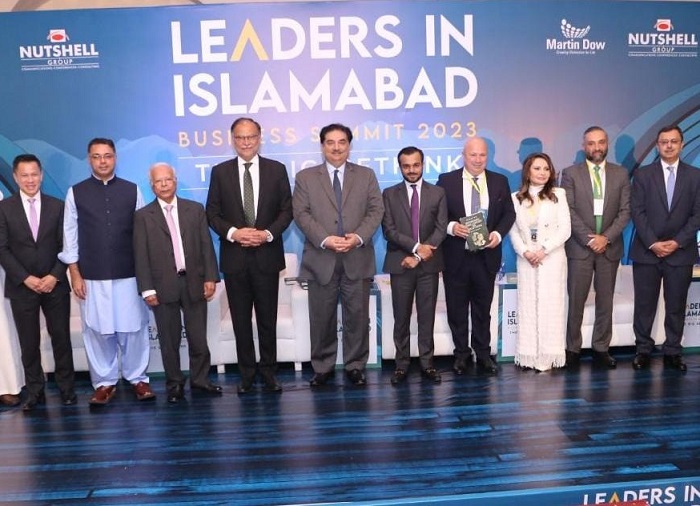
    Latest was Nutshell Conferences Group and Martin Dow Group, in strategic partnership with Overseas Investors Chamber of Commerce and Industry, and Unity Foods Limited, hosted  6th Edition of LEADERS IN ISLAMABAD BUSINESS SUMMIT, with the theme “The BIG Rethink.”
    Ahsan Iqbal, Federal Minister for Planning, Development & Special Initiatives said:
    Chinese President Xi Jinping has directed 100 Chinese companies to invest in Pakistan. China Pakistan Economic Corridor (CPEC) is a game changer project for Pakistan which history will not forgive us for not utilizing properly. We are celebrating the 75th anniversary of the creation of Pakistan, but we are far from our goals.
    CPEC has many opportunities for Pakistan, however CPEC was scandalized by allegations of expensive loans and bribery, after which Chinese companies started leaving Pakistan. Pakistan missed the first opportunity in the 1960s when we were called the future Japan but could not move forward after the 1965 war. Pakistan’s second chance came in 1991, when we introduced the first economic reforms in South Asia and liberalized and deregulated the Pakistani economy and embraced privatization. But in the 1990s, due to the musical chairs of power, we lagged behind in reforms.
    CPEC has given Pakistan a third chance. Where is Pakistan currently standing? If any leader, any party or any organization says that they can take Pakistan out of this quagmire, then they should have a city scan. Pakistan can be brought out of these difficult situations through unity and common solutions. We have to think about the next 25 years. Federal Minister for Planning, Development and Special Measures said that Pakistan has to work on 5Es.
    The first is e-export, the second is policy, the third is environment, the fourth is energy and the fifth is e-equity. By following these 5Es we can improve our economy. Pakistan can become a 1000 billion dollar economy in 12-13 years, but for that we have to grow at the rate of 8%.
    Federal Energy Minister Khurram Dastgir went more farther in alleging even the state economy as responsible for not playing its due role for country and countrymen.
    He said that the state and economy of Pakistan is not benefiting the common man but the elite. Due to the war between Ukraine and Russia, coal became expensive by 400%, which gave a blow to the energy system. However, the government has done a major rethink regarding the production of electricity and now the electricity production in Pakistan will not be based on imported fuel.
    Imported coal, RLNG and oil have to be phased out of power generation. We have alternative energy sources like solar and wind energy. He said that despite the rapid depreciation of the rupee, the price of electricity has not been increased since September 2022, which is due to the generation of electricity from Thar Coal. Pakistan has to dismantle expensive power plants. We have to rethink how to open our economy to the world.
    Other “Leaders” of Economy
    Muhammad Azfar Ahsan, Founder & CEO Nutshell Group, and former Minister of State & Chairman Board of Investment, in his welcome address, elaborated on the theme “The BIG Rethink” for progress. “I blame incompetence, lack of political will, absence of collaboration between stakeholders and lack of continuity of policy framework for bringing us to the present condition.” He reinforced that Pakistan’s progress lies in uplifting education, health and digitalization, and that we need to model after ASEAN and the Central Asian Republics to expedite our progress.
    Ali Akhai, Chairman, Martin Dow Group, focused on the importance of embracing transformation. In his opening remarks, he said; “In a world that is constantly evolving, change is the only constant. It is the responsibility of us leaders to reimagine and rethink. I believe we should all embrace The BIG Rethink with open minds and hearts. Together, we can defy the norms, envision a brighter future, and seize the infinite opportunities that lie ahead.”
    Dr. Zeelaf Munir, Managing Director & CEO, English Biscuit Manufacturers (Pvt) Limited, stated that if Pakistan has experienced a collective failure, we need a collective rethink. On an impassioned note, using the analogy of a ship, she refused to sink and encouraged the 220 million pairs of hands and hearts to be on the deck and to rise like a phoenix from the ashes.
    Faisal Rehman, Managing Partner Middle East, SoftBank Investment Advisers, spoke about the urgent need to head towards digital transformation; he lauded NADRA’s role in doing so. He added that, to streamline progress, NADRA must use the unique data most effectively for economic growth via analytics.
     Kaan Terzioğlu, Group CEO, VEON, said; “Pakistan needs to transform data into useful information that can be used for the creation of value-added services. Let us make sure that every Pakistani uses the Internet for personal and professional development. We want 4G for all and not 5G for a few.”
    The Summit included a soft launch for Dr. Ishrat Husain’s new book titled ‘Economic Challenges and Solutions for Pakistan.’ The second session had Dr. Ishrat Husain, N.I, H.I, Author, Economist, former Federal Minister & Governor, State Bank of Pakistan, in conversation with Sajjeed Aslam, Regional Lead Public Affairs – Asia Pacific ACCA. Dr. Husain stated that contrary to popular belief, there has been a consensus. The real issue, he said, is instability and lack of accountability. “We need our youth to be equipped in the field of Sciences, Engineering, Creative arts, Mathematics, etc. Education is a game changer and teachers of STEM need to be facilitated.”
    This was followed by the first panel discussion of the day. Dr. Moeed W. Yusuf, Pakistan’s former National Security Adviser; Muhammad Aurangzeb, President & CEO, HBL and Chairman Pakistan Business Council & Pakistan Banks’ Association; Ghias Khan, President & CEO, Engro Corporation; Aamir Ibrahim, President & CEO, Jazz & Chairman, Mobilink Microfinance Bank; Maheen Rahman, CEO, InfraZamin Pakistan; and Sajjeed Aslam were part of this illustrious panel.
    Muhammad Aurangzeb, expressed his desire to make banks equally involved in financial partnering and get rid of collateral mind set.
    Reinforcing the need for renewables, Ghias Khan, said; “The biggest challenge is the rising cost of energy, which we need to address urgently. Wind and solar alone cannot manage the load; we would need to include the Thar Coal project to curb the price surge.”
    Maheen Rahman lamented the lack of innovation across sectors; “Companies in Pakistan have been operating for 50-60 years, but they have been unable to innovate their processes.”
    Aamir Ibrahim emphasized on the importance of Internet availability for all and said that Internet shutdowns would only push the country backwards. He said that RAAST has shown the potential of digitalization. “We need to shift gears to rethink trade across borders and use digitalization in our favor.”
    Yousaf Hussain, President & CEO, Faysal Bank Limited, in his address following the panel discussion, shared that the bank’s journey to Islamic instruments is a testament to the possibility of rethinking and reimagining. “There must be minimization of disruption. Customers, stakeholders, and investors all must be brought on the same page alongside regulatory compliance.” He highlighted to need for an increased awareness of Islamic Banking and urged the academia to play its role.
    The third session was a dialogue titled ‘Leadership and Strategy in the Age of Disruption.’ Panelists included Irfan Wahab Khan, CEO, Telenor Pakistan & Chairman, Telenor Bank; Ayla Majid, Global Vice President, ACCA and Founder & CEO, Plaintive; Samina Rizwan, Founder, CalmKaaj; Mujeeb Zahur, Managing Director, S&P Global; and was moderated by Saquib Ahmad, Managing Director, SAP Pakistan, Iraq & Afghanistan. All speakers, who are leaders in their respective fields, echoed the need to empower teams, celebrate the failures and think of ‘long-term’ in terms of generations and not number of years.
    The fourth session continued the discussion on disruption with a change of panelists, including Asif Peer, CEO, Systems Limited; Adil Farhat, CEO, Procter & Gamble Pakistan; Dr. Ayesha K. Khan, Regional Managing Director, Acumen; Syed Moonis Abdullah Alvi, CEO, K-Electric Limited; and Sami A. Wahid, Managing Director, Mondelez Pakistan Limited. They shared their views on the need for disruption to achieve progress. The country, they agreed, is going through an existentialist crisis; disruption is no longer an option for Pakistan rather it has become a necessity to address food insecurity and sustainability. Asif Peer elaborated “When we talk about disruption, we must understand that it does not look familiar, and we need to change in order to combat it.”
    Moonis Alvi stressed on the need for privatization by referring to the loss incurred by K-Electric as to how it is not contributing to circular debt in any way, and was accounted for. “Disruption in the power sector can be brought about through privatization. A non-exclusive distribution license will shape Pakistan’s future, especially concerning the power sector.”
    The fifth session comprised the closing address by H.E. Nicolas Galey, Ambassador of France to Pakistan. Referring to France as a ‘Land of Innovation,’ the Ambassador highlighted the contribution of training institutions that changed the game. He said that France can aid Pakistan in its journey towards green energy. The trade between Pakistan and France grew by 20% in 2022 and he looked forward to fostering ties between both countries on collaborative and stronger footings.
    The event was moderated by Rabia Ahmad, Director & Chief Operating Officer, Nutshell Group, and Shaha Tariq, Head of Content & Storytelling, Nutshell Communications (Pvt) Limited.

    LEAVE A REPLY

    Please enter your comment!
    Please enter your name here