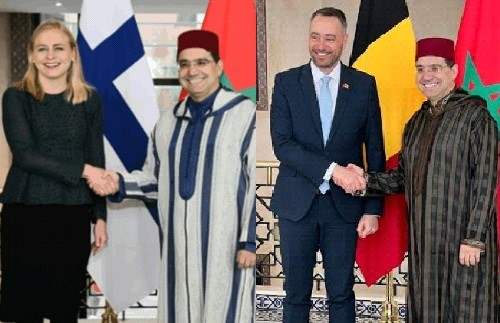
 RABAT / Morocco : The Beligiun and Finish Foreign Ministers visited Rabat and met with host Minister of Foreign Affairs, African Cooperation and Moroccan Expatriates, Nasser Bourita. The sides discussed respective bilateral relations and matters of mutual interest with focus on enhancing trade and economic cooperation. The sides deliberated on concul affairs of the citizens and regional issues as well.
According to Moroccan press statement, The Kingdom of Belgium reaffirmed its clear and consistent support for the Autonomy Initiative under Moroccan sovereignty, considering it “the most adequate, serious, credible, and realistic basis” for achieving a fair, lasting, and mutually acceptable political solution to the regional dispute over the Sahara.
This position was expressed by the Deputy Prime Minister and Minister of Foreign Affairs, European Affairs and Development Cooperation of the Kingdom of Belgium, Maxime Prévot, following his meeting in Rabat with the Minister of Foreign Affairs, African Cooperation and Moroccan Expatriates, Nasser Bourita. On this occasion, Prévot also emphasized that this position is consistent with the stance expressed in the Joint Declaration signed in Brussels on October 23, 2025, and acknowledges the existential importance of this issue for the Kingdom of Morocco, firmly placing the Sahara region within the framework of Morocco’s sovereignty and national unity.
The Belgian Foreign Minister also stressed that he intends to act accordingly on diplomatic and economic levels and that Belgium’s position aligns with international law. He reiterated the announcement that the Belgian Ambassador in Rabat will soon be invited to visit the Sahara region to prepare and support several economic initiatives, such as visits by Belgian companies and the organization of trade fairs by the three regional agencies.
Regarding the extension of consular coverage for Belgian nationals residing in the Sahara and for Belgians traveling in the region, Belgium reiterated that its Consulate General in Rabat is competent for the entire Kingdom of Morocco without regional distinction, including the Sahara region.
Prévot’s visit reflects the positive momentum in relations between the Kingdom of Morocco and the Kingdom of Belgium, marked by regular political dialogue and a shared desire to deepen a strategic partnership based on mutual respect and convergence of views on matters of common interest.
Regarding the visit of Finish FM, the Moroccan sources shared , Finland considers that “genuine autonomy under Moroccan sovereignty could constitute a most feasible solution” to the Moroccan Sahara Issue. This position was expressed in a Joint Communiqué adopted in Rabat, on Sunday, following a meeting between the Minister of Foreign Affairs, African Cooperation and Moroccan Expatriates, Nasser Bourita, and Finland’s Minister for Foreign Affairs, Elina Valtonen, who is on an official visit to Morocco.
In this respect, Finland “reiterated its support for the autonomy plan presented by Morocco”, considering it a serious and credible contribution to the UN-led political process and good basis to achieve a definitive and mutually acceptable political solution, states the Joint Communiqué.
The two Ministers also “welcomed the adoption of United Nations Security Council Resolution 2797 (2025)” and reaffirmed their support for the efforts of the UN Secretary General and his Personal Envoy aiming at achieving a just, lasting, and mutually acceptable political solution to the issue of the Moroccan Sahara.
Background of Sahara Issue
The western Sahara is a matter under debate at UN to be solved in accordance with the aspirations of local Sahrawi population. The Sahrawi Arab Democratic Republic (SADR) claims the territory of Western Sahara, controlling about one-fifth, while Morocco controls the rest.
The Sahrawi people are an ethnic group of mixed Berber, Arab, and black African descent native to the Western Sahara region, spanning southern Morocco, Mauritania, and southwestern Algeria. They traditionally led nomadic, trading lifestyles and are central to the ongoing geopolitical conflict over the partially recognized Sahrawi Arab Democratic Republic (SADR).