 Middle East Monitoring Desk Islamabad
An informed source rejected any talks between Tehran and Washington amid the US-Israeli war of aggression against Iran, stressing that US President Donald Trump has backed off his threat to target Iran’s vital infrastructure after the Islamic Republic’s fierce response.
Speaking to Tasnim on Monday, a senior security official said Trump has retreated in the face of credible military threats from Iran regarding attacks on critical infrastructure.
The source explained that pressures from financial markets and threats to bonds within the US and the West have increased, describing it as another significant factor for Trump’s retreat.
Since the beginning of the war until today, messages have been sent from a number of mediators to Tehran, with the clear response being that Iran will continue to defend itself until it achieves the necessary deterrence, the official stated.
No negotiations are ongoing or have taken place, the source emphasized, adding that with the current state of psychological warfare, neither the Strait of Hormuz will revert to pre-war conditions, nor will there be stability in energy markets.
Trump’s five-day ultimatum means the continuation of the US regime’s program of crimes against the Iranian people, the official warned, adding that Iran will continue its responses and broad defense of the country.
His comments came after Trump claimed in a post on Truth Social on Monday that “the United States of America, and the country of Iran, have had, over the last two days, very good and productive conversations regarding a complete and total resolution of our hostilities in the middle east.”
“Based on the tenor and tone of these in depth, detailed, and constructive conversations, which will continue throughout the week, I have instructed the Department of War to postpone any and all military strikes against Iranian power plants and energy infrastructure for a five day period, subject to the success of the ongoing meetings and discussions,” Trump said.
Financial Times reported that Pakistan is positioning itself as the lead mediator trying to broker an end to the US’s and Israel’s war against Iran, using its military strongman’s ties to Tehran and warm relationship with Donald Trump.
Two officials familiar with the discussions said that Pakistan has pitched Islamabad as a possible venue for talks as early as this week involving senior figures from the Trump administration and Iran.
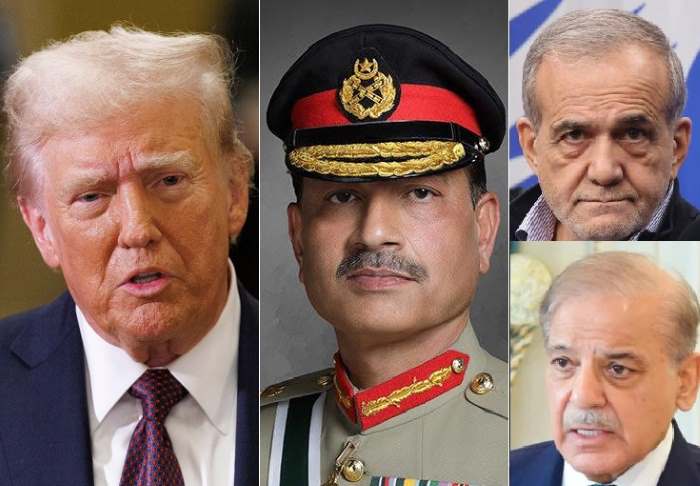
Army chief Asim Munir spoke with Trump on Sunday, according to two people briefed on the call, while Pakistani Prime Minister Muhammad Shehbaz Sharif held talks with Iranian President Masoud Pezeshkian on Monday. The conversation between the Pakistani and Iranian leaders came at around the same time as Trump announced that he was delaying his threat to “obliterate” Iran’s power plants after “very good and productive” conversations with Tehran to end the war.
It was not clear if Pakistan’s mediation push and Trump’s post on his Truth Social social media platform, which caused oil prices to fall sharply, were related. The White House declined to elaborate on Trump negotiations. “These are sensitive diplomatic discussions and the United States will not negotiate through the news media,” the White House said.
Turkey, which was involved in mediation efforts before the war, has also been talking to Iranian officials and Trump’s envoy Steve Witkof in an attempt to secure a brief ceasefire and open space for negotiations.
Pakistan’s foreign minister Muhammad Ishaq Dar held talks with his Turkish counterpart Hakan Fidan on Monday. Egypt’s foreign minister Badr Abdelatty also spoke to his Iranian and Pakistani counterparts on Sunday, as well as Witkoff and Qatar’s foreign minister.
Iran’s foreign ministry denied there had been any direct negotiations with the US since the start of the war, but said that some regional states were involved in mediation efforts.
“Over the past few days, messages were received via certain friendly states conveying the US request for negotiations to end the war,” Esmaeil Baqaei, the foreign ministry’s spokesperson, told official news agency IRNA.
“Appropriate responses were given [to those initiatives] in accordance with the country’s fundamental positions.” The spokesperson insisted that there had been no changes to Iran’s positions regarding the situation at the Strait of Hormuz or Tehran’s conditions for ending the war, according to IRNA.
More than 1280 Casualties in Israel | New Surprises in Coming Days | Will Bring Big Results
Two people briefed on the matter said senior Pakistani officials were back-channelling communications between Tehran and Witkoff and Jared Kushner, Trump’s son-in-law and envoy. Sharif has spoken to Pezeshkian multiple times since the war started.
“While sharing with the Iranian President the diplomatic outreach efforts of Pakistan’s leadership, the prime minister assured the Iranian leadership that Pakistan would continue to play a constructive role in facilitating peace,” Pakistan said in a readout of their conversation on Monday.
Dar told Arab counterparts at a meeting in Riyadh last week that Islamabad was mediating between the US and Iran, but did not provide details, a diplomat said. The diplomat said Pakistan was leading mediation efforts.
Analysts and diplomats cautioned against the prospect of the success of any mediations as the war stretches into its fourth week. People briefed on the matter said the diplomatic efforts involved very early-stage messaging, rather than a formal process.
A security official told Al Mayadeen that Iran has outlined six strategic conditions to halt its defensive war against the US and the Zionist regime, stating that the plan is being implemented in phases and no imminent ceasefire is expected due to battlefield developments.
The Iranian security-political official said Islamic Republic is executing a pre-planned strategy developed months earlier, advancing it step by step with “strategic patience.”
He stated that following the destruction of the enemy’s air defense infrastructure, Iran now holds full control over its airspace.
The official added that, given this military position, Iran sees no immediate prospect for a ceasefire.
He emphasized that Iran will continue a policy of punishing the aggressor until a “historic lesson” is delivered to US-Israeli aggression and US President Donald Trump.
He said regional parties and mediators have presented proposals to Tehran to stop the war, but Iran has set conditions that “must be taken seriously.”
The official outlined Iran’s six core demands for stopping the war within the new legal-strategic framework:
1. guarantee of the non-repetition of war
2. closure of US military bases in the region
3. repelling aggression and payment of compensation to Iran
4. ending the war on all regional fronts
5. implementation of a new legal regime for the Strait of Hormuz
6. prosecution and extradition of anti-Iranian media operatives.