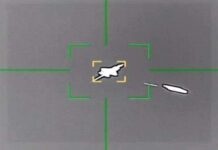
Jarusalem Post reported, this would be the first time Iran has hit a US aircraft in the war. Both the US and Israel are using F-35s, which are fifth-generation stealth jets costing upwards of $100 million.
Iranian media claimed the IRGC was behind the hit shortly after.
According to Capt. Tim Hawkins, a spokesperson for US Central Command, the F-35 was “flying a combat mission over Iran” when it was struck and was forced to make an emergency landing.
 The Islamic Revolution Guards Corps (IRGC) said it has shot down an Orbiter and a Heron drone, both armed, in the airspace of Iranian capital Tehran and Karaj, and has also intercepted a cruise missile in Qazvin.
In a statement on Thursday, the IRGC announced that an Orbiter UAV was targeted and destroyed in the airspace of Tehran at 23:50 local time on Wednesday night.
It noted that an advanced Heron drone was also intercepted and shot down in the skies over Nazarabad in Karaj. The IRGC said both of the military drones were armed and were shot down before any operation against Iran.
The IRGC added that its advanced modern air defense system has intercepted and destroyed a cruise missile in Koohin at Qazvin Province. It said the interception was carried out under the control of the integrated air defense network of Iran.
Earlier on 02 March, a US F-15 aircraft was hit by the Iranian Army’s Air Defense Unit. Iran’s Khatam Al-Anbiya Central Headquarters on Monday had announced the downing of three US fighter jets by Iranian homegrown air defense systems.
Since then, various photos of US aircraft that have been targeted and their pilots who ejected before the warplanes crashed. Photos and footage showing the jet’s descent and crash into Kuwaiti soil were published both in social media and multiple media websites.
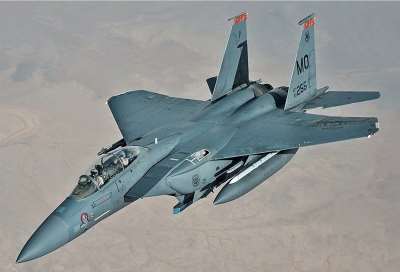
At least 16 US military aircraft have been lost since the start of the war with Iran, including 10 Reaper strike drones hit by enemy fire and a half-dozen other planes badly damaged in attacks or accidents.
Bloomberg published a report by Gerry Doyle and Courtney McBride : The most serious losses were because of accidents: three US F-15s downed by friendly fire in Kuwait, and a KC-135 tanker destroyed during a refueling operation. All six crew members on the tanker were killed in the accident.
Five other KC-135s were reportedly damaged by an Iranian missile strike while parked at an airfield in Saudi Arabia.
So far only the uncrewed Reapers have been brought down by Iranian defenses, with at least nine being destroyed in the air, according to a person familiar with the matter. One was hit at an airfield in Jordan by a ballistic missile, people familiar with the matter said.
The other two Reapers were lost to accidents. The drones are meant to be “attritable” — flown in higher-risk areas because they don’t carry pilots and are much cheaper to replace than a crewed plane.
A US F-35 stealth jet was forced to make an emergency landing at an airbase in the Middle East after a combat mission on Thursday, according to US Central Command. The plane’s pilot is in stable condition and the incident is being investigated, CENTCOM said.
The warplanes have been used in combat since their introduction about 10 years ago, but none is known to have been hit by enemy fire.
Iran operates the infrared-guided 358 surface-to-air missile, which has a small, mobile launcher. They can hit targets at altitudes up to 25,000 feet and, because they have no radars, aircraft will have no warning they are being tracked. They were a threat to US planes in last year’s campaign over Yemen.
During the last large-scale air campaign that the US was involved with, the military intervention in Libya in 2011, there were only three reported combat losses over four months. One of them was a US Navy drone.
The scale of operations, with the US saying it conducted more strikes in the first day of the war than in the “shock and awe” aerial attacks of the 2003 Iraq War, could explain the relatively high losses, said Peter Layton, a former Royal Australian Air Force officer and a visiting fellow at the Griffith Asia Institute.
“The difference might be a much greater rate of effort,” Layton said. “More sorties flown each day.”
US Central Command declined to comment, saying it would not discuss battle damage assessments.
Although Iran’s air defenses were among the first targets of the US and Israeli air campaign, completely stamping them out — and establishing air supremacy — has remained elusive.
Chairman of the Joint Chiefs of Staff Dan Caine has said that the US only has localized air superiority, meaning there are specific swathes of Iranian airspace the US controls.
The Reaper shootdowns also illustrate one of the difficulties of trying to open the Strait of Hormuz: any active air defenses will greatly complicate those efforts. Houthi fighters in Yemen shot down several Reapers in 2025. The US operates 225 Reapers, according to the International Institute of Strategic Studies.
Losing aircraft in accidents during high-tempo operations is not uncommon. The US Navy shot down one of its own aircraft in 2024 in the Middle East.
“Periodic accidents like the tragic mid-air collision with the KC-135s are an unfortunate likelihood in large, high tempo, high pressure combat operations,” said Justin Bronk, a senior research fellow at the Royal United Services Institute.
As the war heads into its third week, Iran has kept up a steady pace of strikes around the region, although US Secretary of Defense Pete Hegseth has said attacks have declined by about 90% since the start of the conflict.
Israeli and Western estimates suggest that about 60% of its launchers have been destroyed, but the number has not fallen much since the early days of the war.
On Thursday Iran hit crucial energy facilities in Qatar and Saudi Arabia in retaliation for attacks on its South Pars gas field.