 Tazeen Akhtar
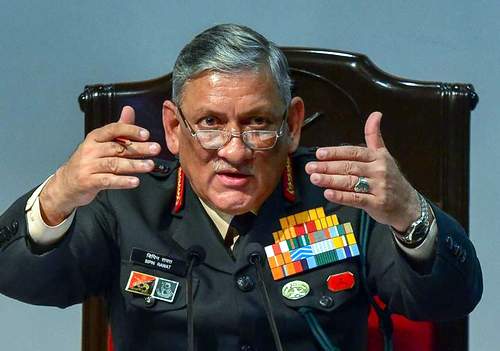
Following the Pakistani model of the leadership and coordination among different wings of defence services, India has appointed the Chief of Army Staff General Bipin Rawat as the country’s first Chief of Defence Staff (CDS) only one day before his retirement on Dec 31, 2019.
Pakistan is carrying the model for decades in which 3 services chiefs remain in contact through the office of Chairman Joint Chiefs of Staff Committee that is most often a 4 star general but not especially the general from army only. Senior most Admiral or Air Marshal can also be appointed.It is a principal military advisory body, and coordinates command operations between the services.
Pakistan established Chairman Joint Chiefs of Staff Committee office after a complete study of military failures during 1971 war with India when the top brass of military almost alienated the defence services in planning and operational decisions. Chairman Joint Chiefs of Staff Committee secretariat was formulated in 1976 to keep all services chiefs on board. Further this arrangement helps create coordination among the civil and military leadership. Inspite ,Pakistan could not avoid military take overs even in the presence of this system of consultative coordination. This is another story.
Now India has followed that model in which the Chief of Defence Staff will be a four-star General, the principal military advisor to the defence minister, to ensure jointness in training, logistics and procurement of the three services as reported by The Economic Times of India.
Report reads that defence ministry had recently amended the army, air force and navy rules by bringing in a new clause that allows the Chief of Defence Staff to serve upto a maximum age of 65 years. The notification came in the backdrop of Gen Rawat retiring on December 31. According to the existing rules, an Army Chief has a tenure of three years or upto the retirement age of 62 years, whichever is earlier. Although Rawat is yet to reach the age of 62 years, he is retiring because he is completing his tenure of three years as Army Chief.
Chief of Defence Staff will administer all tri-services organisations, comprising personnel from the army, air force and navy, but their command will be with the Chief of the service which has a predominant role in their functioning. However, he will head the newly created agencies for cyber and space. The tri-service agency of Special Forces could also come under him, but their deployment will be dependent on ground commanders. Same is Pakistani model in which Chairman Joint Chiefs is not responsible for service and operational matters of the forces.
The headquarters of the Integrated Defence Staff, comprising representatives from the three services, will come under him. The Chief of the Integrated Defence Staff, also known as the CISC, who heads this tri-services organisation will also come under the CDS and be renamed as the Deputy CDS. The CDS will also head all tri-services institutions such as the National Defence Academy in Pune, College of Defence Management in Secunderabad and the National Defence College in Delhi.
Importantly, the DMA will promote jointness in procurement, training and staffing for the services. It will have an appropriate mix of civilians and military officers. The DMA will also facilitate the restructuring of military commands for the best utilisation of resources, including through the establishment of joint or theatre commands. It will also promote the use of indigenous equipment by the services.
Meanwhile, as the Permanent Chairman COSC he will be a member of the Defence Acquisition Council headed by the Defence Minister and the Defence Planning Committee headed by the National Security Adviser. He will be the military adviser to the Nuclear Command Authority, which handles India’s nuclear arsenal. He will bring jointness in operations, logistics, transport, training, communications, repairs and maintenance of the three services, within three years of the first CDS assuming office.
Another notable thing is second tenure of the chief although it is with a different name. In the history of India this is a new chapter that an army chief is not being retired completing his service of 3 years. There is no example in India for the extension in the service of the chief. General Manek Shaw was awarded only 6 months extension and that for he played key role in the disintegration of the enemy country Pakistan in 1971.
General Bipin’s posting is both reappointment as well as extension in the service. This tradition has never been supported in Pakistan for two reasons;1- Mostly it is a political decision-political government gives extension for more its own interest than for the chief”s extra ordinary capabilities and country’s requirement. 2- Extension deprives the junior officers of the right to promotion. They feel ditched and they can not perform their duties amicably. Same situation can be seen in India in the coming weeks and months.
Bipin Rawat’s appointment is also being seen in the background of his recent statement that was quite political and it sparked criticism from mainly opposition parties of India.He was immediately called out for taking sides while still in a post that must be neutral and apolitical.
He said “leaders are not those who lead masses in arson and violence. Leadership is all about leading. When you move forward, everybody follows…But leaders are those who lead people in the right direction. Leaders are not those who lead people in inappropriate directions, as we are witnessing in a large number of university and college students, the way they are leading masses of crowds to carry out arson and violence in our cities and towns. This is not leadership,”
This statement was not only political but also it was in line with the government policies. It means Indian military chief initiated a tradition of poking his nose into political matters. Moreover his appointment is said to be the reward for his statement against the leaders of protests and in favor of the government. Other chiefs can also follow this tradition in the future to secure benefits from the government.