 Tazeen Akhtar
 Pakistan Space and Upper Atmosphere Research Commission SUPARCO is under sever criticism on social media by Pakistanis since when the Indian Space mission Chandryan has made it to land on Moon. Pakistanis’ anger on SUPARCO is for two main reasons:
1- They have been prepared for the same reaction by the same WHO are under criticize now. Tit for Tat and to prove equal to the enemy has been the tradition of Pakistanis. The example Atomic Tests 1998. That is why most of Pakistanis think that now it is challenge for Pakistan.
2-Moon is symbol of Islam actually. The Muslim’s calendar year starts from rising of new Moon and the months take start with the Moon. The Muslims think Moon is Islamic and the Muslims should not remain behind than India to reach there.
Yes! It is science and technology only that leads you towards inventions and discoveries and achievements. Even Islam itself directs its followers to get education and ponder upon how the world and universe came into existence and how they are going in a set pattern. It is very unfortunate that the Muslims, especially the Pakistani Muslims are more radicalized than educated when it is about India.
Then they see the uniform officers at major organizations from weapons or security to science and space technology. Here they find another reason to see the things negatively because they have right question here about why the uniform officers everywhere? How the uniform can be the solution to all problems?
Pakistan-Ukraine Cooperation to be Taken into Space Soon
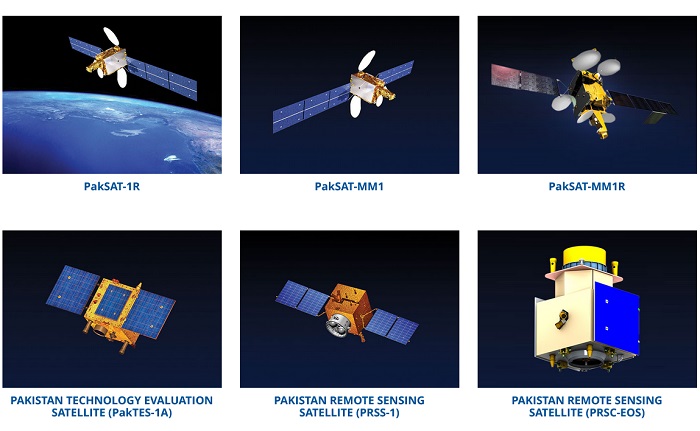
Pakistan certainly have some achievements in space technology. Here is detail of what Pakistan has done in this sector in previous decades. This information is generally known to many journalists but here to the point detail has been taken from the website of SUPARCO;
https://suparco.gov.pk/
Satellite development is a highly sophisticated field which not only requires state of the art facilities but also highly, specialized technological human resource. Through the successful development, launch, and in-orbit operations of a variety of satellites, Pakistan has joined the league of a well-established space faring nation.
Initially, two experimental satellites, Badr-1 and Badr-B were launched which marked a successful footprint of Pakistan in space. Now, Pakistan holds a fleet of earth observation, remote sensing, and communication satellites, making Pakistan self-reliant in communication and high resolution imaging while providing a wide range of different services to the nation and valuable scientific data to global science communities.
The satellite program and space utilization capabilities of Pakistan shall further strengthen with the upcoming design, development and launch of advanced communication and navigation satellites.
Here it is worth noting that SUPARCO is headed by a Maj General of Pakistan Army. Dr Abdussalam the Nobel Laureate was the pioneer and first head of SUPARCO from 1961 to 67. After that it was handed over to Air Force and then to the Army.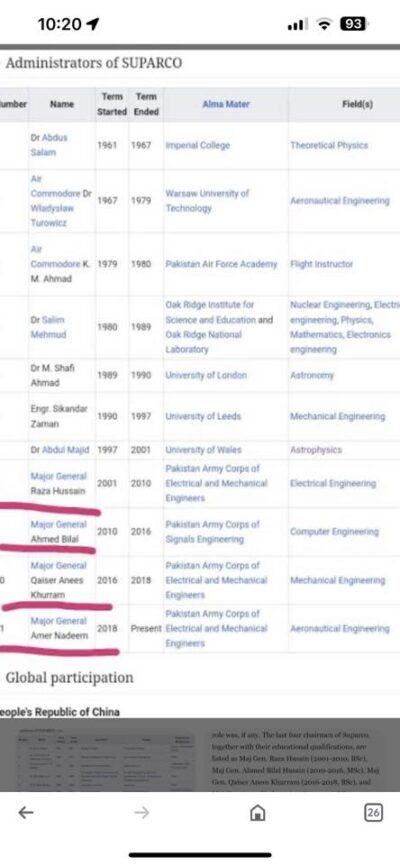
The links of our website are being attached with this report. We have published many reports about Pakistani research and discussions on space technology in the past. I myself visited SUPARCO few years ago to see what is happening there. Pakistan is not at zero point in space research.
It is also a fact that so far Pakistan competed India mainly in weapons only. The justification for that is you need security first. When you are secure and safe, you can proceed properly toward other sectors as well. It is about resources as well. India has more resources for research than Pakistan. As long as, the expertise is concerned , Pakistan is second to none.
BUT, here again space is the main subject in security and safety as well, especially in case of India Pakistan.
Dr. Ahmad Khan, former visiting fellow, Atlantic Council, and a renowned researcher, author in Islamabad said in a seminar “The 21st century is all about the development of weapons and the advancement of wars. A state needs to preserve its supreme national interests. The Indian weapon system is a threat to Pakistan’s national security and Pakistan will do its best to maintain its position in the region. Indian military doctrine that mainly focuses on space power facilitates the Indian military and took them one step ahead. On 27 March 2019, India tested an anti-satellite weapon during an operation code-named Mission Shakti. The target of the test was a satellite present in a low Earth orbit, which was hit with a kinetic kill vehicle. India has a land war force doctrine that has continuous surveillance through space, microsatellites are also working in Indian space with more accurate and advanced results.”
India is using space surveillance for its army since long. Pakistan was attacked by a projectile (What India termed and Pakistan admitted for reasons only the security officials know). India is always threatening surgical strikes. For that all data is provided by the satellites only. Therefore, the time has come, that Pakistani officials instead of remain engaged in political engineering , go to their actual duties and do the needful.
” Future Wars: A Case Study of Pakistan and India ” – Pakistan House holds Webinar with International Experts