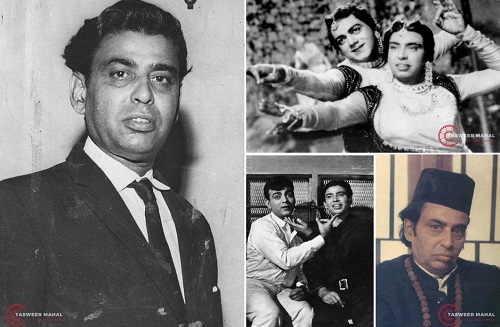
 Special Report with thanks to Tasweer Mahal – All about Cinema
Actor, writer, producer and director I. S. Johar’s career spanned over five decades, during which he made several comedy movies, often on social topics. His unique style, sharp wit, and satirical approach made him a beloved figure in the industry. Internationally, he is known for portraying Gasim in the epic classic “Lawrence of Arabia.”
He was born as “Inderjeet Singh Johar” on 16 February 1920 in Talagang, Punjab, which is now in Pakistan. Some sections of media have reported that he was the brother of noted producer Yash Johar (father of Karan Johar).
After years of speculation, Karan Johar revealed in an interview with Subhas K. Jha, “Yes, that was IS Johar, shockingly irreverent and ahead of his times. He wasn’t afraid of speaking his mind. He did some really cool stuff in his time. And yes, we are related. He is my father’s second cousin. I never got to meet him in person. He passed away when I was just a child. But as I grew older, I heard stories about him.”
He pursued higher education and completed his master’s degree in economics and politics before obtaining a law degree (LLB). Johar was drawn to the world of cinema from a young age. His journey into the film industry began in the late 1940s, a period marked by the tumultuous events of the Partition of India.
During the Partition, Johar was visiting Patiala with his family for a wedding when serious rioting broke out in Lahore. Johar never returned to Lahore and eventually moved to Bombay (now Mumbai), where he began his career in the film industry.
I. S. Johar made his acting debut in the 1949 Hindi comedy action film “Ek Thi Ladki,” directed by Roop K. Shorey. The film was a commercial success and marked the beginning of Johar’s illustrious career. His unique comedic style and ability to deliver witty dialogues quickly made him a popular figure in the industry.
Throughout his career, I. S. Johar appeared in numerous iconic films, both in India and internationally. Some of his most notable films include Nagin (1954), Shart (1954), Hum Sab Chor Hain (1956), where he plays nine characters, Goonj Uthi Shehnai (1959), Banarsi Thug (1962), April Fool (1964), Teen Devian (1965), Chaddian Di Doli (1966), Maya (1966), Dil Ne Phir Yaad Kiya (1966), Shagird (1967), Raaz (1967), Anita (1967), Nanak Naam Jahaz Hai (1969), Pavitra Paapi (1970), Johny Mera Naam (1970), Safar (1970), Chhoti Bahu (1971), Dastaan (1972), Gomti Ke Kinare (1972), Banarasi Babu (1973), Ek Mutthi Aasmaan (1973), Sankoch (1976), Ganga Ki Saugandh (1978), Teesri Aankh (1982) and many more.
In 1952, he turned director with “Shrimati Ji,” starring Nasir Khan,Shyama and himself. The film was well received by both critics and audiences. In 1954, he directed “Nastik,” a film exploring the impact of the Partition on individuals and families, highlighting themes of displacement, loss, and resilience. Johar’s direction and performance in the film were widely appreciated, and “Nastik” remains one of his most significant works.
Following the success of Nastik, he wrote and directed many films, like Shri Nagad Narayan (1955), Ham Sab Chor Hain (1956), Kitna Badal Gaya Insaan (1957), Miss India (1957), and Bewaqoof (1960).
He then created one of his most successful film franchises with the Johar-Mehmood series, where he collaborated with another comic genius, Mehmood Bhai Jan. The first film was Johar Mehmood in Goa (1965), which was inspired by the comedy films of the Bob Hope-Bing Crosby style “Road to…” series.
It follows the misadventures of two friends as they navigate various challenges and humorous situations in the backdrop of Goa’s independence struggle. The film was a commercial success and is remembered for its witty dialogues and comedic performances.
“Johar Mehmood in Hong Kong (1971)” is another comedy film directed by I. S. Johar, featuring him and Mehmood in the lead roles. Similar to their previous collaboration, the film is a light-hearted comedy that takes the audience on a fun-filled journey through Hong Kong.
He also wrote and directed films such as Johar in Kashmir (1966), Jai Bangladesh (1971), Aage Barho (1972), Kirchen (1972), 5 Rifles (1974), Amartava (1978), and Nasbandi (1978). Johar was known for his satirical approach to filmmaking. His film “Nasbandi” (Vasectomy) was a spoof on Prime Minister Indira Gandhi’s failed policy of population control by coerced vasectomies during the period of Emergency. The film was banned when it was first released.
Johar was a unique and idiosyncratic individual, a lifelong liberal who poked fun at institutionalised self-satisfied smugness. He was not afraid to tackle controversial topics such as partition, religion, politics and population control in his films.
He also had a flair for satire and parody, often spoofing popular genres and stars of his time, and did it with a deadpan expression. He used the film medium as an effective weapon to eradicate the superstitions and evils prevailing in the society in a humorous way.
I. S. Johar gained international recognition for his role as Gasim in the epic film “Lawrence of Arabia (1962),” directed by David Lean. The film is a historical drama based on the life of T. E. Lawrence.
“Death on the Nile (1978)” is a British mystery film based on Agatha Christie’s novel of the same name. Johar played the role of Mr. Choudhury in the film, which features an ensemble cast including Peter Ustinov, Bette Davis, and Mia Farrow.
He also acted in Harry Black (1958) and North West Frontier (1959), as well as in Maya (1967), a US TV series. Johar was nominated for a BAFTA Best British Actor in 1959 for “Harry Black.”
He won the Filmfare award for best actor in a comic role for “Johnny Mera Naam” and was nominated for “Aaj Ki Taaza Khabar.”
Johar was married five times, a distinguished number by Indian standards. His first wife, Ramma Bains, was a former actress, and the couple had two children, Anil Johar and Ambika Johar. Johar also had relationships with actresses Minna Johar and Sonia Sahni.
Johar passed away in Bombay on 10 March 1984.
I. S. Johar’s contributions to Indian cinema are immense and enduring. His ability to blend humour with social commentary made his films both entertaining and thought-provoking. Johar’s work continues to inspire and entertain audiences, ensuring that his legacy will be remembered for years to come.