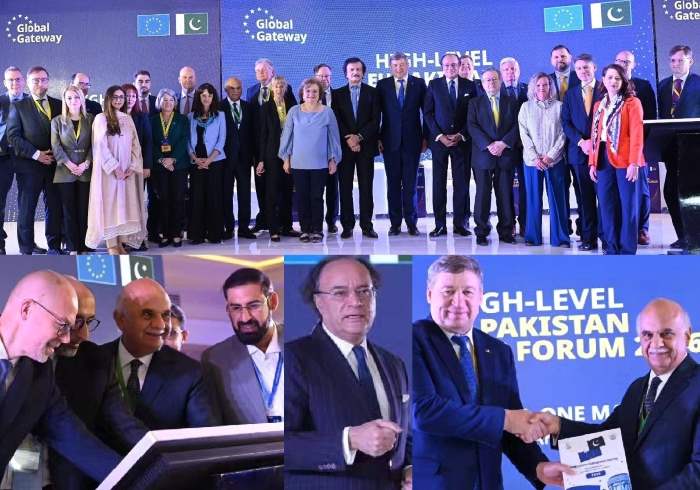
 ISLAMABAD : The European Union, in collaboration with the Government of Pakistan, today inaugurated the first-ever “High-Level EU-Pakistan Business Forum” in Islamabad, marking an important milestone in strengthening bilateral economic relations. Pakistan announced the launch of the EU–Pakistan Business Network, which connects over 300 European companies operating in Pakistan.
The Forum brings together around 1000 senior policymakers, European and Pakistani business leaders, investors and financial institutions. With the EU being the largest single market in the world, a leading exporter of outward Foreign Direct Investment globally and Pakistan’s number one export destination, the Forum represents a significant opportunity to further the EU-Pakistan economic partnership.
It aims to turn strong trade ties into increased investment flows, technology partnerships, greater innovation, and sustainable industrial growth.
The European Union Ambassador to Pakistan, H.E. Raimundas Karobolis, opened the Forum, stating:
“The European Union enjoys strong economic relations with Pakistan. It is a source of pride for me to say, that the European Union is the top export destination for Pakistan.
The purpose of the forum is not just to celebrate our trade relations, but to deepen, diversify, “green,” and transform them into long-lasting investments. Through this, our mutual prosperity will thrive.”
Federal Minister of Finance, Muhammad Aurangzeb highlighted the solid work done to improve macroeconomic fundamentals, undertake structural reforms and through this enhance potential for future investments. He emphasised Pakistan’s stability and readiness for business under the theme “Pakistan Means Business.”
He highlighted that key economic indicators, including foreign exchange reserves, remittances, taxation, tariffs, and public debt, are showing encouraging trends, reflecting overall macroeconomic stability. Aurangzeb noted that wide-ranging structural reforms are underway in critical sectors, including privatization, rightsizing of public institutions, tax system improvements, and public debt management.
Providing an update on external accounts, Aurangzeb revealed that Pakistan’s foreign exchange reserves have reached $18 billion, sufficient to cover three months of imports. He shared that investments under the Roshan Digital Account have gained momentum, rising from an average of $200 million per month to $260 million in March.
The minister also highlighted a notable increase in workers’ remittances, attributing it to growing confidence among overseas Pakistanis.Remittances reached $3.8 billion in March, marking a 17 percent increase compared to February. For the first nine months of the current fiscal year, total remittances stood at $30.3 billion, with projections indicating they could exceed $41 billion by year-end.
Despite global economic uncertainties, Aurangzeb said remittance inflows remain stable and are expected to grow further. He added that international credit rating agencies have begun issuing more positive outlooks on Pakistan’s economy, reflecting greater confidence in its direction.
Touching on emerging sectors, the finance minister pointed to developments in the digital and “new economy,” particularly cryptocurrency and freelancing, where Pakistan’s youth are playing a key role in enhancing the country’s global economic presence.
He also emphasized progress in privatization efforts, noting that public-private partnerships are being leveraged to improve the productivity of key state-owned entities, thereby supporting long-term sustainability.
In the energy sector, Aurangzeb highlighted ongoing reforms, including initiatives in renewable energy, which he described as critical for industrial expansion and economic resilience.He further stressed the strategic importance of Pakistan’s seaports, Karachi Port, Port Qasim, and Gwadar Port in facilitating trade and driving future economic growth.
Reaffirming the government’s economic vision, the minister said the strategy centers on “Pakistan Rising: Incentives, Reforms, and the next Investment Frontier,” with a focus on improving the business climate, strengthening foreign exchange reserves, and enhancing overall economic resilience.
Special Assistant to the Prime Minister (SAPM) on Industries and Production Haroon Akhtar Khan said Pakistan and the European Union were entering a renewed phase of partnership focused on investment, innovation, and sustainable growth, as the country strengthens reforms and enhances its global economic standing.
Haroon underscored that the European Union remains Pakistan’s largest export destination, with the GSP Plus framework playing a pivotal role in expanding market access and improving standards. However, he stressed that the future of this partnership lies beyond trade, focusing on investment, technological collaboration, and integration into global value chains.
“From textiles to technology, and from manufacturing to digital services, Pakistan is ready to move up the value chain and become a trusted partner in global supply systems,” he stated.
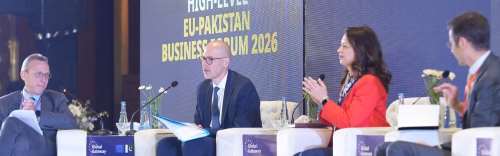 (At the #EUPKBusinessForum, Peteris Ustubs of EU Commission,Thouraya Triki of EIB and Hans Bogaard of FMO highlighted how the aims to mobilise €400B (2021–27) for sustainable investment & to unlock the opportunity corridor)
Haroon Akhtar Khan highlighted Pakistan’s economic potential, noting its population of over 240 million, expanding middle class, and strategic location at the crossroads of South Asia, Central Asia, and the Middle East, providing access to a market of over 3 billion people.
Emphasizing industrial revival as a cornerstone of economic policy, the SAPM said that the government is implementing structural reforms aimed at enhancing productivity, competitiveness, and long-term growth. These include improved access to finance, SME empowerment, and policy measures to reduce the cost of doing business.
He informed that initiatives such as the National Tariff Policy and the Regulatory Guillotine are simplifying regulations, reducing red tape, and creating a more predictable business environment. “Pakistan is committed to providing ease, certainty, and scale to investors,” he added.
The SAPM also highlighted the government’s focus on sustainability through the New Energy Vehicle Policy and broader environmental reforms, aligning economic growth with climate responsibility.He pointed to vast opportunities across sectors including mining, tourism, renewable energy, agriculture modernization, pharmaceuticals, logistics, and infrastructure.
He also emphasized the untapped potential of regions such as Gilgit-Baltistan, Khyber Pakhtunkhwa, and Balochistan, rich in natural resources and investment prospects. Inviting European partners to explore Pakistan’s tourism sector, he noted the country’s unique blend of natural beauty and cultural heritage, offering high-value investment opportunities.
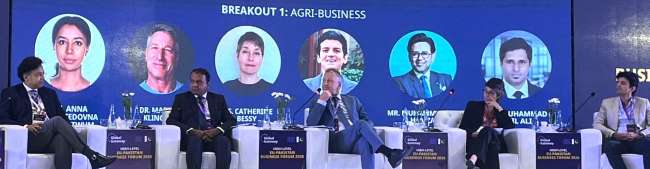 (A strong Dutch presence was observed on first day with firms leading the Agri-Business breakout session and FMO discussing investment opportunities. As Pakistan’s 2nd largest export market in the EU, the Netherlands is open for further collaboration in agri-food, water, and climate)
The opening session also marked the launch of the EU-Pakistan Business Network, which brings together more than 300 EU companies active in Pakistan. The Network aims to serve as a collective voice of EU businesses in the country, facilitating dialogue with policymakers and supporting new European companies exploring opportunities in Pakistan.
The opportunities emanating from the EU’s Global Gateway initiative, the EU’s largest investment program outside of the EU which aims to mobilise and de-risk 400 billion EUR of investments in the period 2021-2027 – were presented in a dedicated plenary session with Mr Peteris Ustubs, Director for Asia and the Pacific at the Directorate-General for International Partnerships,European Commission ; Ms Thouraya Triki, Director at the *European Investment Bank ; and Mr Hans Bogaard, Director of Agribusiness, Food and Forestry at FMO, (the Entrepreneurial Development Bank from the Netherlands).
Discussions throughout the day focused on opportunities and challenges in priority sectors such as agribusiness, digital innovation and fintech, green logistics, sustainable textiles, and responsible mining.
Throughout the two-day Forum more than 600 B2B meetings are scheduled reflecting strong interest from both European and Pakistani companies in forming joint ventures and partnerships.New financial programmes and partnerships are also expected to be signed during the Forum. The event provides a structured platform for high-level dialogue and deal-making between a combined economy of over 700 million people.
A key milestone of the opening was the launch of the EU–Pakistan Business Network, bringing together more than 300 European companies active in Pakistan.
The Network will serve as a collective voice for EU businesses, support dialogue with policymakers, and facilitate new investment opportunities.