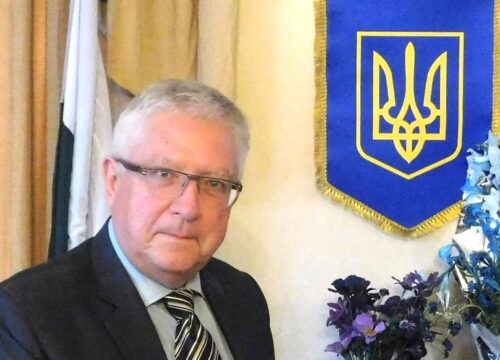
 Volodymyr Lakomov (b. 1958) is a Ukrainian diplomat, Ambassador Extraordinary and Plenipotentiary of Ukraine (he represented Ukraine’s interests as Ambassador to Angola (2004–2007), Brazil (2007–2010), and Pakistan (2012–2020)), and an expert of the Ilko Kucheriv Democratic Initiatives Foundation.
He specializes in political philosophy, global diplomacy, and cultural introspection. He is the author of studies dedicated to freedom in Timothy Snyder’s interpretation, Ukraine’s role in dialogue with the Global South, and the visual comprehension of contemporary concepts.
In the depths of history, before imperial anthems were sung, there existed civilizations that chose another model of existence — harmonious, ritual, decentralized. Mohenjo-Daro on the banks of the Indus and the Trypillian settlements along the Dnipro — two cultures that did not seek to conquer the world but left a mark in its symbolic landscape.
Mohenjo-Daro — a city with straight streets, public baths, and a complex drainage system. Architecture without palaces, without temples, without monarchs. As if a society that knew how to live without centralized power but with a high level of organization. Seals depicting bulls, unicorns, dancers — not as tools of power, but as signs of the inner world.
Trypillia — not a city in the classical sense, but a proto-city: settlements that preceded urbanization yet already displayed features of complex social organization. A culture that built settlements in spiral form, ritually burned them, and rebuilt them anew. Pottery that speaks the language of ornament: spirals, waves, female figures. Here there were no imperial ambitions, but there was a deep metaphysics of the earth, fertility, and the cycle.
Both civilizations disappeared — not because they were weak, but because they did not strive to become stronger than others. Their strength lay in symbol, in rhythm, in the ability to live without violence. They left behind no armies, but they left behind aesthetics. They did not create empires, but they created myth.This myth is alive.
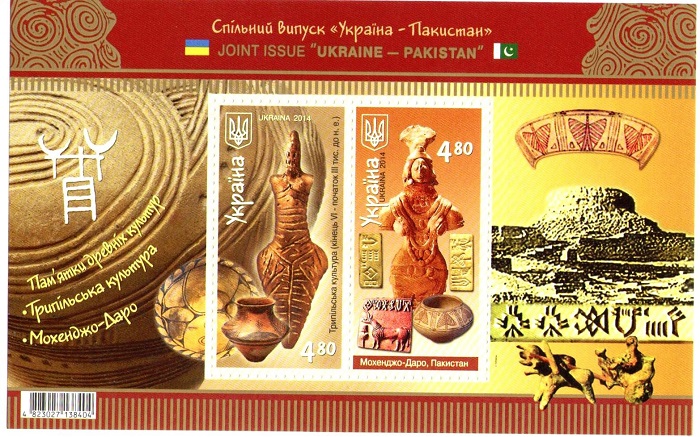 In 2014, Ukraine and Pakistan carried out a joint philatelic gesture: the release of a block of postage stamps “Monuments of Ancient Cultures” — the Trypillian culture and Mohenjo-Daro. This was not just philately — it was a symbolic dialogue between two peoples that remember their pre-colonial roots.
On the Ukrainian version of the block — a deep visual symphony:
On the left — a Trypillian female figurine with raised arms, a painted bowl, a goblet with plant ornament. This is the image of fertility, cyclicality, earthly ethics.
On the right — a Pakistani seal with a unicorn, a terracotta goddess figure, a toy cart with oxen. This is myth, trade, childhood, faith.
In the background — fragments of pottery, petroglyphs from Kamyana Mohyla, ruins of the Mohenjo-Daro stupa, a scene of dancing figures. At the top — inscriptions in Ukrainian and English: Joint Issue “Ukraine – Pakistan.” Nearby — national flags, coats of arms, and the visual equality of two cultures.
This block is not just a stamp. It is a cultural declaration: about the dignity of pre-colonial civilizations, about the right to one’s own model of development, about dialogue without domination. In a world where empires once again try to dictate the rules, Ukraine and Pakistan chose another path — memory, aesthetics, coexistence.
In this context, Timothy Snyder’s concepts become especially relevant — particularly his idea of the “politics of memory” as a struggle for the future. Snyder emphasizes: empires do not merely conquer territories — they rewrite the past. In his book The Road to Unfreedom, he shows how the idea of the “end of history” — the belief that ideas no longer matter — became an instrument of modern authoritarianism.
Therefore, the recovery of pre-colonial narratives such as Trypillia is not archaism, but an act of historical resistance. It is a way to reclaim the right to another — non-imperial — vision of civilization.
Today, as the world again balances between centralization and freedom, it is worth remembering these proto-cities. As an alternative. As a reminder that civilization is not only about power, but also about forms of coexistence. And that Ukraine, as the heir of Trypillia, has the right to its own model — not imperial, but humane.
Ukrainian Version
Protó-cidades da Memória: Tripília, Mohenjo-Daro e a Escolha da Civilização
Volodymyr Lakomov (n. 1958) é diplomata ucraniano, Embaixador Extraordinário e Plenipotenciário da Ucrânia (defendeu os interesses do país como Embaixador em Angola (2004–2007), Brasil (2007–2010) e Paquistão (2012–2020)), além de especialista da Fundação Iniciativas Democráticas Ilko Kucheriv.
Especializa-se em filosofia política, diplomacia global e introspeção cultural. É autor de estudos dedicados à liberdade na interpretação de Timothy Snyder, ao papel da Ucrânia no diálogo com o Sul Global e à compreensão visual de conceitos contemporâneos.
Nas profundezas da história, antes de soarem os hinos imperiais, existiram civilizações que escolheram outro modelo de existência — harmonioso, ritual, descentralizado. Mohenjo-Daro às margens do Indo e os assentamentos tripilianos às margens do Dnipro — duas culturas que não buscaram conquistar o mundo, mas deixaram marcas no seu horizonte simbólico.
Mohenjo-Daro — uma cidade de ruas retas, banhos públicos, complexo sistema de drenagem. Arquitetura sem palácios, sem templos, sem monarcas. Como se fosse uma sociedade capaz de viver sem poder centralizado, mas com elevado grau de organização. Selos com figuras de touros, unicórnios, dançarinas — não como instrumentos de poder, mas como sinais de um mundo interior.
Tripília — não uma cidade no sentido clássico, mas uma protó-cidade: assentamentos que precederam a urbanização, mas já apresentavam sinais de organização social complexa. Uma cultura que construía povoados em forma de espiral, queimava-os ritualmente e renascia em seguida. Cerâmica que fala a linguagem do ornamento: espirais, ondas, figuras femininas. Aqui não havia ambições imperiais, mas sim uma profunda metafísica da terra, da fertilidade, do ciclo.
Ambas as civilizações desapareceram — não porque fossem fracas, mas porque não quiseram ser mais fortes que as outras. A sua força estava no símbolo, no ritmo, na capacidade de viver sem violência. Não deixaram exércitos, mas deixaram estética. Não criaram impérios, mas criaram mito.Esse mito permanece vivo.
Em 2014, a Ucrânia e o Paquistão realizaram um gesto filatélico conjunto: o lançamento de um bloco de selos “Monumentos das Culturas Antigas” — a cultura tripiliana e Mohenjo-Daro. Não se tratava apenas de filatelia — era um diálogo simbólico entre dois povos que recordam as suas raízes pré-coloniais.
Na versão ucraniana do bloco — uma profunda sinfonia visual:
À esquerda — estatueta feminina tripiliana de braços erguidos, tigela pintada, cálice com ornamento vegetal. É a imagem da fertilidade, da ciclicidade, da ética terrena.
À direita — selo paquistanês com unicórnio, figura terracota de deusa, carrinho de bois em miniatura. É mito, comércio, infância, fé.
Ao fundo — fragmentos de cerâmica, petroglifos da Pedra Mogila, ruínas da estupa de Mohenjo-Daro, cena com figuras dançantes. No topo — inscrição em ucraniano e inglês: Joint Issue “Ukraine – Pakistan”. Ao lado — bandeiras nacionais, brasões e a igualdade visual de duas culturas.
Esse bloco não é apenas um selo. É uma declaração cultural: sobre a dignidade das civilizações pré-coloniais, sobre o direito a um modelo próprio de desenvolvimento, sobre o diálogo sem dominação. Num mundo em que os impérios voltam a tentar ditar regras, Ucrânia e Paquistão escolheram outro caminho — memória, estética, convivência.
Nesse contexto, os conceitos de Timothy Snyder tornam-se particularmente relevantes — sobretudo a sua ideia da “política da memória” como luta pelo futuro. Snyder sublinha: os impérios não apenas conquistam territórios — eles reescrevem o passado.
No seu livro O Caminho para a Falta de Liberdade, mostra como a ideia do “fim da história” — a crença de que as ideias já não importam — tornou-se um instrumento do autoritarismo contemporâneo. Portanto, recuperar narrativas pré-coloniais como a de Tripília não é arcaísmo, mas ato de resistência histórica. É uma forma de recuperar o direito a outra — não imperial — visão de civilização.
Hoje, quando o mundo novamente oscila entre centralização e liberdade, vale recordar essas protó-cidades. Como alternativa. Como memória de que civilização não é apenas poder, mas também forma de convivência. E que a Ucrânia, como herdeira de Tripília, tem direito ao seu próprio modelo — não imperial, mas humano.
Earlier published in Ukrainian newspaper “Literaturna Ukrayina”