 ISLAMABAD : Monitoring Desk – President of the Republic of Kazakhstan, H.E. Mr. Kassym-Jomart Tokayev has expresses concern over the growing number of global conflicts and shared his vision for building a more just and stable world amid the escalation of crises and the serious weakening of multilateral cooperation mechanisms.
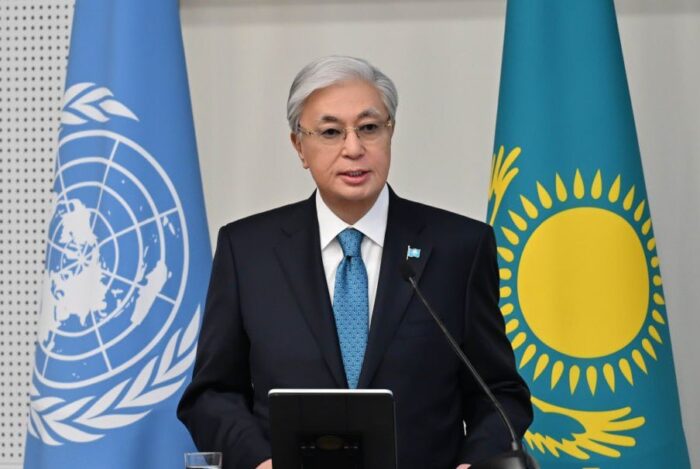
He visited the United Nations (UNU) in Tokyo, where he delivered a lecture entitled “Restoring Strategic Trust in an Era of Turbulence: How Kazakhstan Envisions a More Just and Stable World.”
“The number and intensity of armed conflicts worldwide have reached their highest level in recent decades, while global military expenditures last year amounted to a record USD 2.7 trillion. At the same time, rivalry among major powers has reached its peak, which has already resulted in the inability of the United Nations Security Council to resolve any large-scale international conflicts,” Mr. Tokayev stated.
“A renewed culture of strategic trust must become the foundation of international cooperation and collective decision-making.”
According to H.E. Mr. President, the international community urgently needs to restore mutual trust and predictability to ensure the effective functioning of international institutions.
“A renewed culture of strategic trust must become the foundation of international cooperation and the process of collective decision-making. In this regard, Kazakhstan consistently promotes these principles through such initiatives as the Conference on Interaction and Confidence-Building Measures in Asia and the Congress of Leaders of World and Traditional Religions, Kazakh leader noted.
“There is no doubt that no state can cope alone with today’s challenges. Only principled and effective joint action can deliver long-term results. In this context, the United Nations must continue to play a central role in international relations as a universal and irreplaceable organization,” H.E. Mr. President emphasized.
H.E. Mr. President: “Comprehensive UN Reform is no longer a Rhetorical Issue, but a Common Priority and Strategic Necessity”
President pointed out that the UN’s capacity is increasingly constrained by growing geopolitical polarization and declining trust among major powers.
Therefore, as he noted, comprehensive UN reform is becoming not a rhetorical issue, but a shared priority and a strategic necessity.
“Any meaningful reform must begin with reaffirming commitment to the UN Charter. Its core principles sovereignty, territorial integrity, and the peaceful settlement of disputes must be strictly observed without any exceptions. However, certain provisions of the Charter no longer reflect the realities of the 21st century, including those that are unfair to Japan and other countries that provide significant support to the Organization. The world has changed, while the Charter has not kept pace with these changes. I believe the time has come for a responsible dialogue on how to ensure its credibility and relevance in the future,” H.E. Mr. Kassym-Jomart Tokayev said.
Central Asia and Japan discuss new cooperation formats at inaugural Tokyo summit
H.E. Mr. President Calls for Broader Participation of Responsible Middle Powers in the UN Security Council
H.E. Mr. President considers reform of the UN Security Council to be an extremely important and urgent task. He called for broader participation in this body by middle powers representing Asia, Africa, and Latin America.
“The voices of responsible middle powers should carry greater weight in the Security Council, where they can act as constructive mediators and contribute to advancing solutions amid contradictions among larger players. It is precisely in this role that Kazakhstan sees its foreign policy mission. We pursue a principled, balanced, and constructive multi-vector diplomacy that reflects our national interests and identity as a developing middle power, consistently committed to the UN Charter,” H.E. Mr. President stated.
Taking the opportunity, H.E. Mr. Kassym-Jomart Tokayev expressed sincere appreciation to former Minister for Foreign Affairs of Japan Ms. Yoriko Kawaguchi for her outstanding contribution to strengthening ties between the two countries.
President recalled that she was the initiator of the “Central Asia + Japan” summit format.
H.E. Mr. President: “Kazakhstan Is Developing Comprehensive Strategic Partnerships with Its Closest Neighbors”
H.E. Mr. Kassym-Jomart Tokayev emphasized that Kazakhstan enjoys broad recognition as an authoritative and reliable partner.
“Kazakhstan is developing comprehensive strategic partnerships with its closest neighbors Russia, China, and the countries of Central Asia. We view this neighborhood as a strategic advantage that enables Kazakhstan to promote trust and connectivity across Eurasia. We are also expanding long-term engagement with the United States and the European Union, strengthening our contacts in the Middle East, Asia, and the Global South.
Japan is of great importance to Kazakhstan, and we will continue to strive to deepen our friendship and cooperation in order to unlock new opportunities in trade and investment. Such a balanced and impartial approach strengthens Kazakhstan’s constructive diplomacy in an increasingly geopolitically fragmented world,” H.E. Mr. President continued.
H.E. Mr. President: “The Global Security Architecture Cannot Be Based on Nuclear Deterrence”
A special place in the address was devoted to the growing nuclear threat. H.E. Mr. Kassym-Jomart Tokayev recalled that few countries understand as deeply as Kazakhstan and Japan the price humanity has paid for nuclear weapons.
“Hiroshima, Nagasaki, and Semipalatinsk serve as reminders of the high cost of nuclear responsibility and restraint. After gaining independence, Kazakhstan made a historic decision to close the Semipalatinsk nuclear test site and renounce the world’s fourth-largest nuclear arsenal.
This was not a sign of weakness, but a reflection of strategic foresight and a firm commitment to peace and human security. Three decades later, our position remains unchanged: the global security architecture cannot be based on nuclear deterrence. The international community must intensify efforts toward complete nuclear disarmament and ensure the entry into force of the Comprehensive Nuclear-Test-Ban Treaty.
Kazakhstan calls for the resumption of high-level dialogue among nuclear-weapon states and for more decisive multilateral action to eliminate the threat of the use and testing of nuclear weapons.
In these global efforts, Kazakhstan and Japanpossess unique moral authority. Together, our countries could help bridge differences and demonstrate pragmatic leadership where nuclear powers struggle to reach consensus,” H.E. Mr. President stated.