 ASEAN Monitoring Desk Islamabad
As was expected and noted here earlier, on the claim made by Pentagon having access to Indonesian airspace and indirectly on Malacca Strait , the Indonesian Ministry of Defense of Indonesia denies reports of a finalized United States airspace deal, stressing talks remain preliminary.
Indonesia’s Ministry of Defense has pushed back against widespread reports in mainstream and social media claiming that a final agreement had been reached to grant United States military aircraft unrestricted access to Indonesian airspace, stressing that discussions remain at a preliminary stage.
“This is an initial draft that is still under internal and inter-agency discussion,” said Brigadier General Rico Ricardo Sirait, Head of the Ministry’s Bureau of Public Relations and Defense Information, in a written statement cited by BBC Indonesia on Monday, April 13, 2026.
The clarification follows circulating claims that a bilateral agreement would allow U.S. military aircraft full transit rights across Indonesian airspace, with some reports suggesting that Defense Minister Sjafrie Sjamsoeddin was preparing to sign such a deal in Washington, D.C.
Claims fuel confusion amid ongoing deliberations
The issue gained traction after online accounts alleged that Washington was actively seeking comprehensive overflight access. A report by international outlet The Sunday Guardian on April 12 referenced a purported confidential U.S. defense document outlining efforts to secure such rights.
The document was reportedly linked to a February meeting between President Prabowo Subianto and U.S. President Donald Trump, during which Indonesia was said to have approved a proposal granting broad transit permissions.
Indonesian defense officials, however, dismissed these claims as premature and not reflective of any binding commitment.
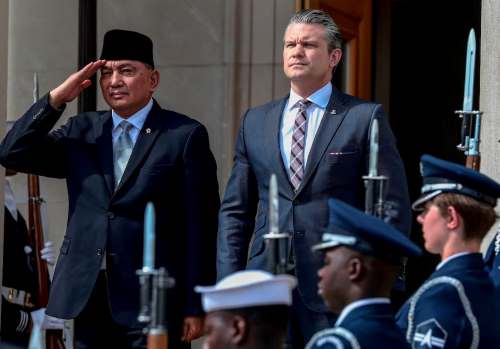
Notably, the clarification comes even as Indonesia and the United States continue to deepen defense ties. On April 13, both countries signed a Major Defense Cooperation Partnership (MDCP), underscoring that while broader cooperation is advancing, no agreement on airspace access has been finalized.
Government says claims misleading, stresses sovereignty
In a statement posted on its official Instagram account, the Ministry of Defense (Kemhan) described claims of a finalized overflight agreement as misleading and lacking legal standing.
The ministry emphasized that any defense cooperation with foreign partners must prioritize national interests, fully safeguard Indonesia’s sovereignty, and comply with both domestic regulations and international law.
It further underscored that any proposal or draft cooperation mechanism must undergo a thorough, multi-layered review process involving all relevant stakeholders before it can be considered.
“Every discourse, proposal, or draft mechanism of cooperation must go through a careful, strict, and multi-layered review process before it can be considered further,” Rico said.
Full control over national airspace maintained
The ministry also reaffirmed that Indonesia retains full authority over its airspace, including the regulation and oversight of any foreign activity.
“Any potential arrangement will continue to guarantee Indonesia’s full authority to approve or reject any activity within national airspace,” Rico stated.
The government’s response aims to reassure the public amid growing speculation, emphasizing that no agreement compromising national sovereignty has been concluded.
“There is no room for unilateral implementation outside Indonesian law,” he added.
Expert on the regional affairs and dynamics , Mr. Tazeen Akhtar shared ;
A highly disturbed US in Strait of Hormuz was expected to work on that direction where the important straits can be accessed and controlled easily with local partners. Malacca is the next on the route of Iranian petroleum to ASEAN and China. But, here we will see how Indonesia elaborates and implements the partnership. It is least possible that Indonesia let US to exploit the deal against the interests of any country of the region.
Malaysia is equal stake holder at Malacca on both sides of the strait. Indonesia will never sign any deal with any third party from beyond the region , especially , with that is already controversial , if we do not say notorious, US. Neither Indonesia will forge any partnership that jeopardise her strong cooperation with China.
Analysts highlight strategic implications
According to regional defense outlet Defense Security Asia, the reported proposal, if eventually realized, could mark a significant shift from Indonesia’s current case-by-case approval system toward a more structured access framework supported by diplomatic coordination and direct military communication channels.
Such a mechanism could streamline overflight procedures and reduce operational delays in time-sensitive situations.
However, such an arrangement could position Indonesia alongside partners such as Australia, Japan, and the Philippines within a broader U.S.-linked military mobility network across the Indo-Pacific. Given Indonesia’s geography, bridging key maritime and aerial routes between the Pacific and Indian Oceans, its airspace holds strategic importance for regional logistics and contingency planning.
From a military standpoint, even limited notification-based access could enhance U.S. operational flexibility, enabling faster and less predictable movement of assets ranging from refueling aircraft to surveillance and bomber platforms.
At the same time, analysts caution that the implications extend beyond operational efficiency. For Southeast Asian nations, such a proposal could represent a broader inflection point in balancing strategic autonomy with intensifying great-power competition.
For now, Jakarta is signaling caution as it navigates deepening ties with Washington without compromising strategic autonomy.