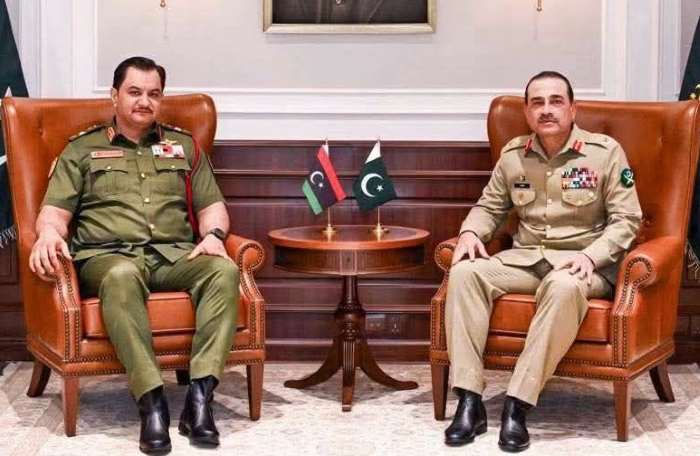
 RAWALPINDI : ISPR + Monitoring Desk – Lieutenant General Saddam Khalifa Haftar, Deputy Commander-in-Chief of the Libyan Arab Armed Forces, called on Field Marshal Syed Asim Munir, NI(M), HJ, COAS & CDF, at General Headquarters (GHQ), Rawalpindi.
Upon arrival at GHQ, the visiting dignitary was presented a Guard of Honour by a smartly turned-out tri-services contingent.
During the meeting, matters of mutual interest, regional security dynamics, defence cooperation and avenues for enhanced military-to-military collaboration were discussed.
Both sides underscored the importance of strengthening bilateral defence ties and expanding cooperation in areas of professional military training and security.
The Field Marshal highlighted Pakistan Army’s commitment to promoting peace, stability and constructive engagement with friendly countries. The visiting dignitary appreciated the professionalism of the Pakistan Armed Forces and acknowledged their contributions towards regional peace and security.
( Note from Editor : Saddam Haftar is the Deputy Commander-in-Chief of the Eastern Libyan (self styled National) Army, a UN and Pakstan non recognized regime ruling over east and south of Libya.)
According to Libyan media , he met with Pakistan’s Chief of Army Staff Field Marshal Asim Munir during his official visit to Pakistan to discuss regional developments, shared interests, and defense cooperation.
The meeting also highlighted Pakistan’s mediation efforts that contributed to de-escalating military tensions between the United States and Iran amid rising regional instability, along with its broader role in promoting security and stability at the regional and international levels.
However, there is a growing debate around this military visit to Islamabad specially at a time when efforts to unify the country’s divided institutions are reportedly gaining momentum, supported by several international actors, including the United States and Italy and other key regional players like Turkey and Egypt.
With elections announced for 17 February 2027, the timing has added political weight to these developments.
Recent visits by top Turkish and Egyptian intelligence officials to both Libyan factions were widely seen as signals of a more balanced and publicly neutral approach or atleast on the surface. In comparison, Pakistan’s position is viewed as less clearly neutral, with diplomatic engagement on both sides but stronger military ties appearing more visible in the eastern region.
At the same time, reports from local sources suggest growing cooperation between Pakistan and eastern Libyan authorities, including claims of large-scale defense agreements, though none of these details have been officially disclosed.
Pakistani authorities are also said to be engaging with both Libyan sides in a more flexible approach, with military cooperation more visible in the east and diplomatic engagement more present in the west, reflecting different areas of expertise on each side.
Pakistan’s military is often described as one of the strongest forces in the world and arguably among the most powerful in the Islamic world. This perception is largely linked to its nuclear capability, its large and well-structured armed forces, and decades of operational experience.
Unlike many regional militaries, Pakistan’s forces have been continuously shaped by high-intensity tensions with India, including periods of open conflict, as well as ongoing proxy dynamics, intelligence operations, counterterrorism campaigns, and long-term insurgency management.
This sustained exposure to multi-layered security challenges has given the Pakistani military a depth of experience that is difficult to match. For this reason, any visible expansion of its military presence abroad tends to draw significant attention and strategic implication.
Analysts note that such developments are being closely watched as Libya moves through a sensitive transition period, where external engagement and internal reconciliation efforts are both shaping the country’s future direction.