 Russia Ukraine Monitoring Desk Islamabad
President Volodymyr Zelenskyy has unveiled FREYJA, an ambitious new European initiative aimed at building a next-generation anti-ballistic missile defense system to protect the continent from the rapidly growing threat of ballistic missiles. He emphasized that over the next 12 months, FREYJA will be seen in action.
Speaking ahead of the Anti-Ballistic Coalition meeting, Zelenskyy said Europe can no longer rely solely on existing systems as Russia continues making ballistic missiles a centerpiece of its war against Ukraine.
“Europe needs more protection against ballistic missiles. Together we can create such a system.”
Ukraine will contribute what may become one of the project’s most important components—the interceptor missile itself, which Zelenskyy said is now in its final stages of development. European partners would provide the advanced radars, sensors, command systems, and other critical technologies needed to complete the network.
The coalition brings together many of Europe’s leading defense powers, including France, Germany, the United Kingdom, Italy, Norway, Denmark, Sweden, the Netherlands, Spain, alongside NATO, the European Union, and major defense companies such as MBDA, Thales, Saab, Leonardo, Diehl Defence, Kongsberg, and HENSOLDT.
Zelenskyy argued that the need extends far beyond Ukraine.
Russia’s increasing reliance on ballistic missile attacks—and the growing cooperation between Russia, Iran, and North Korea on missile technology—means Europe must prepare for a future where ballistic threats become more common, not less.
His goal is ambitious: to see FREYJA operational within the next 12 months.
If realized, the project would mark one of the most significant advances in European air and missile defense in decades, giving Europe greater strategic independence while creating a shield capable of protecting millions from one of the most difficult weapons to intercept.
As Russia continues to terrorize Ukrainian cities with ballistic missiles, Europe is no longer discussing whether it needs stronger defenses. It is beginning to build them.
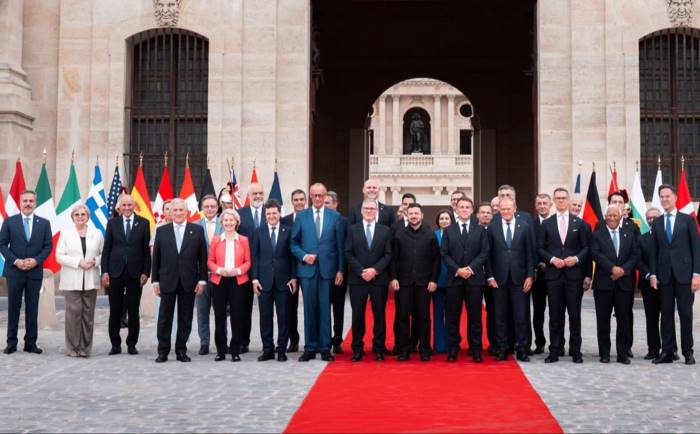
Another source added ; On July 13, in Paris, during a meeting of the Coalition of the Willing, Ukraine and nine other European states became the founders of the “anti-ballistic coalition.” President Zelenskyy announced that the coalition’s key project is the FREYJA air defense system. He noted that work on it has already begun.
“Europe needs more anti-ballistic defense. Together, we can build such a system. Ukraine is ready to deliver its part: the anti-ballistic missile. We are now finalizing it. It is important to confirm politically that FREYJA is our common project, in the interests of all of Europe,”
French President Emmanuel Macron announced that Ukraine has received licenses to produce some of France’s most advanced weapons, including Aster-30 missiles for the SAMP/T air defense system, AASM Hammer precision-guided bombs, and SCALP long-range cruise missiles.
Macron also confirmed that Ukraine will receive French Rafale multirole fighter jets in 2028–2029, further deepening the strategic defense partnership between the two nations.
This marks a significant evolution in Western support.
Rather than relying solely on deliveries from abroad, Ukraine is increasingly being granted licenses to manufacture advanced Western weapons domestically. Producing these systems inside Ukraine dramatically reduces delivery times, strengthens long-term defense capabilities, and allows weapons to reach the battlefield far more quickly than waiting for production abroad and international transfers.
Since the full-scale invasion began, the West has increasingly recognized that building weapons in Ukraine during wartime is often faster and more efficient than exporting finished systems. It also helps create a sustainable defense industry capable of supporting Ukraine for years to come.
With production licenses now spanning multiple advanced weapon systems, Ukraine is steadily transforming from a country dependent on foreign deliveries into one of Europe’s emerging defense manufacturing hubs.
This is about far more than new missiles.
It is about ensuring Ukraine can build, sustain, and replenish the weapons it needs—on its own soil, with the support of its allies—for as long as it takes.
The European Union and the United Kingdom stand united in their unwavering support for Ukraine.
The agreement on the UK’s participation in the €90 billion Ukraine Support Loan marks an important step forward. It will expand Ukraine’s access to defence capabilities and ensure continued, predictable financial support.
This is a clear demonstration of EU+UK shared commitment — and of the strength of EU–UK cooperation in support of Ukraine and European security.
Bulgaria will no longer participate in the Coalition of the Willing
Prime Minister Roumen Radev announced, distancing the country from the group of nations supporting Ukraine. Radev said the war should be resolved through diplomacy rather than further arms deliveries.