 ISLAMABAD : The 9th OIC Ministerial Conference on Women has adopted the Islamabad Ministerial Declaration, reaffirming the OIC’s collective commitment to advancing the rights, dignity, and empowerment of women.
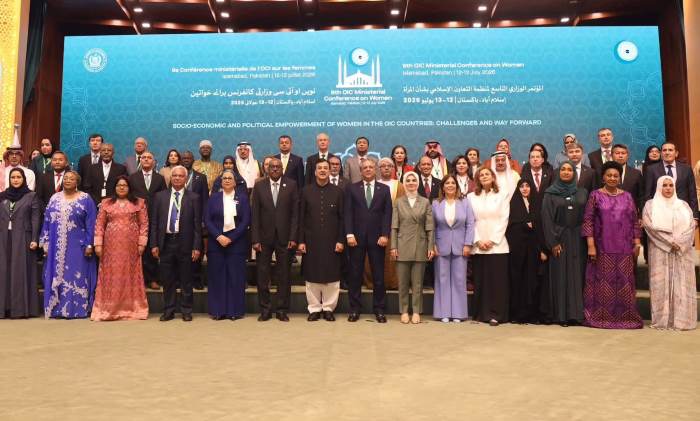
Pakistan hosted the 9th Ministerial Conference on Women of the Organisation of Islamic Cooperation (OIC) on 12-13 July 2026, drawing delegates from across the Muslim world to the Jinnah Convention Centre for two days of high-level talks on advancing the socio-economic and political empowerment of women.
The Ninth Session of the OIC Ministerial Conference on Women, held in Islamabad on July 12–13, 2026, adopted the Islamabad Ministerial Declaration and a comprehensive omnibus resolution.
The joint declaration reaffirms the collective commitment of OIC member states to advance the socio-economic and political empowerment of women.
Key pillars of the declaration focus on:
Digital Inclusion: Launching the “Islamabad Initiative” to close the digital gender divide through STEM, AI, and literacy training.
Economic Empowerment: Promoting financial inclusion, education, and removing barriers to employment.
Safety & Rights: Strengthening measures against violence and combating Islamophobia.
Solidarity & Leadership: Supporting women in Palestine and IIOJK, while promoting female representation in decision-making roles.
Additionally, Pakistan assumed the chair of the conference from Egypt.
The conference held under the theme “Socio-Economic and Political Empowerment of Women in the OIC Countries: Challenges and Way Forward,” was organised by the Ministry of Human Rights and marked the first time Pakistan has hosted the event.
Delegates from 57 member states gathered to chart a collective strategy for advancing women’s socio-economic and political empowerment and strengthening cooperation among OIC countries. The conference brought together around 190 delegates, including ministers, senior government officials and representatives from the OIC’s 57 member states.
Algeria, Brunei, Oman, Tajikistan, Malaysia, Morocco, Tunisia, Jordon, Kazakhstan were represented by the Ambassadors designated to Islamabad. Azerbaijan, Egypt,Gambia, Iran, Libya, Maldives, Syria, Saudia, Sudan, Turkiye, Yemen, Uganda, Berkinafaso, Djibouti and many other countries sent their respective ministers.
Packed opening day of technical talks
Pakistan formally opened proceedings on Sunday with technical-level meetings. The conference began with a series of technical sessions during which participants approved the agenda and reviewed progress on the implementation of the OIC Plan of Action for the Advancement of Women.
Delegates held extensive discussions on key challenges facing women in OIC member states, including social, economic, and political empowerment, access to education and healthcare, economic opportunities, financial inclusion, and greater participation in decision-making processes.
The sessions also highlighted the need to enhance women’s representation in technology and digital sectors.
Chairman Senate of Pakistan, Syed Yousaf Raza Gilani , while addressing as the Chief Guest ,urged the Muslim world to move beyond declarations and translate commitments into concrete actions for the economic empowerment of women, describing it as both an Islamic obligation and an indispensable prerequisite for sustainable development.
Welcoming ministers, parliamentarians, senior officials of the Organization of Islamic Cooperation (OIC), and delegates from member states to Pakistan, the Chairman Senate said that Islam had established the principles of justice, dignity and equal opportunity for women more than fourteen centuries ago by guaranteeing their rights to education, property, inheritance, economic participation and social respect.
The Chairman Senate emphasized that women constitute nearly half of the population of OIC member states and that no nation can achieve inclusive growth while excluding half of its human capital from economic and political participation. He reaffirmed Pakistan’s unwavering commitment to women’s empowerment through education, entrepreneurship, digital inclusion, financial access and employment opportunities.
Minister for Law and Justice Azam Nazeer Tarar says the government is determined to fully utilize all available resources to empower women.
Deputy Prime Minister and Foreign Minister Ishaq Dar said the conference would help transform commitments on women’s empowerment into measurable progress across OIC member states.
Punjab Chief Minister Maryam Nawaz Sharif
Punjab Chief Minister Maryam Nawaz Sharif urged the Muslim world to work together to ensure that every girl has access to education, every woman has equal opportunities, and every mother and daughter can live with dignity, security, and hope.
High-profile delegations
The gathering drew senior women’s affairs officials from across the Islamic world. Attendees included Saudi Arabia’s Family Affairs Council Secretary General Dr Maimoonah Khalil Alkhalil, Egypt’s National Council for Women President Amal Ammar, Bangladesh’s Women and Children Affairs Minister Abu Zafar Md. Zahid Hossain, Iraq’s Vice President for Women and Family Affairs Dr Zainab Al-Mulla Al-Sultani, Libya’s Minister of State for Women’s Affairs Grebe Randa, Yemen’s Minister Dr Ahed Mohammed Jassous, Nigeria’s Women Affairs Minister Imaan Sulaiman-Ibrahim, Somalia’s Minister for Family and Human Rights Development Khadija Makhzoumi, and Mauritania’s Social Affairs Ministry Secretary General Hamoudi Cheikhna Ali.
On the sidelines, Federal Minister for Law and Human Rights Azam Nazeer Tarar held separate meetings with ministers and senior officials from Iran, Türkiye, Saudi Arabia, Egypt, Bosnia and Herzegovina, Syria, Somalia, and Yemen. In a notable bilateral outcome, Pakistan and Türkiye signed a Memorandum of Understanding to enhance cooperation in the fields of family affairs, social services, and social protection.
Pakistan takes the chair
A central feature of the conference was the transfer of leadership to the host nation.
Tarar announced that Pakistan would formally assume the chairmanship of the OIC Ministerial Conference on Women from Egypt for the next two years, with the handover formalised during Monday’s ministerial session.
Speaking ahead of the opening, Tarar described hosting the event as a point of national pride and said Pakistan would “utilise this high-level forum to highlight the government’s initiatives aimed at women’s empowerment and building an inclusive society.”
Day two: a call to close digital divide
The ministerial session on Monday, shifted focus toward technology and the future.
Addressing the second day, Tarar urged OIC member states to ensure women and girls have equal access to emerging technologies, warning that artificial intelligence and digital innovation could either bridge inequality or deepen it. He argued that every woman and girl must have an equal opportunity to learn, innovate and lead so that the digital future becomes “a bridge to inclusion” rather than “a barrier to equality.”
Framing empowerment in economic terms, Tarar said no nation could realise its full potential while half of its population lacked equal opportunities to learn, work, innovate and lead.
He pointed to Pakistan’s domestic reforms, noting that the government was implementing the National Gender Policy Framework 2025 and the Prime Minister’s Women Empowerment Package.He also stressed that Pakistan viewed its chairmanship “not as a position of prestige but as a responsibility” to build consensus and translate shared aspirations into practical action.
Concluding his address, Tarar said Pakistan would use its chairmanship to strengthen dialogue and cooperation among OIC member states, urging delegates to translate commitments into tangible progress for nearly 940 million women across the Islamic world. “The next generation of Muslim women must not merely participate in the digital economy; they must help lead it,” he said.
The bigger picture
For context, women represent a substantial share of the bloc’s population.
There were around 940 million females living in the OIC member states, constituting 49.3 percent of the OIC member countries’ total population, though officials acknowledged that their role in and contribution to the socio-economic development of their societies were often suboptimal.Pakistan positioned the conference as a platform to reaffirm its commitment to gender-inclusive development.
The discussions were focused to feed into practical recommendations spanning women’s access to education, healthcare, employment, entrepreneurship, financial services, technology and digital opportunities.