ASEAN Monitoring Desk Islamabad
Sindh Governor Syed Muhammad Nehal Hashmi has called for stronger cooperation among Asian countries to address shared economic, environmental and regional challenges.
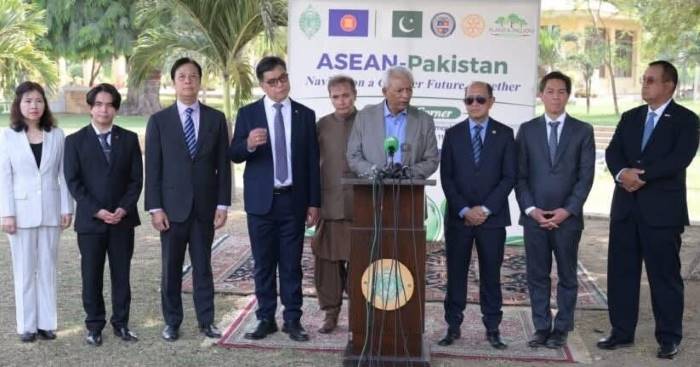
He was speaking to a delegation of Ambassadors, Consuls General and other diplomatic representatives from ASEAN member countries, including the Philippines, Indonesia, Malaysia, Thailand and Myanmar, during a meeting at Governor House in Karachi.
This meeting marks an important milestone in regional diplomacy, reflecting Pakistan’s “Vision East Asia” policy and a shared commitment to building deeper economic, commercial, and environmental ties.
The ASEAN enovys included the Chair , Ambassador Philippine, H.E. Dr. Emmanuel R. Fernandez, Brunei Darussalam Mr. Hazem represented H.C H.E. Colonel (R) Pengiran Haji Kamal Bashah (High Commissioner) Indonesia H.E. Chandra W. Sukotjo, Myanmar, Ambassador Wunna Han, Malaysia High Commissioner Azhar Mazlan, Thailand: H.E. Mr. Rongvudhi Virabutr (Ambassador) Head of the Vietnam Trade Mission Nguyen Thi Diep Ha.
The high-level interactions between the Sindh Governor’s Press Office and the ASEAN delegation at the Governor House highlight several critical dimensions of cooperation. The discussions covered bilateral relations, regional cooperation, environmental protection and ways to strengthen diplomatic and economic ties.
The Governor described the Association of Southeast Asian Nations (ASEAN) as an important regional organisation contributing to stability, mutual cooperation and collective development. Developing countries faced common economic, social and environmental challenges that required coordinated responses, he said.
Highlighting climate change as a shared threat, he called for regional cooperation to tackle its effects, particularly heavy rainfall, floods and natural disasters, and urged countries to benefit from one another’s experience.
Hashmi said Pakistan’s foreign policy was strengthening its diplomatic standing and international recognition, adding that the participation of ASEAN diplomats reflected growing engagement between Pakistan and the international community.
Referring to regional tensions, he said Chief of Army Staff Field Marshal Syed Asim Munir, Prime Minister Muhammad Shehbaz Sharif and Deputy Prime Minister and Foreign Minister Muhammad Ishaq Dar had played important roles in efforts to promote peace and stability.
To a question on water security, the Governor said access to water was a fundamental human right and no country should be deprived of this essential resource. He described India’s threat to restrict Pakistan’s water supply as water aggression, saying the use of water as a political instrument could undermine regional peace and stability.
Appreciating the diplomats’ participation in the plantation campaign, Hashmi said the initiative symbolised a shared commitment to environmental protection and stronger ties among Asian nations. An ASEAN Corner has also been established at the urban forest.
ASEAN comprises 11 member states: Brunei Darussalam, Cambodia, Indonesia, Laos, Malaysia, Myanmar, the Philippines, Singapore, Thailand, Timor-Leste and Vietnam.
Key Areas of Partnership
Trade & Economic Investment: Both sides are focused on expanding commercial cooperation, exploring joint ventures in Sindh’s industrial, energy, and infrastructure projects, and tapping into the fast-growing Southeast Asian markets.
Climate Change & Greener Initiatives: Recognizing shared vulnerabilities to extreme weather events, floods, and natural disasters, the leaders emphasized coordinated responses, exchange of environmental protection knowledge, and green infrastructure developments.
Full Dialogue Partnership (FDP): Pakistan is actively working to upgrade its status from a Sectoral Dialogue Partner (a position held since 1993) to a Full Dialogue Partner of ASEAN. Diplomatic visits like this reinforce international engagement and build critical institutional support.
This diplomatic outreach by the ASEAN Committee in Islamabad—which included representatives from the Philippines, Indonesia, Malaysia, Thailand, and Myanmar—paves the way for a more integrated roadmap focusing on connectivity, technology transfers, and closer people-to-people ties.