 Tazeen Akhtar | Islamabad for COP31 Monitoring Desk by Pakistan in the World Media
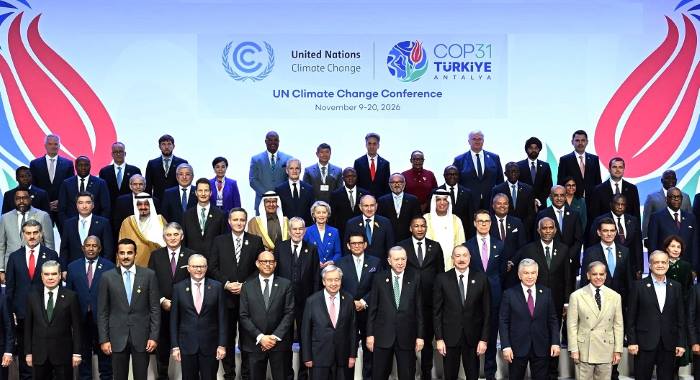
 COP31 opened on 9 November in Antalya, Türkiye, and is scheduled to run until 20 November. The Leaders’ Summit was held on 11-12 November. What follows is therefore an assessment of the first week, not a final verdict, because the final cover decision has not yet been agreed.
Partly successful so far, but not yet decisive. COP31 was deliberately framed as an “Implementation COP” and a “COP of the Future”, not a pledging COP.
Its purpose was to turn existing commitments into bankable projects, finance flows, and delivery on the ground, rather than announce new headline targets.
It has produced movement on electrification, carbon markets, nuclear energy, and climate finance architecture. But on the hardest test, finance for vulnerable countries and a roadmap to transition away from fossil fuels, agreement is still pending. The Presidency itself clarified on 13 November that its summary of consultations does not represent consensus among Parties. The final scope of the cover decision remains subject to further consultations.
Main Topics Under Discussion?
The Joint Presidency of Türkiye (President Murat Kurum) and Australia (President of Negotiations Chris Bowen) set five core priorities: accelerating electrification, turning commitments into bankable projects, mobilizing public and private finance, strengthening adaptation, and protecting oceans.
The negotiations covered in detail :
Electrification and energy transition: The Presidency’s flagship “35 by 35” pledge to raise electricity’s share of final energy consumption to 35% by 2035, from about 23% today.
1.5°C overshoot: The Presidency’s summary records that global temperatures will rise beyond the 1.5°C target, with current projections around 2.6°C even if pledges are fully implemented.
Fossil fuel transition and methane: Implementation of the COP28 Global Stocktake call to transition away from fossil fuels, phase out inefficient fossil fuel subsidies, and slash methane from oil, gas and waste.
Climate finance: Delivery of the COP29 promise to mobilise at least $300 billion annually by 2035 for developing countries, and scaling all sources to $1.3 trillion annually.
Adaptation, Loss and Damage, and Just Transition: Including the dispute at the opening over tripling adaptation finance, and the institutional arrangements for the Belem Action Mechanism.Carbon markets, technology, food security, oceans, resilient cities, green industrialisation,
AI and data centres: The agenda also gave dedicated attention to oceans, resilient cities, green industrialisation and investment-ready projects.
US absence: The United States had no official federal delegation after its withdrawal from the Paris Agreement became effective on 27 January 2026.
3. What Was Agreed Upon?
No final COP31 cover decision has been adopted yet. What has been agreed or launched in the first week is a series of voluntary initiatives and coalitions.
Antalya Statement on Carbon Markets:
Ministers and climate envoys signed the Antalya Statement, backing a Policy Playbook with eight policy levers to grow high-integrity carbon credit markets. Analysis cited at COP31 says supportive policy could quadruple the market to US$21 billion by 2035.
Electrification push: About a dozen countries had publicly backed the 35 by 35 pledge by 11 November, including South Korea. Japan had not yet signed, though its companies were promoting the needed technology.
Nuclear expansion: The coalition backing the Declaration to Triple Nuclear Energy by 2050 grew from 25 countries at COP28 to 39 countries at COP31.
Antalya Ocean Declaration: The Presidency pushed for a formal resolution on ocean protection, nature-based solutions and marine ecosystems, following Pacific Pre-COP meetings in Fiji and Tuvalu.
South-South cooperation: AIIB and China’s Ministry of Ecology and Environment signed a letter of intent at COP31 to expand cooperation on low-carbon and climate-resilient development for emerging markets.
These are important, but they are largely voluntary and outside the formal UNFCCC negotiated text.
4. Joint Declaration?
There is no single COP31 Joint Declaration yet.There are two different things being called declarations in media coverage, and they should not be confused.
a- The Antalya Statement (13 November): A joint statement by 14 initial signatories, later rising to 16, including Canada, France, Indonesia, Ireland, Italy, Kenya, Luxembourg, New Zealand, the Philippines, Singapore, Switzerland, Türkiye, UK and Zambia, plus Egypt and others expressing intent to join. It says carbon credit markets “play an important role in directing capital to climate action” and “what matters now is implementation.”
b- The Presidency’s Summary of Consultations (13 November): This lists issues proposed for the cover decision, including 1.5°C overshoot, 35% electrification, fossil fuel transition and trade measures, but it is explicitly not consensus.
A true joint declaration / cover decision will only be known when negotiations close on or after 20 November.
5. Was the Purpose of the Conference Served?
The shift from pledges to implementation was accepted as the framing by most delegations.
Concrete tools were launched: the carbon markets playbook, electrification pledge, nuclear coalition, and ocean agenda.The Climate Implementation Bridge goal, to scale up climate investment delivered on the ground, was kept central.
Not yet Addressed: Vulnerable countries still report that finance is not predictable, adequate or accessible enough.The fossil fuel transition roadmap, which failed at COP30, remains unresolved. Negotiators have cautioned against reopening existing negotiations or creating new obligations.
Nearly 50 parties had still not filed updated Nationally Determined Contributions (NDCs) at the start of COP31.
UN Secretary-General Antonio Guterres called for a “climate justice compact” to tax fossil fuel companies and redirect funds to vulnerable nations, a proposal that has not been adopted.
6. Pakistani Participation
Pakistan participated at the highest level, as a frontline climate-vulnerable country.Prime Minister Shehbaz Sharif addressed the Leaders’ Summit on 11 November, calling for concrete measures against climate change, highlighting Pakistan’s rapid solarisation, expansion of renewable energy, disaster preparedness and early-warning systems, and demanding predictable, adequate and accessible climate finance for developing countries.
Pakistan was also named as one of the first five countries chosen for the COP31 Presidency’s new climate-finance pilot programme (BRIDGE), and had sealed a climate partnership with Türkiye on climate resilience, flood management and water security before the summit.
Pakistan’s private sector was also present. PRGMEA represented the apparel sector to promote textile decarbonisation, sustainable manufacturing and circularity, and proposed a COP31-aligned project for SMEs.
Civil society delegates from Pakistan, including WILPF Pakistan, also participated, calling for redirecting military spending toward climate justice.
For Pakistan, COP31 was therefore both a climate negotiation and a diplomatic platform to present its case as a country that contributes least to emissions but bears disproportionate damage, a position it has held since its push for the Loss and Damage Fund at COP27.
7. Conclusion
COP31 succeeded in keeping the implementation agenda alive, launching practical tools on electrification, carbon markets and nuclear energy, and giving vulnerable countries like Pakistan a high-level stage.
It has not yet succeeded in delivering the two things that matter most to the Global South: guaranteed, grant-based, accessible climate finance, and a clear, time-bound roadmap to transition away from fossil fuels.
The real test will come in the second week, when the cover decision is negotiated. If the final text includes strong language on adaptation finance, loss and damage delivery, and fossil fuel transition, COP31 can be called moderately successful. If it ends with only voluntary pledges, it will be remembered as another implementation COP that implemented too little.
The message from Antalya is clear: the world now accepts that 1.5°C will be overshot, so the fight has shifted from preventing warming to surviving it, and that survival depends on finance actually reaching the frontline.