 Middle East Monitoring Desk – Report : Tazeen Akhtar Editor Pakistan in the World
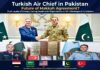
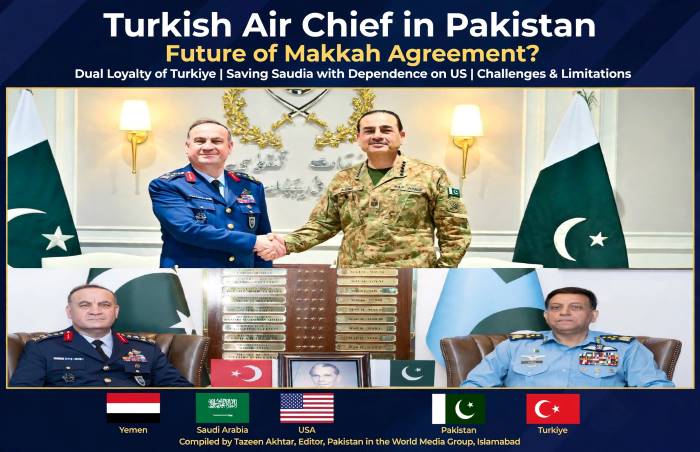
 On 16-19 November 2026, General Rafet Dalkıran, Commander of the Turkish Air Force, paid an official visit to Pakistan.The visit took place at a time when Pakistan–Türkiye defence relations have moved beyond traditional friendship and ceremonial exchanges, into joint production, joint training, joint technology development and now, joint collective defence under a trilateral framework with Saudi Arabia.
The visit had three layers: Strategic-political – GHQ RawalpindiOperational-air power – Air Headquarters, Islamabad, Industrial and training – NASTP, PAC Kamra, Risalpur
Meeting at GHQ Rawalpindi – 17 November 2026
General Rafet Dalkıran called on Field Marshal Syed Asim Munir, NI (M), HJ, Chief of Army Staff & Chief of Defence Forces (COAS & CDF), at General Headquarters, Rawalpindi. Discussed:Matters of mutual interestRegional security dynamicsAvenues for enhancing bilateral defence cooperation.
COAS & CDF highlighted: Deep-rooted historical, cultural and strategic ties between Pakistan and TürkiyeAppreciation for the strong defence partnership between the Armed Forces of Pakistan and Türkiye.
Visiting dignitary:Reciprocated desire to strengthen bilateral defence tiesAppreciated professionalism of Pakistan Armed ForcesAcknowledged Pakistan’s contributions to regional peace and stability.
Outcome: Reaffirmation that Pakistan–Türkiye partnership is not transactional, but rooted in shared history and strategic trust.
Meeting at Air Headquarters, Islamabad
General Dalkıran called on Air Chief Marshal Zaheer Ahmed Baber Sidhu, Chief of the Air Staff, Pakistan Air Force, at Air Headquarters, Islamabad.Upon arrival, he was accorded a Guard of Honour by a smartly turned-out contingent of Pakistan Air Force.
Focus of engagement: Translating the longstanding strategic partnership into: Enhanced operational collaboration, Technological cooperation, Shared vision to address contemporary air power challenges.
Both Air Chiefs identified substantial opportunities in: Unmanned and autonomous systems,Electronic warfare,Advanced aerospace technologies,Indigenous research, development and production.
Both stressed:Institutionalized professional exchanges,Integrated training programmes,Joint exercises to enhance interoperability and foster greater operational synergy.
This was the operational core of the visit – not just diplomacy, but a work-plan for how two air forces will train, fight, and build together.
Industrial and Training Visits
a) National Aerospace Science and Technology Park (NASTP), IslamabadCentre of PAF’s indigenous innovation ecosystem, startups, AI, space, cyber, aerospace R&D
b) Pakistan Aeronautical Complex (PAC), KamraHeart of JF-17 production, overhaul, and now, a key node for future joint programmes including KAAN / TF-X cooperationc) PAF Academy Asghar Khan, Risalpur, Visited the Centre of Excellence,Met Turkish Air Force personnel undergoing training in Pakistan,Attended the Academy’s graduation ceremony as Guest of Honour
This last point is symbolically and practically important: Turkish cadets / officers are now training in Pakistan, just as Pakistani engineers are embedded in Türkiye. The relationship is now two-way.
The Larger Industrial Context – KAAN / TF-X
The visit cannot be understood without the KAAN programme, which is now publicly confirmed. Pakistan is considered a tier-1 partner in Türkiye’s TAI KAAN fifth-generation fighter programme, with nearly 200 Pakistani engineers already embedded in Turkish Aerospace Industries (TAI) since 2023, and a joint factory to co-produce KAAN agreed at the Pak-Turkish Industrial Expo in 2025.
In a PAF video released 9 November 2026, the phrase “TF-X Cooperation” appeared on screen, confirming for the first time officially that Pakistan is a design, engineering and manufacturing partner, not just a future customer.
Reports in 2026 also speak of a possible larger package for KAAN, though quantities and costs have not been officially confirmed by either government. The visit to NASTP and PAC Kamra must be read in that light – Dalkıran was inspecting the industrial base that will have to deliver that partnership.
CONCLUSION : Status of Defence Cooperation Between Pakistan and Türkiye – Challenges After Makkah Agreement and Middle East Crisis
What the Makkah Agreement Changed
On 7 August 2026, in Makkah, Pakistan, Saudi Arabia and Türkiye signed the Makkah Joint Defence Agreement (MJDA), also called the Makkah Agreement / Makkah Defence Alliance. Its core clause is modelled on NATO Article 5:”Any armed attack against any one of the three states shall be regarded as an attack against them all” It builds on the earlier Pakistan-Saudi Strategic Mutual Defence Agreement of 17 September 2025 to include Türkiye.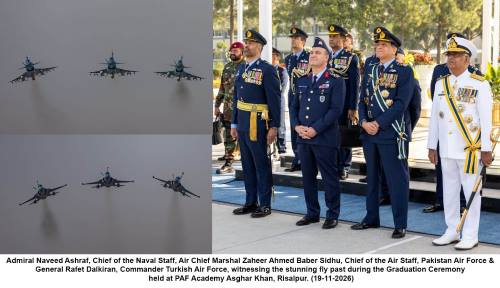
Why the Visit Matters More than other visits so far ?
Türkiye Parliament approved 5 Nov 2026 by 279 votes to 119, law published in Official Gazette 14 Nov 2026. Dalkıran’s visit (16-19 Nov) was therefore the first high-level Turkish military visit after full Turkish ratification. That is why it matters.
The bilateral Pakistan-Türkiye visit is therefore no longer just bilateral. It is now the air-power pillar of a trilateral alliance.
Current Status – Strong on Paper, Tested in Practice – What is working:
Political will: All three leaders signed in Makkah, all three parliaments / governments have ratified
Institutionalisation: Secretariat, Secretary-General, SPDC, Chiefs meetings, working committee are functioning
Industrial depth: KAAN, AKINCI drones to Saudi Arabia ($3.1bn deal 2023 for 60 AKINCI), JF-17, HQ-9, joint factory talks – this is real hardware, not just statements
Human capital: Turkish personnel training at Risalpur, Pakistani engineers at TAI, joint exercises, pilot training exchange
Operational deployment: Pakistan has reportedly deployed ∼8,000 troops to Kingdom, including JF-17 squadron and HQ-9 air defence system, in advisory / training / air defence role
What was tested – and exposed limits of Pakistan and Turkiye :
The first real test came after Houthi attacks targeted Saudi Arabia, killing three people at Riyadh airport. On 5 October, the pact’s committee announced activation of collective deterrence and rapid deployment.
But: Pakistan denied it had conducted air strikes against Houthis and ruled out sending troops into Yemen, Türkiye also rejected participation in attacks on another country.
Turkish FM Hakan Fidan: Agreement is “defensive, not offensive,” Türkiye “will not send forces to the territory of another state to launch an attack from there.”
Turkish Defence Minister Yasar Guler: “We absolutely do not foresee entering into any conflict with the Houthis”
Analysts now describe the emerging model as “Defence without combat” – guard Saudi Arabia, but do not fight its war.
FIVE CORE CHALLENGES
1. Three Different Threat Maps, One Pact
The most complicating feature is that the three signatories don’t share a single common adversary.
Pakistan’s primary threat: India, plus Afghanistan border / TTP
Türkiye’s primary threats: PKK / Syria / Eastern Mediterranean / NATO-Russia tension
Saudi Arabia’s primary threat: Iran / Houthis / Yemen / Red Sea
A pact stitched from three different threat maps will not function like NATO Article 5. It is better understood as a framework for closer strategic, industrial and diplomatic coordination than as an ironclad collective-defence treaty with automatic triggers.
Opposition in Turkish Parliament asked exactly this: “What are the limits of responsibility Turkey might assume” in face of Pakistan-India tensions or Pakistan-Afghanistan border issues?
2. The Iran Dilemma
All three insist the pact is “not directed against any particular country” and “not targeting Iran”. But: The pact was announced amid the 2026 Iran war, Saudi Arabia is seeking guarantees against Iran-backed threats.
Pakistan shares a 900+ km border with Iran, has 2nd largest Shia population in world (10-15%), and cannot afford to be seen as part of an anti-Iran Sunni bloc.
Türkiye also maintains economic and diplomatic ties with Tehran, and a trilateral delegation even held talks in Tehran last month to try to avert renewed fighting.
Pakistan’s position is therefore a tightrope: stand shoulder-to-shoulder with Saudi Arabia, while keeping Tehran channel open. Any offensive action would inflame domestic sectarian pressures and destroy Pakistan’s mediation role.
3. The Yemen / Houthi Trap
Turkish opposition warned: “They brought this agreement to send Turkish soldiers to the deserts of Yemen” – a reference to Ottoman losses in Yemen in early 20th century.
Pakistan Parliament unanimously rejected joining Saudi Yemen intervention in 2015 for same reason.
Both Ankara and Islamabad have now drawn a line: defensive assistance – air defence, intelligence, technology, drone operators, training – yes. Offensive ground combat in Yemen – no.
This creates a credibility gap: Riyadh expected a NATO-like guarantee, it got “defence as a service” – equipment + training + logistics + political support, packaged together.
4. NATO vs Makkah – Türkiye’s Dual Loyalty
Türkiye is NATO’s second-largest military, bound by NATO Article 5, and now bound by Makkah Article 2. Turkish officials dismiss conflict-of-interest concerns, but: Deploying Turkish troops to Saudi Arabia requires separate parliamentary mandate, not automatic under Makkah ratification.
Any Turkish deployment would be scrutinised by NATO allies, especially US, which is itself in war / tense standoff with Iran. Türkiye’s defence industry depends on Western components – e.g., US approval in June 2026 of $705m GE F110 engines for KAAN Block-10 – which gives Washington leverage over how far Ankara can go.
5. Pakistan’s Capacity and Economic Constraints
Pakistan’s FY2027 defence budget is ~Rs 3 trillion vs Rs 8.05 trillion for debt servicing, with $21.5bn external financing needs and IMF programme constraints.
It is fighting: 1,415 deaths linked to armed violence / counter terrorism in 3 months of 2026 alone, up 83% over previous quarter. Escalating tensions with Afghanistan, Continuing confrontation with India.
It cannot sustain a second front in Middle East. Its contribution will remain limited, defensive, and largely in-Kingdom – guarding air bases, operating HQ-9 / JF-17 air defence, training Saudi forces – which also protects 2+ million Pakistani workers in Saudi Arabia who sent home $9.78bn in FY2026, the single largest source of Pakistan’s record $41.6bn remittances.
What Dalkıran’s Visit Signals for the Future
Despite these challenges, the visit shows the bilateral track is accelerating precisely to make the trilateral track credible:
If Makkah Agreement MA is to survive, it needs interoperability – same training, same EW, same drones, same air defence concepts. That is what Dalkıran and Sidhu discussed.
If MA is to survive, it needs industrial self-reliance – KAAN, joint production, indigenous R&D – so the three are not dependent on US / Europe for every spare part in a crisis.
If MA is to survive, it needs a non-combat model that all three can sell domestically: Türkiye’s parliament will not vote for Yemen war, Pakistan’s parliament will not vote for Yemen war, but both will vote for air defence, training and technology.
Bottom line: Pakistan-Türkiye defence cooperation is at its highest point in history – from friendship to co-production to collective defence. But the Makkah Agreement has turned that friendship into a test of credibility. The next 6 months – the Islamabad Apex Committee meeting, the Turkish deployment mandate debate, the Saudi-Houthi / US-Iran trajectory, and whether KAAN joint factory moves from announcement to ground-breaking – will decide whether MA becomes ;
a) A real regional security architecture, or
b) A symbolic pact – strong on paper, limited in war.
Dalkıran’s visit suggests both Islamabad and Ankara want option (a), but on their own terms: defence, deterrence, and technology – not expeditionary war.