 Pakistan China Monitoring Desk | Tazeen Akhtar | Islamabad
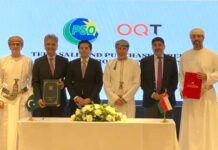
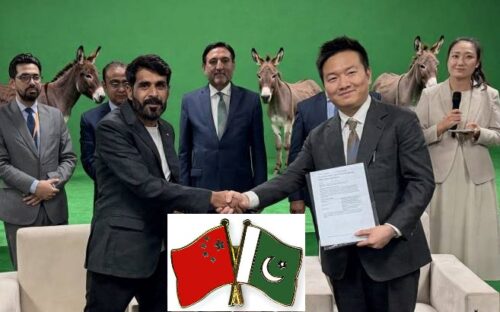
A US$50 million annual purchase agreement for Pakistani donkey meat, hides and bones was signed between Hangeng and Zhongchen International on Tuesday at the FoodAg Pakistan 2026 exhibition. Hangeng acknowledged the support of the Trade Development Authority of Pakistan (TDAP) and the Government of Pakistan in facilitating efforts to bring Pakistani products from Gwadar to the Chinese market.
The agreement was concluded during the fourth edition of FoodAg Pakistan 2026, held from November 23–26 at the Expo Centre Karachi. Organised by TDAP under the theme “Harvesting Innovation, Cultivating Sustainability,” the four-day exhibition brought together 400 Pakistani exhibitors and around 820 international delegates from 72 countries.
For centuries in Pakistan, the donkey was the poor man’s truck. It carried bricks in Karachi, sand in Lahore, goods in Peshawar’s bazaars, and water in Balochistan’s villages.
Today, that same animal has become one of Pakistan’s most talked-about new exports – not because Pakistanis have started eating it, but because *China wants it.*
And China wants it in huge numbers.
Why Does China Want Donkeys?
China does not want donkeys mainly for transport. It wants them for two things:
*1. Donkey Meat -* Considered a delicacy in parts of China, eaten as frozen boneless meat, especially foreleg meat.
*2. Donkey Hides – For Ejiao -* This is the real gold.
Ejiao is a gelatin made by boiling donkey skin to extract collagen. In Traditional Chinese Medicine, it has been used for more than 2,000 years as a blood tonic to treat anaemia, boost immunity, improve sleep, and for skin and beauty products.
China’s ejiao market was valued at around *$7.8 billion in 2021*, according to a 2023 US Congressional Research Service report. To feed that market, an estimated *2.3 million to 4.8 million donkeys are slaughtered every year worldwide* for their hides alone. 699d
The problem for China: Its own donkey population has plunged after years of slaughter. It simply cannot meet its own demand anymore.
The Donkeys are in Demand in China – 6 Million Available in Pakistan – Opinion by Majyd Aziz
Why Pakistan? Why Now?
Pakistan has one of the world’s largest donkey populations:
– *5.9 million in 2023-24*
– *6.0 million in 2024-25*
– *6.2 million in 2025-26* – Pakistan Economic Survey 2025-26 db56
Punjab has nearly half, followed by Sindh 22%, Khyber Pakhtunkhwa 16%, and Balochistan 13%.
For years, this was an informal, unregulated trade. Donkeys were smuggled, hides were sold illegally, and in 2015 Pakistan even banned hide exports after cases where donkey meat was passed off as beef and mutton in some cities.
That changed when Africa closed its doors. In 2024, the *African Union endorsed a continent-wide moratorium on slaughtering donkeys for skins* and related exports, after alarming decline in Africa’s donkey population.
Chinese buyers suddenly needed a new, reliable, legal source. They looked to Pakistan, Brazil and Australia. Pakistan was ready.
The Legal Framework – How It Became Official
Pakistan and China did not start this trade overnight. It was built step by step:
*2023:* Protocol on donkey hides signed
*October 2024:* During Chinese Prime Minister Li Qiang’s visit to Pakistan, a protocol on quarantine requirements for export of donkey meat and hides was signed.
*2024:* Economic Coordination Committee (ECC) amended the Export Policy Order, lifting the ban on donkey hide exports.
*April 2025:* Government announced commercial export, allowing Chinese companies to set up farms, slaughterhouses and export facilities in Gwadar Export Processing Zone under CPEC.
*May 2026:* ECC officially approved export of donkey meat from Gwadar North Free Zone. 699d
All exports are restricted to *certified slaughterhouses in designated zones, notably Gwadar Free Zone*, to enforce quality control and full traceability, and to keep the products *out of Pakistan’s domestic food chain*, because donkey meat consumption is prohibited locally under Islamic dietary laws.
The heart of this new industry is *Gwadar*.
Chinese company *Hangeng Trade (SMC Pvt) Ltd / Hangeng Group* has invested about *$50 million* over six years in Pakistan and built Pakistan’s first modern donkey slaughterhouse in *Gwadar North Free Zone*. It employs around *500 local workers* alongside nine Chinese managers. 5ef9
The plan is big:
– *216,000 donkeys per year* target – under agreement with China
– *800 donkeys per day* slaughter capacity within months
– *$5 million per month* in foreign exchange within six months, rising to *$7 million per month* within two years – Hangeng CEO Andy Liao told Bloomberg.
In July 2026, Pakistan’s first commercial shipment of donkey products arrived in Guangdong, China, and cleared customs on July 15. The consignment, labelled *Frozen Boneless Donkey Foreleg Meat*, was exported from Gwadar, packed in 25-kg cartons, frozen at or below -18°C, with certification from Pakistan’s Animal Quarantine Department.
Then came the biggest deal so far:
At *FoodAg Pakistan 2026*, held 23-26 November at Expo Centre Karachi, a *$50 million annual purchase agreement for Pakistani donkey meat, hides and bones was signed between Hangeng and Zhongchen International*.
That is the agreement seen in the photo – a handshake that formalised a new trade corridor: *Gwadar to China.*
The Money – Is It Worth It?
Government estimates say the sector could generate *around $300 million each year* if the 216,000 annual target is met. Other researchers are more optimistic. Modernisation could raise the value per animal from about *$150 to over $600*, increase rural household incomes by *200-300%*, create more than *75,000 direct and indirect jobs*, and eventually earn *$100-150 million annually* in foreign exchange.
For a country whose exports fell 6% to $30.1 billion in FY ending June, and which is desperate for new foreign exchange, even $300 million matters.
The Controversy – Probe and Concerns
The trade is not without controversy. In November 2026, Islamabad launched a probe into Hangeng’s $30 million facility in Gwadar. A three-member fact-finding committee led by PARC Director-General Irfan Ali was tasked to review procurement, breeding, transportation, slaughtering, processing, storage and export, and to check traceability, breeding arrangements and compliance with Pakistan-China protocols. The committee has not specified any violation, and Hangeng says it will fully cooperate.
There are also deeper concerns:
1. *For the poor:* In Karachi’s Lyari donkey market, hundreds of daily-wage labourers depend on donkeys. Prices have surged to as high as *Rs 0.3 million* per donkey. If working donkeys become too expensive, the poor lose their livelihood.
2. *For sustainability:* If Pakistan slaughters 216,000 donkeys a year without proper breeding, will its population fall like China’s did? The government says breeding farms – including a 3,000-acre farm in Okara, Punjab – will prevent depletion.
3. *For food safety:* Pakistanis fear donkey meat entering the local market. The government insists all processing is confined to Gwadar Free Zone, with strict quarantine.
In October 2025, a Donkey Industry Forum in Islamabad signed a *Donkey Industry Self-Regulation Declaration* with binding commitments on full compliance with export, sanitary and national laws.
What It Means for Pakistan-China Relations
This is no longer just about donkeys. It is about a new model of CPEC cooperation:
– From infrastructure and energy, to *agro-trade*
– From government-to-government loans, to *private Chinese investment in Gwadar*
– From informal smuggling, to *formal, traceable, certified exports*
Pakistan’s exports to five key southern Chinese provinces – Guangdong, Fujian, Guangxi, Hunan, Hainan – rose to *$549.15 million in first half of 2026, up 31.9%* from $416.19 million in same period 2025. Donkey products are a small but growing part of that. 0284
Conclusion – A Humble Animal, A Big Test
The donkey, once mocked as stubborn and lowly, is now at the centre of a $7.8 billion Chinese industry and a $50 million annual deal for Pakistan.
If Pakistan manages it well – with breeding, traceability, Gwadar-only processing, and protection for poor donkey owners – it can become a sustainable export that brings jobs, foreign exchange, and rural income.
If it manages it badly – with over-slaughter, illegal trade, and loss of working animals – it will repeat China’s mistake and Africa’s crisis.
The handshake in Karachi in November 2026 was not the end. It was the beginning.
Pakistan’s donkey has finally entered the world market. Now Pakistan must decide: Will it be a burden lifted, or a burden lost?