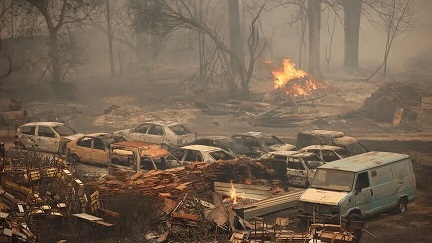
 ISLAMABAD : Monitoring Desk – Algerian President Abdelmadjid Tebboune has announced three days of mourning for victims of deadly fires raging across the country. At least 12 people have died in wildfires burning through parts of northern Algeria, including in Jijel province, home to port cities dotted along the Mediterranean Sea coastline.
The pace of forest fires in Algeria slowed Saturday as firefighting operations continued in several provinces and major solidarity convoys headed toward affected areas, particularly the eastern province of Jijel.
The Civil Protection Authority said in a statement that 123 fires were recorded between Aug. 28 and 29 as of 7 a.m. local time (0600GMT), of which 118 had been extinguished while five remained active. Two of the ongoing fires were in Jijel, two in Setif and one in Tebessa, according to the statement.
In Jijel, civil protection teams continued efforts to extinguish a forest fire in the Mechta El-Maissa area of Texenna municipality. Several families were evacuated from their homes as a precaution before the flames were brought under control and residents were allowed to return, while firefighting operations remained underway.
The authority deployed two AT-802 aircraft to support firefighting crews in Jijel.
Local media reported that the authority mobilized 19,000 personnel to battle the fires across Algeria’s eastern provinces.
Funerals for wildfire victims began Friday in Jijel, with a collective burial held at Dar al-Baqaa cemetery in Beni Habibi municipality. Prime Minister Sifi Ghrieb and several government ministers attended the ceremony.
Authorities also launched a search Friday for missing people in the Djemaa Beni Habibi municipality, according to the provincial civil protection authority. As firefighting and search efforts continued, Algerians organized large solidarity convoys to deliver assistance to fire-hit areas, particularly Jijel, according to an Anadolu correspondent.
The convoys departed from several provinces carrying food, bedding and other essential supplies for affected residents.
Jijel authorities, meanwhile, began assessing material damage caused by the fires ahead of compensation for those affected.
Algerian Interior Minister Said Sayoud said Wednesday that 12 people had been killed in the wave of fires across several eastern provinces, according to local media.
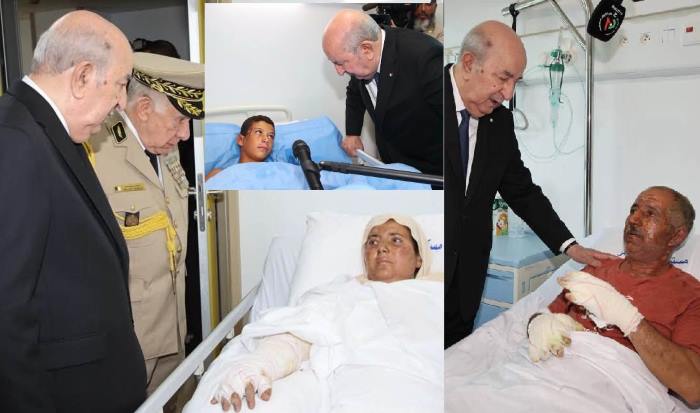
President Abdelmadjid Tebboune on Saturday visited injured victims of the recent wildfires at the Dr Said-Chibane Hospital for Major Burns in Zéralda, Algiers, where he reviewed their health condition and the care being provided to them.
 Accoding to dzair-tube.dz, President Tebboune said that “criminal hands” were behind the fires that affected several provinces across Algeria, while stressing that the authorities concerned would conduct the necessary investigations to determine the actual causes of the outbreaks.
The President also pointed to strong winds as a factor that complicated firefighting efforts and made the task of containing the fires more difficult.
Tebboune inspected the condition of patients with serious injuries who had been evacuated from Jijel and Béjaïa, among other areas affected by the recent fires, and received updates on their medical condition.
The visit underscored the authorities’ continued monitoring of the situation of those seriously injured in the fires and the measures being taken to ensure their medical care.
The President was accompanied by Minister Delegate to the Minister of National Defence and Chief of Staff of the People’s National Army, General of Army Saïd Chanegriha, and Minister of Health Mohamed Seddik Ait Messaoudene.
The authorities have previously announced investigations into the origins of the fires, which broke out simultaneously in several provinces, while Civil Protection, the People’s National Army, security services and other state institutions continue to mobilise resources to contain the fires and assist affected populations.
Whenever dubious forces or criminal hands seek to exploit harsh natural circumstances to sow discord and manufacture turmoil in Algeria, the architects of such schemes are confronted with a hard truth that shatters their illusions: they fundamentally fail to understand this people and the unique code embedded in its collective character.
The repeated attempts to target Algeria’s stability—whether by manufacturing crises or deepening existing wounds—have invariably rested on profoundly flawed assessments by actors who have failed to read history correctly. President Abdelmadjid Tebboune’s remarks during an inspection visit to the Zeralda Major Burns Hospital, where he went to check on the health of those injured in the recent forest fires, articulated this reality with particular clarity.
 President delivered a blunt message: “Those who thought otherwise about this people do not know them. They are mistaken, and they have been mistaken for a long time—not just today. All their analyses of Algeria are wrong.”
This misreading of the Algerian people reflects a profound disconnect between those who devise their schemes behind closed doors and the reality of a society that transcends divisions and adversity the moment danger strikes.
In the face of raging fires and calamity, Algerians do not stand by as passive spectators. Instead, a groundswell of popular solidarity emerges, once again confounding anyone lying in wait for the country.
As President Tebboune stressed: “Our consolation lies in the solidarity of our citizens. The outpouring of solidarity we are witnessing makes one feel proud and deeply honoured to belong to this nationality and to Algeria.”
This spontaneous solidarity among the nation’s citizens is not merely an emotional response. It constitutes an informal popular institution that shields the state in times of crisis and demonstrates that Algeria’s domestic front is remarkably resilient and impervious to penetration.
Nor has the response to adversity been confined to popular mobilisation. It has been accompanied by institutional, security and medical mobilisation, underscoring the Algerian state’s capacity to confront hardship. The President emphasised that “Algeria will confront every ordeal with the resources of the state. The army stands ready in every hardship, and Civil Protection is setting an example for the world.”
Moreover, past experiences have not been in vain. Earlier tragedies have been transformed into lessons learned and foundations for greater preparedness. President Tebboune’s observation that “every blow we receive teaches us a lesson,” together with his praise for the high level of preparedness within the medical sector and the Major Burns Hospital’s ability to treat victims locally, demonstrates that Algeria is turning its ordeals into sources of institutional strength and resilience, thereby denying those lying in wait for the country the opportunity to achieve their designs.
While acknowledging the harsh natural conditions and powerful winds, which exceeded speeds of 100 kilometres per hour and significantly complicated operations on the ground, President Tebboune nevertheless did not rule out the possibility of criminal involvement. He vowed that investigations would be pursued to identify and hold accountable all those who may have contributed to these tragedies.
He further stressed that the full mobilisation of the state’s various institutions, together with the Algerian people, constitutes “a lesson for anyone who intended evil against the country.”
Those who wager on setting Algeria ablaze or tearing apart its social fabric by manufacturing crises and exploiting calamities are engaged in an exercise in futility. The latest fires, like every ordeal that preceded them, have once again demonstrated that, at moments of danger, the Algerian people become an impregnable bulwark, closing ranks around their homeland, leadership and institutions.
” The message could hardly be clearer today: Reconsider your calculations—you still do not know the Algerian people well enough, President warned.