 Tazeen Akhtar | Islamabad
Saudi Arabia, Turkey and Pakistan have signed a joint defence agreement, against the backdrop of war between the US and Iran.Pakistan’s foreign ministry said an attack on any of the three states “shall be regarded as an attack against them all”. But the question is about its implementation that seems very hard if not impossible. This is the first trilateral defence block in Muslim world as well as Middle East.
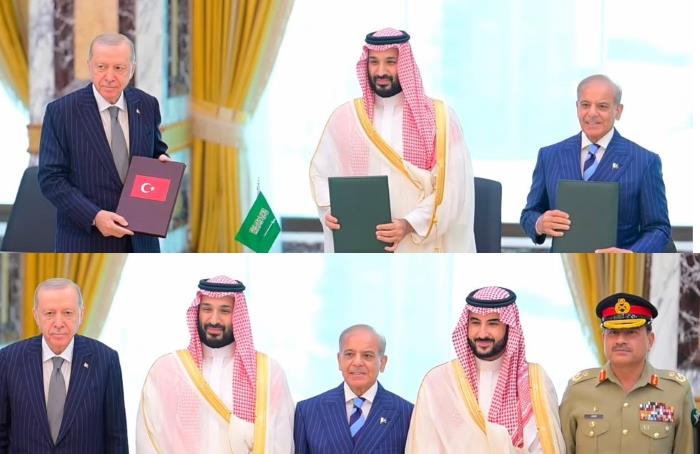
The pact was announced at a meeting between Saudi Crown Prince Mohammed bin Salman, Turkish President Recep Tayyip Erdogan and Pakistani PM Shehbaz Sharif in the Saudi city of Jeddah.
The agreement establishes a collective defense framework—similar to NATO’s Article 5—stipulating that an armed attack against any one of the three countries will be regarded as an attack against them all.
Geopolitical Context and Catalyst
The agreement was forged during a period of severe Middle Eastern turmoil, heavily accelerated by the U.S.-Israel conflict with Iran that began in early 2026. The alliance directly responds to regional security threats, including an Iranian blockade of the Strait of Hormuz and repeated drone/missile strikes by Yemen’s Houthi rebels targeting Saudi oil facilities and shipping routes.
While Pakistan previously signed a bilateral defense pact with Saudi Arabia in September 2025, the inclusion of Türkiye significantly scales up the alliance into a formidable trilateral security architecture.
Scope and Implementation
Defense Industry: Security analysts from organizations like the Royal United Services Institute highlight that the agreement creates major avenues for joint weapons production, technology partnerships, and interoperability.
Purely Defensive Nature: Officials from the participating nations have clarified that the pact is strictly defensive, is not aimed at any specific country, and does not represent an effort to create a sectarian military axis or spark a nuclear arms race
Core Purpose: To strengthen collective deterrence against external aggression, enhance all aspects of defense cooperation, and build regional strategic autonomy amidst shifting geopolitical dynamics.
Strategic Capabilities: The alliance unifies three distinct military and economic powerhouses in the Muslim World
Saudi Arabia: Gulf’s leading financial powerhouse and top global oil exporter.
Pakistan: The only nuclear-armed state in the Muslim world.
Türkiye: NATO’s second-largest standing military force.
The three countries have been looking to strengthen security ties as the conflict in the region has drawn in Saudi Arabia and disrupted shipping through the Strait of Hormuz and the Red Sea. Saudi Arabia and Pakistan announced a joint defence pact last year.
Prime Minister Shehbaz said on X, “Honoured to sign the Makkah Joint Defence Agreement alongside my dear brothers, HRH Crown Prince Mohammed bin Salman and H.E. President Recep Tayyip Erdoğan.
Three brotherly nations, united by faith, friendship and a shared resolve for peace and security. May this historic pact, signed in the shadow of the Haramain, remain a shield of peace for generations to come and may it bring prosperity for our three brotherly countries as well as for the Ummah.
“I would especially like to express my deep appreciation for Field Marshal Syed Asim Munir whose untiring efforts and utmost dedication contributed immensely towards this great cause, Prime Minister noted.
To find the answer to the question of implementation of this agreement , we see from whom Saudia , Turkiye and Pakistan face threat of security.
There are only two countries posing threat for others so far. Iran and Israel ! and both are posing threat from multiple sides if we take into account Houthis in Yemen and Somali Land in Somalia in front of Bab el Mandeb.
The most recent example of Iranian strikes on Saudi Arabia have proved that “Attack on one Attack on all” agreement did not work. Pakistan was not in a position to retaliate against Iran whose mediation Pakistan was/is doing with USA. Similarly, Turkiye can not attack Iran.
Pakistan did not react against the Houthis of Yemen even where Iran does not acknowledge her support and who have attacked on Saudi interests many times while the biggest threat they have posed is the closure of Bab el Mandeb.
Iran takes plea about strikes on Saudia, Turkiye and other countries that the attacks are meant for US installations and not for these countries. In the meanwhile , Iran foreign minister remained continuously in touch with the countrerparts of all countries mentioned here.
Both are neighboring countries with common border and Turkish Saudi history of relations is known to all as how much bitter it has been.
Moreover, other palyers who were active in peace building in Middle East are still out of this arrangement. Qatar and Egypt were equally participating in mediation process.
Pakistan and Qatar have bilateral defense agreement only. Iran itself advocates a regional block or allaince about which President Pezeshkiyan mentioned in his visit to Pakistan.
President of Iran Dr. Masoud Pezeshkian, in his visit to Pakistan late June this year, expressed gratitude to the leadership of Pakistan, Qatar, Turkey, Saudi Arabia, Egypt and friendly countries for the peace process, and also stressed the need for a strong regional security system based on friendship and cooperation.
In this background, Iran becomes acceptable to the alliance but only if does not support Houthis in Yemen and stop interventions into Iraq, Lebanon and Gaza.
Israel is the major threat for the whole region. Here Turkiye’s commitment is questionable.
Turkiye has recognized Israel and maintains diplomatic relations with one embassy and consulate of Xionist state. Turkiye did not take any military action against Genocide of Gazans by Israel.
Turkiye and her most allied states have economic partnerships with Israel. What Turkiye will do if Israel attacks Saudi Arabia that has not recognized Israel so far. One can avoid recalling the hot debate between Saudia and Turkiye on the issue of the murder of Saudi journalist in Saudi Embassy in Turkiye nor it is time to mention how arabs cheated Ottoman Sultanate by siding with British. But Turkiye can forget that page of history?