PAKISTAN CHINA MONITORING DESK ISLAMABAD
The China Program at the Institute of Regional Studies, Islamabad hosted a seminar titled “Protecting Shared Interests through Multilateralism: An Imperative for Global Peace and Stability,” aimed at examining the significance of upholding multilateralism in the contemporary fragmented world order marked by geopolitical tensions, unilateral actions, and rising great power competition.
The event was also aimed at assessing the role of China-led initiatives in addressing geopolitical fragmentation, development gaps, and conflict management. The event was organized and moderated by Ms. Nabila Jaffer, Senior Research Analyst and Head of the China Program at IRS.
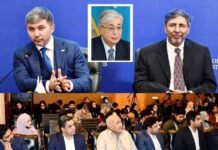
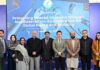
Amb. Jauhar Saleem, President IRS, delivered opening remarks, a keynote address by Senator Mushahid Hussain Sayed (Chairman of Pakistan-China Institute), and other distinguished panelists, including ;
Dr. Zafar Nawaz Jaspal (Meritorious Professor and Dean of FSS Quaid-i-Azam University), Amb. Naela Chohan (Pakistan’s former ambassador), Dr. Manzoor Afridi, (Professor of IR and Dean of FSS International Islamic University (IIUI), Dr. Qian Feng (Senior Research Fellow and Director of the Research Department at the National Strategy Institute, Tsinghua University), Dr. Noor Fatima (Associate Professor and Chairperson of the Department of Politics and International Relations at IIUI), Dr. Talat Shabbir (Director of the China-Pakistan Study Centre at the Institute of Strategic Studies Islamabad (ISSI) and Mr. Wang Shengjie (Counsellor at China Embassy Islamabad) shared valuable insights on the subject, summarized as follow:
The discussion explored the growing tendency of traditional powers towards unilateral actions on part of a few countries have resulted in the weakening of international institutions and the disruption of peace and stability. India’s proclivity for military aggression demonstrates this trend.
There was a consensus among panelists that strengthening multilateral mechanisms of cooperation and conflict resolution is need of the hour in this current fragmented world. Against this backdrop, China was termed the flagbearer of multilateralism and globalization, evident from a multitude of countries joining President Xi’s ambitious Belt and Road Initiative (BRI).
Ambassador Jauhar Saleem, President of IRS, highlighted the growing trend among traditional powers toward unilateral actions, protectionism, conditional diplomacy, and transactional approaches, which he noted are undermining international law and the rules enshrined in the UN Charter. Referring to India’s proclivity for military aggression as reflective of this trend, he emphasized that the protection of shared interests cannot rest on the discretion of a single power. Instead, it requires global cooperation and adherence to multilateral mechanisms.
In this context, he noted that China’s expanding institutional engagements are rooted in a quest for shared prosperity and reflect concrete contributions toward strengthening the UN-based international order.
Senator Mushahid Hussain Sayed underscored the centrality of multilateral engagement in safeguarding global peace and stability. He praised China’s various global initiatives, describing them as core frameworks for protecting shared interests within the existing international system. Calling China a flag bearer of multilateralism and globalization, he cited the broad participation of countries in the Belt and Road Initiative as evidence.
He further noted that Pakistan has consistently advocated mediation and dialogue as tools for conflict resolution, emphasizing that multilateralism has been a foundational pillar of Pakistan’s foreign policy since its inception. He concluded by stating that multilateralism is no longer a policy option, but a strategic necessity.
Ambassador Naela Chohan, highlighting the erosion of the contemporary international order, cited unilateral actions such as Indian military aggression against Pakistan, the Russia–Ukraine war, U.S. actions in Venezuela, and ongoing tariff wars as stark examples of decisions that have destabilized peace and security. She observed that the current global order is under severe strain and viewed Chinese-led alternatives as more inclusive, noting their role in strengthening regional and international institutions and revitalizing multilateral diplomacy.
Professor Zafar Nawaz Jaspal, Meritorious Professor and Dean of the Faculty of Social Sciences at Quaid-i-Azam University, expressed concern over intensifying strategic and great-power competition, warning that its impact is increasingly spilling over into middle powers. Against this backdrop, he highlighted the significance of China’s initiatives in promoting peaceful dialogue and multilateral cooperation.
 Professor Qian Feng, Director of the Research Department at the National Strategy Institute, Tsinghua University, presenting a Chinese perspective, stated that China’s approach seeks to accommodate diverse viewpoints and promote equity-based global governance frameworks. He emphasized that China’s position on multilateral institutions is grounded in the principles of universal security, inclusivity, and building a shared future for mankind, in contrast to unilateralism and protectionism.
Dr. Manzoor Khan Afridi, Professor and Dean of the Faculty of Social Sciences at the International Islamic University, Islamabad, addressing multilateralism from the standpoint of the Global South, noted that platforms such as the Shanghai Cooperation Organization and China’s development initiatives demonstrate a cooperative approach to international relations. He asserted that the Global South has benefited significantly from these initiatives, contributing to sustainable and long-term development.
Dr. Noor Fatima, Associate Professor and Chairperson of the Department of Politics and International Relations at the International Islamic University, Islamabad, emphasized that China’s initiatives prioritize human security and development rather than ideological or geographical considerations. She highlighted the people-centric and inclusive nature of these initiatives, noting that they lend legitimacy to China’s advocacy for multilateralism and reforms in global governance amid shifting power dynamics. She further observed that China’s approach is pluralistic and outcome-oriented, promoting participation, capacity building, and tangible results.
Dr. Talat Shabbir, Director of the China–Pakistan Study Centre at the Institute of Strategic Studies, Islamabad, described China’s inclusive governance model and its four major global initiatives — the Global Development Initiative (GDI), Global Security Initiative (GSI), Global Civilization Initiative (GCI), and Global Governance Initiative (GGI) — as deeply rooted in the principles of multilateralism. He argued that the erosion of trust due to veto politics and selective engagement necessitates the reinvention of mediation mechanisms that are inclusive and preventive rather than reactive, stressing that mediation is a collective responsibility.
Mr. Wang Shengjie, Counsellor at the Embassy of the People’s Republic of China in Islamabad, concluding the seminar, outlined China’s comprehensive and viable alternative to unilateralism. He noted that violations of sovereignty and exceptionalism are among the most alarming realities of today’s world. In an era marked by “my interest first” approaches, he stated that China envisions a world based on shared interests.
He explained that China’s multilateralism rests on the principles of sovereign equality, openness and inclusiveness, opposition to cliques and exceptionalism, and a focus on tangible outcomes, all of which complement the UN-based international order.
Highlighting Pakistan–China relations as an example of mutual trust and shared well-being, he concluded by noting that multilateralism is a collective journey grounded in equity, shared responsibility, and cooperation — and that as a middle power, Pakistan offers a constructive middle path.
The seminar was hosted on the perspective of multilateralism is no longer a policy option but a necessity, this was a collective view of the panelists. In this regard, China supports multilateral diplomacy based on shared prosperity, inclusive development, and dignity for all.
Moreover, China’s approach to multilateralism is not ideological and geographical, but is human-centric, inclusive, and development-oriented, which also provides legitimacy to China’s endeavours for multilateralism and reforms in global governance, panelists noted.
Additionally, the erosion of trust in the system owing to veto politics and selective engagement necessitates the adoption of mediation mechanisms that are inclusive and preventive rather than reactive. Since mediation is a collective responsibility, mediation mechanisms must be reinvented to meet the realities of the contemporary world, panelists suggested.