 Islamabad : Legal Forum for Kashmir (LFK) has published biannual report on severe human rights violations and war crimes in Indian Illegally Occupied Jammu and Kashmir (IIOJK). The report sheds light on the first six months of 2024 (January-June) that saw a continued trend of state repression and counter-insurgency operations in the war-trampled region of (IIOJK).
The report consists of violations of International Human Rights Law (IHRL) and International Humanitarian Law (IHL) led to appalling human tragedies. The international response against these ‘Atrocity Crimes’ was inconsistent, as well as other patterns of egregious violations, some amounting to war crimes and crimes against humanity.
They include heavy hand repression, Confiscation of civilian properties, land grabbing and demolition of civilian properties, torture, enforced disappearances, extrajudicial executions, and other series of crimes against Kashmiris. Human rights defenders and journalists often bore the brunt of India’s excessive use of force and repressive policies.
The occupying authorities use anti-terror laws to criminalize the work of Human rights organizations, civil societies, socio-religious organizations, and digital media networks in the IOJK. These anti-terror laws supersede the universal safeguards guaranteed under UDHR, ICCPR & other international conventions.
Our on-ground research has uncovered disturbing evidence of escalating “atrocity
crimes” perpetrated against the civilian population in the UN-recognized disputed
territory. These findings shed light on the crimes against humanity arising from the
transitional phase of settler colonialism, which appears to be a deliberate attempt to
alter the demographic composition of the region.
Since August 05, 2019, the occupying authorities have brazenly disregarded the
established regulations and protocols designed to protect the health and environment
of the local population. This flagrant disregard for the well-being of the people has
exacerbated the already dire situation in the region, leading to a deepening health and
environmental crisis.
Facts and Figures of Gross Indian Violations of Human Rights and International Conventions
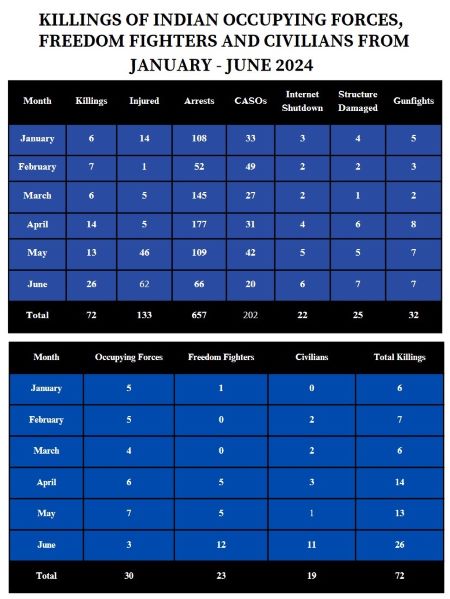 Indian occupying authorities and the occupying forces stationed in IOJK have perpetrated a series of ‘Atrocity crimes’ during the first six months of 2024:
Indian occupying forces persisted in their repressive policies and disregard for
international law and principle of Right of Self-determination. A total of 202 CASO’s
were reported by the local media which are just a fraction of the total Search
Operations launched by the Occupying Forces.
The first six months of 2024 recorded 72 killings in multiple incidents of violence
across IOJK. The armed action of India’s Occupying Forces against the native
population as a result of heightened military presence has resulted in the killing of 19
civilians, 23 freedom fighters and 30 Indian occupying personnel from Jan to June
2024.
At least 32 Gun fights took place between Indian occupying Forces and the
freedom fighters of Kashmir. During these CASOs, vandalism and destruction of
nearly 25 civilian properties were reported. Also, 22 instances of Internet Shut down
in IOJK were reported.
Heightened Militarization
The militarization of occupied territories is a critical issue that has drawn significant
attention from International Human Rights Organizations. The occupying powers
often resort to deploying military forces in the occupied territories, to assert control,
suppress resistance, and maintain a perceived sense of security.
This militarization involves the establishment of military installations, checkpoints, and security infrastructure, resulting in a pervasive presence of occupying forces in the daily lives of the occupied population. Such militarization leads to a range of negative
consequences and can exacerbate tensions and fuel resentment among the occupied
population, perpetuating the cycle of violence and instability.
Additionally, the increased military presence restricts the freedom of movement and basic rights of the natives, contributing to a climate of fear and oppression. Moreover, the militarization
of occupied territories hinders the prospects for peaceful resolution and undermines
efforts toward dialogue and reconciliation.
The issue of militarization in Indian occupied Kashmir features a unique phenomenon
of de facto sovereignty & impunity. The nearly one hundred thousand (100,000)
Indian army and paramilitary forces stationed in UN recognised disputed territory
operate through a legal instrument – Armed Forces Special Powers Act (AFSPA) of
1990 giving the occupying forces unbridled powers, which enable them to maintain an
unlawful occupation of the occupied territory and conduct military operations against
the civilians without any regard for the principle of distinction.
This results in the situation of normalising the ‘Atrocity crimes’ against the civilian population.
The presence of a large number of occupying forces in Kashmir has resulted in a
heavy militarization of the region. This has led to restrictions on civil liberties, such as
curfews, limitations on freedom of movement, and increased surveillance.
In addition, the militarization has facilitated the process of colonization and illegal annexation,
which further undermines the right and dignity of Kashmiris. In 2019, India moved
almost 50,000 military and paramilitary personnel to the region.
On 08 March 2024, The Ministry of Home affairs and Defence ministry of India
which directly control the occupied territory, announced the deployment of A 10,000-
strong unit of Indian Army previously assigned to the country’s western border to
guard a stretch of its frontier with China.
On 29 June 2024 ahead of Amarnath Yatra, the MHA has decided to deploy over 500
companies of Central Armed Police Forces (CAPFs) to the Union Territory in the
backdrop of a recent spate of gruella attacks in the Jammu region.
A Narrative of Erasure
Post 05, August 2019, Indian Occupying Forces have organized and sponsored
multiple Cultural events, Police Melas and Sports events as a narrative to win hearts
and minds of Kashmiris.
A North Kashmir based RTI activist who chose to remain
anonymous because of the fear being persecuted said, Indian Occupying Forces are
using the rehabilitation process and civilian programs as a pretext to carry out a dirty
war in Kashmir.
These programs are in reality, being used as a tool to control and manipulate the population. For instance, the Indian Occupying Forces have been accused of using these programs to gather intelligence, recruit informants, and monitor the activities of the people of Kashmir.
Moreover, these programs have been criticized for their lack of transparency, accountability, and effectiveness. The occupying forces’ actions have further undermined the trust and confidence of the Kashmiri people, leading to a situation where the forces have been equipped with an excessive amount of power, which enables them to conduct operations against
civilians without any regard for their safety.
On Jan 13, the Indian Army’s then Northern Commander LG Upendera Dwivedi chaired a crucial joint security review meeting at Victor Force headquarters in Awantipore to fine-tune the strategy for counter terrorism, and strengthening the synergy.
The army commander stressed on intensifying the anti-terrorist operations by generating more human and technical intelligence by enhancing the public outreach in Southern districts of Kashmir.
On June 22, International Yoga Day as designated by Indian PM Narendra Modi, yoga sessions were conducted all across Kashmir valley along with Badami Bagh Cantonment in Srinagar.
In a press release, the Army spokesperson remarked that the “local Kashmiri populace and Civil administration collaborated closely with the Indian Army contributing significantly to the grand session of the event.”