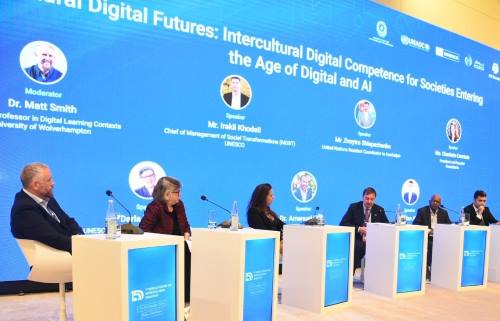
 ISLAMABAD : The United Nations Educational, Scientific and Cultural Organization UNESCO held an important session at The 7th World Forum on Intercultural Dialogue on 27th Oct in Baku Azerbaijan. The forum paved the way to evolution from shared values and peaceful coexistence toward practical responses to global division. It translates dialogue into concrete action for understanding, cooperation, peace and sustainable development.
The Framework integrates intercultural competences such as empathy, perspective-taking, multilingual communication and ethical reasoning into digital literacy, governance, education and online participation. It addresses the competences of users and the responsibilities of platforms, institutions and creators who design and govern digital environments, and is structured across four levels (values, competences, behaviours and outcomes) mapped onto the five competence areas of DigComp 3.0.
Developed through a review of existing frameworks, a global survey and expert consultations across the Global North and South, and aligned with UNESCO’s work on intercultural dialogue, Media and Information Literacy and Global Citizenship Education, the Framework provides practical pathways for embedding human-centred, intercultural approaches into digital ecosystems.
This session explored how intercultural digital competences can support more inclusive, respectful and socially cohesive digital futures. The session considered how intercultural dialogue can be fostered in digital societies where opportunities for global connection coexist with growing risks of exclusion and fragmentation.
Drawing on the new Intercultural Digital Competence (IDC) Framework, it introduces an approach to digital competence that joins ethical, cultural and human-centred dimensions to technical skills.
The session pursued three objectives:
Present the IDC Framework as a practical, globally adaptable tool for embedding intercultural values in digital education, governance, platform design, media literacy and online engagement, and for strengthening resilience against hate speech, misinformation and algorithmic bias.
Opened a dialogue among policymakers, educators, researchers, cultural practitioners and technology actors on the challenges and opportunities of building inclusive digital societies, drawing on case studies and practical examples of intercultural understanding and equitable participation in digital spaces.
Reaffirmed that digital transformation must remain human-centred: sustainable peace, social cohesion and inclusive digital futures require not only access to technology but also the intercultural capacities that enable individuals and institutions to engage ethically and constructively across differences, in support of inclusive knowledge societies grounded in dignity, diversity and shared humanity.