 MIDDLE EAST MONITORING DESK ISLAMABAD
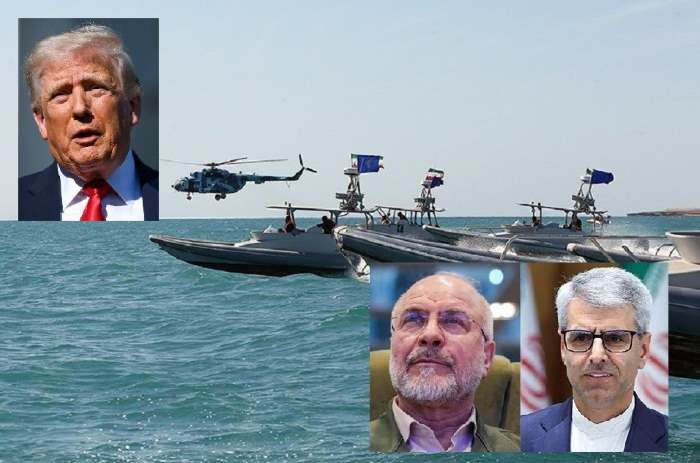
Speaker of the Iranian Parliament Mohammad Baqer Qalibaf dismissed recent comments by US President Donald Trump regarding negotiations with Iran, stating that all seven of his claims are false.
Qalibaf posted a message on his X account about the precise details of the negotiations, stating that all seven claims made by Trump are false.
Qalibaf, who headed Iran’s negotiating team in the recent Pakistani-mediated talks in Islamabad, wrote:
“1. The US president made seven claims in one hour, all seven of which are false.
2. With these lies, they did not win in the war, and they certainly will not achieve results in negotiations either.
3. With the continuation of the blockade, the Strait of Hormuz will not remain open.
4. Passage through the Strait will take place based on a ‘designated route’ and with ‘Iran’s permission’.
5. Whether the Strait is open or closed, and its regulations, are determined in the field, not on social media.
6. Media warfare and the engineering of public opinion are an important part of the war, and the Iranian nation will not be influenced by these tactics.”
Qalibaf also said, “Read the real and accurate news of the negotiations in the recent interview of the (Iranian) Foreign Ministry spokesman.”
Strait of Hormuz under Iran control until the US-Israeli war of aggression fully ends
The secretariat of The Supreme National Security Council (SNSC) announced in a statement on Saturday that following the failure of the aggressor parties on the battlefield and subsequent requests from the United States for negotiations, Iran agreed—through mediation by Pakistan—to hold talks aimed at ending the conflict based on a proposed framework.
It noted that the Iranian delegation engaged in lengthy negotiations, during which it firmly presented the country’s positions despite deep distrust of the United States. According to the statement, the talks ultimately failed because the opposing side introduced additional demands that Iran rejected, insisting it would not compromise on its core positions. The continuation of negotiations was therefore postponed until the other side aligns its stance with battlefield realities, it added.
The statement also said that new proposals have recently been received through Pakistani mediation and are currently under review, with no response issued yet.
It emphasized that Iran’s negotiating team will not concede on national interests and will continue to defend the rights and sacrifices of the Iranian people.
“One of the essential preconditions for Iran’s acceptance of a temporary ceasefire was the cessation of fire on all fronts, including Lebanon. But the Zionist regime violated this from the outset with brutal attacks on Lebanon and heroic Hezbollah,” it added.
The statement added that with Iran’s insistence, the Zionist regime accepted a ceasefire in Lebanon, and it was agreed that if the ceasefire is respected on all fronts by the enemy, the Strait of Hormuz would be temporarily and conditionally opened only for commercial vessels—not military ships or non-military vessels of hostile countries—under the control and authorization of Iran’s Armed Forces and along routes designated by Iran.
Given that the majority of logistical support for US military bases in the Persian Gulf is provided through vessel traffic via the Strait of Hormuz, which constitutes a threat to Iran’s national security and the region, Iran emphasized that it is determined to enforce supervision and control over transit through the Strait until the definitive end of the war and the establishment of lasting peace, the SNSC underlined.
It explained that such control is exercised through obtaining complete information from passing vessels, issuing transit certificates in accordance with regulations announced by the Islamic Republic of Iran, in line with wartime conditions, and the payment of relevant fees for services related to security, safety, and environmental protection, as well as movement along routes designated by Iran.
The statement further stressed that as long as the enemy seeks to disrupt vessel traffic or impose measures such as a maritime blockade, the Islamic Republic of Iran will consider it a violation of the ceasefire and will prevent even the limited and conditional opening of the Strait of Hormuz.
The secretariat finally recalled the recommendations of Leader of the Islamic Revolution Ayatollah Seyed Mojtaba Khamenei, emphasizing that for the full consolidation of battlefield achievements and success in diplomacy, the continued presence of the Iranian people in public spaces, full vigilance on all fronts, and the preservation of national unity by officials, media, and social and political activists remain essential.
The spokesperson for the Iranian Foreign Ministry firmly rejected any possibility of transferring the country’s enriched uranium to another country, stressing that such an option has never been mooted.
In comments on Friday, Esmaeil Baqaei emphasized that Iran’s enriched uranium will under no circumstances be transferred elsewhere.
He stated that transferring uranium to the United States has never been considered an option, adding that just as Iran’s soil is sacred, its enriched uranium holds the same significance.
Baqaei noted that decisions regarding the opening or closure of the Strait of Hormuz are not made in virtual spaces, stressing that Iran is the determining authority in this matter.
He added that following the ceasefire, Iran announced that the passage of non-military vessels through the Strait of Hormuz is permitted, subject to the assessment of relevant authorities.
The spokesman further underlined that any action described as a naval blockade of Iran would certainly be met with an appropriate response from Iran, stressing that such a blockade would constitute a violation of the ceasefire and that Iran would adopt the necessary measures.
Whenever Iran feels that its issues and interests are taken into account and secured within an agreement, it could then be said that a deal is within close reach, he added.
Baqaei highlighted that the removal of sanctions is of great importance to Iran and that compensation for damages inflicted on the country carries particular significance.
There is no ambiguity regarding any part of the negotiations, as Iran has clearly expressed its positions, Baqaei stated.