 Tazeen Akhtar | Middle East Monitoring Desk Islamabad
He kept the deliberations alive when the talks appeared close to collapse. Throughout this period, he was awake all day and night. He sacrificed day and night to extinguish the flames of war. There were many moments, when “it felt like the negotiations would come to a halt” but he did not give up. If this journey had not continued,the dream of peace would have been shattered.
Who is this He-Man ? He is General Asim Munir , and the narrator is none other than Prime Minister of Pakistan Shehbaz Sharif who share the credit with his Chief of Defense Staff, Field Marshal, COAS , General Munir. Shehbaz appreciated Asim’s role at the floor of the National Assembly this week.
Matter of fact is, the international activities like the mediation between Iran US are not One Man Show but a team work and the credit should be shared accordingly.
Earlier it was shared by PM Pakistan that the deal will be struck on Sunday 14 June , the day passed without signing and at midnight of Sunday Monday , President Trump said the deal will be done but in few more hours. Finally on Monday the signing date emerged as Friday 19 June 2026 and the venue not Islamabad but Geneva.
Till the publication of this edition , the signing would have been done at Geneva, if the sides remained committed to bring this uncalled for standoff to end that took half of the world in grip and engaged multiple states in war like situation, causing energy crisis and uncertainty in three continents.
Shehbaz praised DPM/FM Ishaq Dar,his team and Interior Minister Mohsin Naqvi for their “tireless efforts”. He paid tribute to the leaders of Qatar, Saudi Arabia, Turkiye and China for their roles in the mediation.
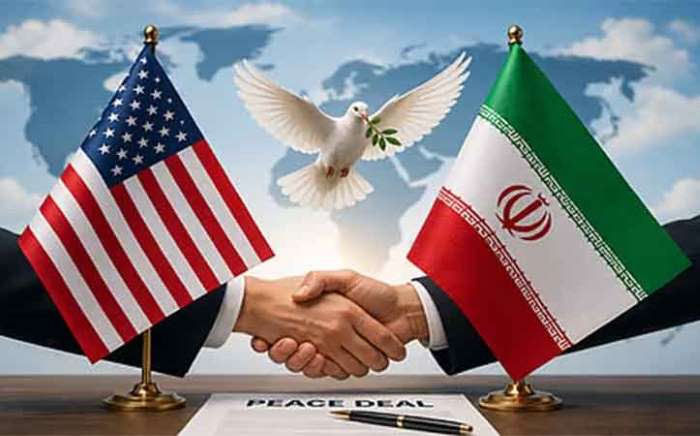
What the US and Iran say is in the memorandum to end the war
That all is encouraging and good to hear but the history of the parties to this agreement is not as bright to attach hopes with another agreement, even if it is signed. Trump One, in May 2018, withdrew from the Iran nuclear deal, formally known as the Joint Comprehensive Plan of Action (JCPOA). He decried the 2015 multinational accord as a “horrible, one-sided deal” and immediately ordered the re-imposition of economic sanctions against Iran.
Trump One left this agreement on the pretext that it does not reduce Iranian influence in the region. How Trump Two can absorb this influence that now has multiplied after Iranian resistence and resilience against a super power and many of her allies including Israel?
China, Russia, Germany, France and UK were also in that agreement but still Trump One took an unexpected decision unilaterally, showing disrespect to other members
Trump Two invaded Iran in between the dialogue with Iran through Oman in Geneva on 28 Feb 2026. Here there was no China Russia EU UK. Certainly, how much bound the US may feel for Oman only when it did not bother the reaction of 5 big countries of the world in case of JCPOA?
And now there is another dialogue and another agreement and here the mediator is Pakistan. This history tells clearly that negotiations between US and Iran are not for the first time as some Pakistani sources claim. Also it leads us to the conclusion that ; First , we are not sure about signing of the agreement until unless it is signed. Second , we fear the latest agreement may find the same destiny as we have seen for the other agreements or dialogue processes.
President Trump hinted at nuclear type attack on Iran on Saturday 13 June and the next day, the sides were telling about the deal on Sunday. VP Vance said on Monday 15 June , the agreement has already been signed electronically. Scattered information , different from different sides created confusion more than clarity on the matter.
Pakistan said one thing, Iran shared the other and American side has been throwing different points in the news market. VP Vance said , no money back gauranttee has been given to Iran while media was reporting at least half of the frozen funds will be released.
The draft consisted of mainly , an immediate, permanent termination of military operations between the U.S. and Iran, explicitly covering the conflict in Lebanon.
Here is what has been known so far with some clarity in between a lot of confusion.
Immediate De-escalation & Security
The strategically vital shipping lane will reopen within 30 days. Initially, it will open toll-free for naval mine removal before returning to pre-war commercial shipping levels. The U.S. Navy will completely lift its blockade of Iranian ports within 30 days. The U.S. has committed to withdrawing military forces deployed immediately around Iran and agreed not to increase its overall force presence in the region.The U.S. formally pledges not to interfere in Iran’s internal affairs, etc.
Economic & Reconstruction Terms
Approximately $24 billion in frozen Iranian foreign assets will be unfrozen in phases during the 60-day negotiation window. The U.S. will lift or suspend sanctions on Iranian oil and energy products, allowing Iran to re-enter global trade. The U.S. and its allies have reportedly committed to delivering reconstruction plans for Iran valued at a minimum of $300 billion. The U.S. agrees not to impose new economic sanctions for the duration of the framework.
The Nuclear Issue & Agenda Rules
The Core Nuclear Pledge: Iran reiterates its permanent commitment never to build or procure nuclear weapons. Detailed negotiations over how to handle Iran’s existing stockpile of highly enriched uranium, uranium enrichment limits, and IAEA monitoring infrastructure are deferred to a 60-day post-signing window. Contentious debates regarding Iran’s ballistic missile program and its regional financial support for armed proxy groups have been completely removed from the current negotiating agenda.
Major Remaining Hurdles
While financial markets have reacted positively, causing global oil prices to slide, underlying regional frictions remain highly volatile. Despite the framework declaring an end to military operations in Lebanon, the Israeli government has stated its forces intend to remain in southern Lebanon indefinitely, creating an immediate point of friction for the deal’s longevity.
Speaking at a meeting with ambassadors, chargés d’affaires, and heads of foreign and international missions based in Tehran on Tuesday, Araqchi said difficulties in reaching a comprehensive agreement had emerged following the US-Israeli war of aggression against Iran, prompting the two sides to divide negotiations into two stages.
He explained that the first phase focused on ending the imposed war and addressing issues related to the Strait of Hormuz, maritime blockade concerns, reconstruction, and related matters, culminating in a memorandum of understanding.
According to Araqchi, the second phase will begin immediately after the signing of the MoU and continue for 60 days, during which the parties will seek to reach a final agreement addressing nuclear issues and sanctions relief.