 Central Asia Monitoring Desk Islamabad
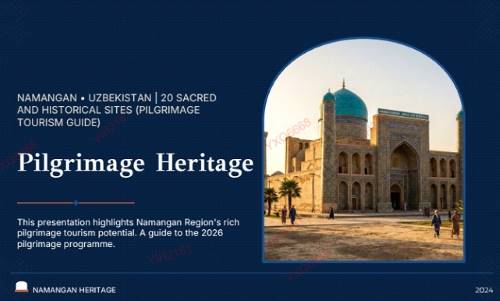
Uzbekistan’s rich historical and spiritual heritage, sacred pilgrimage sites, and unique culture are attracting considerable interest among international tourists. With the aim of further increasing the number of pilgrims from Muslim countries, a tourism routes programme entitled “Heritage of Pilgrimage” has been developed in the Namangan Region.
Initiated by the Namangan Regional Administration, this programme is designed to introduce international visitors to the region’s rich religious, historical, and cultural heritage. Through this initiative, visitors will not only have the opportunity to visit sacred sites but also to gain a deeper insight into the centuries-old history, national traditions, and profound spiritual values of the Fergana Valley.
In particular, the “Heritage of Pilgrimage” tourism programme includes historical monuments and pilgrimage sites located in various districts and cities of the region.
Key destinations along the route include the Aksikent Archaeological Park in Turakurgan District, the Bibiona Mazar pilgrimage site in Chust District, and the Sultan Uvays Qaraniy and Bibi Naima Ona pilgrimage sites in Chortoq District.
Other notable destinations include the “Mothers’ Tears” Complex in Pop District, the “Eleven Ahmad” pilgrimage site in Davlatabad District, and the Mulla Kyrgyz Okhund Complex in Namangan city.
Importantly, the routes are not limited to these destinations alone. The programme also encompasses more than 20 other major pilgrimage sites and cultural heritage attractions located throughout the region. This will enable international tourists to explore Namangan’s historical and spiritual treasures in greater depth.
The initiative is primarily aimed at showcasing the potential of pilgrimage tourism in the Namangan Region on the international stage. At the same time, by bringing historical monuments and sacred sites together into integrated tourist routes, it will enhance the region’s appeal as a travel destination.
In the future, this is expected to help increase the flow of international tourists to the region, develop local tourism infrastructure, and create new economic opportunities.
Namangan’s pilgrimage destinations are particularly likely to attract interest in Pakistan, where the majority of the population is Muslim. Indeed, Uzbekistan and Pakistan share common religious values, a rich historical heritage, deep respect for great Islamic scholars, and spiritual traditions that have evolved over centuries.
In this regard, the “Heritage of Pilgrimage” tourism routes programme represents an important opportunity to take tourism and cultural cooperation between our countries to a new level.
Namangan Punjab Connection – Time to Tap the Potential -by Tazeen Akhtar Islamabad
Namangan is the second most populous city in Uzbekistan, serving as the administrative, economic, and cultural center of the Namangan Region in the northern part of the Fergana Valley.
- Location & Geography: Situated in eastern Uzbekistan near the Syr Darya and Naryn rivers, roughly 200 kilometers southeast of Tashkent and close to the border with Kyrgyzstan.
- Population & Size: It ranks as one of the largest and most rapidly growing urban centers in the country.
- The “City of Flowers”: Namangan is widely known for its gardens and tradition of floriculture, most famously hosting the International Flower Festival every year since 1961.
- Afsonalar Vodiysi (Valley of Legends): A large modern theme park and recreation complex featuring water rides, green spaces, and evening entertainment.
- Akhsikent Archaeological Site: The ancient ruins of the historical city of Akhsikat, located nearby with a millennium-long history.
- Traditional Crafts: Known historically for craft production, including Chust-style knives, embroidered skull-caps (tubeteika), and silk weaving.
- Historical Architecture: Features local sites such as the Mullah Kyrgyz Madrasa and various regional mosques
- Industries: Focused on light industry, cotton processing, textiles, food production, and local handicrafts.
- Transport: Connected via Namangan Airport, a historic 1912 railway station, and regional roadways.