 Maliha Mughal
When Quaid-e-Azam Muhammad Ali Jinnah addressed the fledgling Royal Pakistan Air Force at Risalpur in 1948, his call for an efficient Air Force “Second to None” was remarkable because it came at the beginning, not the culmination, of an institutional journey. It was never a claim of permanent superiority, but a standard of professional excellence that every generation would have to interpret according to the demands of its own time. The history of PAF can therefore be understood as successive generations confronting the same demanding question: what does it take, in our time, to remain Second to None?
For the generation that fought in 1965 , the answer lay in professional skill, combat readiness and PAF’s ability, as a young institution under courageous leadership, to convert individual excellence into collective effect. The F-86 Sabre became inseparable from the memory of that war, while pilots such as MM Alam and Sarfaraz Rafiqui became enduring symbols of courage and skill.
Yet no pilot fought alone: controllers, technicians, engineers, planners and Command all shaped every engagement, working under the severe time pressure peculiar to air warfare. Leadership, professionalism and heroism worked in unison in a way that heroism gave the moment its names and faces, while leadership and professionalism turned individual courage into operational success.
For that generation, “Second to None” meant showing that dynamic & selfless leadership, rigorous preparation, discipline and institutional cohesion could generate air power greater than individual aircraft and airmen alone.
The generations that followed inherited that standard but could not preserve it by repeating the methods that first demonstrated it. The Sabre belonged to one era; the Mirage and F-16 shaped others, while indigenous capability through JF-17 marked another stage in national air power.
This evolution reflected the foresight required to adapt to changing speed, range, sensors, weapons and doctrine. Here, “Second to None” for PAF could never mean fighting tomorrow by yesterday’s assumptions simply because they had once succeeded; its more demanding meaning was to preserve the qualities that produce effectiveness while continually reinventing the means through which it is achieved.
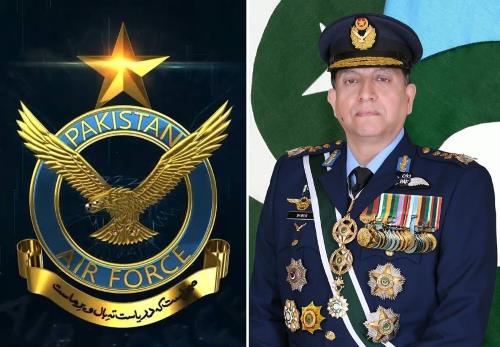
The present generation, under the visionary leadership of Air Chief Marshal Zaheer Ahmed Baber Sidhu, Chief of the Air Staff, has anticipated the demands of this new era through deliberate preparation. While the technological distance between the Sabre and platforms such as JF-17 Block III and J-10C is substantial, the deeper transformation has occurred around the aircraft itself: Airborne Early Warning systems extend awareness beyond a fighter’s own sensors, data links distribute information across platforms and Command Centres, Electronic Warfare contests an adversary’s perception of the battlespace and long-range weapons convert information advantage into operational effect.
” The Day the Sky Took an Oath ” | 06 September 1965 | The Defense Day of Pakistan
Cyber, Space, Artificial Intelligence, Unmanned Systems and Electromagnetic Spectrum further complicate air power, making it no longer aircraft against aircraft, but system against system, where a platform’s effectiveness depends on the architecture linking sensors, shooters, commanders and information.
A capable fighter strengthens a fleet; one connected to surveillance, air defence and command networks changes how the entire force can fight. Through this foresight, ACM Zaheer Ahmed Baber Sidhu has demonstrated that for PAF in contemporary changing air warfare, being “Second to None” demands more than sophisticated aircraft; it requires mastery of integration, institutional adaptability and the ability to orchestrate every element of air power into a unified and decisive fighting system.
The May 2025 India-Pakistan confrontation was a real-world vindication of this transformation, proof of what integration delivers in modern warfare. Fighters operated within a networked architecture of surveillance, real-time information, Electronic Warfare, long-range engagement and Command-and-Control, demonstrating that air power today is decided not by a single platform but by how effectively an entire system can sense, decide and strike under pressure.
Through the foresight of PAF leadership, Pakistan’s integrated employment of these assets accounted for the destruction of eight Indian Air Force aircraft and the neutralisation of an Indian S-400 air defence system — a result that stands as validation of its system-of-systems approach to air warfare. The episode underscored the value of integration: information reaching decision-makers, sensors extending awareness and Command-and-Control converting both into timely, decisive action.
PAF readiness shapes deterrence not only in combat but in peacetime too. A force maintained at high readiness influences strategic calculations through the capability it is believed able to employ, resting on the relationship between demonstrated competence and the costs an adversary anticipates from escalation. Any adversary must weigh not just aircraft numbers but how effectively they can be generated, networked and employed.
The same institutional qualities acquire another meaning during natural disasters, humanitarian emergencies or evacuations, when mobility becomes relief, logistics become humanitarian reach and readiness becomes the ability to respond when time itself is critical. The mission may change, but for PAF, the standard remains the same.
This is why “Second to None” has endured as a defining aspiration across PAF generations. In 1965, it meant exceptional flying, readiness, discipline and cohesion. Later, it demanded new aircraft, weapons, doctrine and indigenous capability.
Today, it increasingly means integrating platforms, information and multiple domains. Its true test is not whether PAF preserves what it has, but whether it can anticipate change and remain effective when the next challenge arrives. Its strength lies in preserving the purpose while continually reinventing the means. Youm-e-Fizaya carries the memory of 1965, but the standard PAF represents belongs to no single war or generation.
To be “Second to None” is not a status secured by history but an obligation earned repeatedly through preparation, professional excellence, leadership and the willingness to adapt before necessity demands it. Aircraft will change, technology will evolve and warfare will continue to transform, but the standard must endure.
Nearly eight decades later, “Second to None” remains not a legacy inherited from the past, but a standard each generation must earn anew.