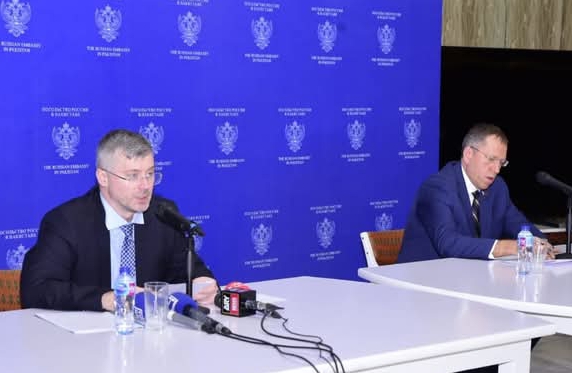
ISLAMABAD: 27 May 2025 – Ambassador of Russian Federation Me. Albert P. Khorev along with Ambassador of Belarus Andrey Metelitsa held a media briefing in Embassy of Russian Federation share the details of celebration of the Day of the Eurasian Economic Union, which is observed annually on May 29 and provided an overview of the association and its future prospects.
The situation with Ukraine and relations with Pakistan also came under discussion. Russian Ambassador once again dismissed reports about Islamabad supplying weapons to Ukraine. He said, no evidence of such matter had been found. Ambassador expressed Russia’s high appreciation of Pakistan’s neutral stance on the Russia-Ukraine war.
Russian ambassador said Western countries are trying to increase pressure on Pakistan regarding the Russia-Ukraine conflict but Russia is happy that Pakistan opted to a neutral position.
Mr. Khorev welcomed steps taken by China, Brazil and some African countries for the Ukraine peace process.
On Eurasian Economic Union, he elaborated that the EAEU comprises Russia, Belarus, Armenia, Kazakhstan, and Kyrgyzstan, representing 185.5 million people. The EAEU boasts a GDP of $2.6 trillion, industrial production worth $1.6 trillion, agricultural output of $132 billion, and investments totaling $487 billion, says press note. Iran, Uzbekistan, Moldova and Cuba are observer countries at EAEU.
Pakistan Identifies Six Trade Corridors to Russia via Iran, China & Afghanistan
The EAEU was established through the Treaty on the Eurasian Economic Union signed on May 29, 2014, in Astana. Armenia and Kyrgyzstan joined in 2015, and the union marked its 10th anniversary in 2024. The EAEU has since implemented unified regulations and policies in areas including customs, trade, energy, agriculture, and digitalization.
Ambassador Khorev noted the Union’s growing international outreach, with free trade agreements with Iran, Serbia, and Vietnam, and over 80 cooperation memorandums with global entities. Observer states include Iran, Uzbekistan, Cuba, and Moldova.
The Russian ambassador explained that Pakistan’s important location on trade routes gives hope for strong connections and better transport links between Pakistan and the countries of the Eurasian Economic Union.
He added that Pakistan’s important location makes it a strong partner for trade and transport links with these countries.
Speaking about the root causes of the Ukrainian conflict, he said, Russia has stopped attacks on Ukraine’s energy infrastructure for 30 days, but Ukraine has broken this agreement more than 130 times.
It was reported that Ukraine broke the ceasefire more than 4,900 times during Easter from April 19 to 21. He said this shows Ukraine does not want peace and only wants to rebuild its army with help from Europe.
On March 18, Russian President Vladimir Putin and U.S. President Donald Trump spoke by telephone and agreed that Russia would unilaterally suspend its strikes on Ukrainian energy infrastructure facilities for 30 days.
The Ukrainian side later verbally supported this initiative. This “energy moratorium” has become a kind of “litmus test” to evaluate Kiev’s ability and willingness to implement the ceasefire agreements. A 30-day energy strike moratorium proposed by President Vladimir Putin and supported by President Donald Trump began on March 18.
Additionally, Mr. Khorev said, despite Zelensky’s pleas for a ceasefire, Ukraine ignored two more opportunities to demonstrate its commitment to peace.
First, Kiev refused to cease hostilities during the Easter truce from April 19-21, violating it a total of 4,900 times, and then rejected President Vladimir Putin’s initiative to suspend hostilities from May 9-11.
Ambassador Russia alleged over 130 violations by Ukraine during the period. He criticized Ukraine’s rejection of the Easter truce and May 9-11 ceasefire proposals, stating these actions demonstrated a lack of commitment to peace.
He questioned the sincerity of Ukraine’s calls for a 30-day ceasefire, arguing such efforts aim to regroup with Western aid. Ambassador Khorev accused Western leaders of pushing militarization over peace, with Germany notably increasing its defense budget.
Ambassador Khorev reiterated that sustainable peace requires addressing the conflict’s root causes. He recalled President Putin’s June 2024 peace proposal, which includes withdrawal of Ukrainian forces from new Russian territories, non-NATO alignment by Ukraine, lifting of sanctions, and protection of Russian-speaking citizens.
He praised the recent Istanbul talks between Russia and Ukraine on May 16, which led to a significant prisoner exchange.
The media briefing session concluded with recognition of the United States’ constructive role, especially President Trump’s efforts in facilitating dialogue. Both sides are now engaged in drafting a potential memorandum for future peace.
The main milestones of EAEU development were highlighted at the briefing through a photo exhibition prepared by Embassy of Russia in collaboration with the Embassy of Belarus .
Here is the text of the statement , Ambassador Russia issued at the briefing on EAEU, specifically ;
Over the past ten years, the EAEU has introduced unified regulations in areas such as creating a common internal market and customs union, technical regulations, tariff and non-tariff regulations, and foreign trade policy. EAEU countries are pursuing coordinated policies in energy, industrial cooperation, agriculture, and digitalization.
The EAEU’s experience has attracted external actors seeking dialogue with our union in various formats. The EAEU has signed free trade agreements with Iran, Serbia, and Vietnam, as well as a non-preferential agreement with China. The Eurasian Economic Commission, the EAEU’s supranational body, has over 80 memorandums of cooperation with third countries, organizations, and integration associations, including the CIS, SCO, ASEAN, and UN structures. Four countries — Iran, Uzbekistan, Cuba, and Moldova — are observer states.
Pakistan’s important geographical location at the crossroads of trade routes makes us optimistic about the great potential for interaction between the Islamic Republic and EAEU countries, particularly with regard to strengthening connectivity and logistical ties.
This year, the Republic of Belarus is presiding over the Eurasian Economic Union. I would like to give the floor to Mr. Andrey Metelitsa, Ambassador of Belarus to Pakistan, for his insights on this matter.
On May 9 Russia held a major celebration of the main anniversary of this year – the 80th anniversary of the Victory in the Great Patriotic War of 1941-1945. One of the most notable events was the Victory Parade, which took place on May 9 on the Red Square in Moscow. The parade was attended by 29 foreign leaders, including President of Belarus Alexander Lukashenko and President of China Xi Jinping.
The marching column on Red Square included 55 ceremonial units. Military contingents from 13 countries – Azerbaijan, Belarus, Kazakhstan, Kyrgyzstan, Tajikistan, Turkmenistan, Uzbekistan, Vietnam, Egypt, China, Laos, Mongolia, and Myanmar – also took part in the Victory Parade.
The mechanised column was led by the legendary T-34 Victory Tank and SU-100 self-propelled artillery units. Missile and artillery units showcased self-propelled artillery systems, Iskander-M precision missile systems, the S-400 Triumf air defence complex, and Yars intercontinental ballistic missile launchers.
For the first time, the parade presented unmanned aerial vehicles and loitering munitions, including the Orlan, Lancet, Garpiya and Geran drones.
The parade concluded with the renowned Kubinka Diamond formation of Su-30 and MiG-29 fighter jets from the Russkiye Vityazi (Russian Knights) and Strizhi (Swifts) aerobatic teams. Closing the flyover, Su-25 attack aircraft painted the sky in the colors of the Russian national flag.
The reception held at Russia Embassy on May 6 was graced by the President of Pakistan, Asif Ali Zardari, as well as the leaders of the Senate and National Assembly, Yousuf Raza Gilani and Sardar Ayaz Sadiq, respectively, and the Governor of Khyber Pakhtunkhwa, Faisal Karim Kundi.
Efforts to resolve the Ukrainian crisis.
Since our last meeting on February 25 of this year, several significant steps have been taken in this regard.
On March 18, Russian President Vladimir Putin and U.S. President Donald Trump spoke by telephone and agreed that Russia would unilaterally suspend its strikes on Ukrainian energy infrastructure facilities for 30 days. The Ukrainian side later verbally supported this initiative. This “energy moratorium” has become a kind of “litmus test” to evaluate Kiev’s ability and willingness to implement the ceasefire agreements.
The results of the test are disappointing. During the moratorium period, from March 18 to April 17, the Kiev regime violated the agreement about 130 times. Despite Ukraine’s apparent lack of political will to honor the peace agreement, Russia refrained from attacking Ukrainian energy facilities for a month.
Additionally, despite Zelensky’s desperate pleas for a ceasefire, Ukraine ignored two more opportunities to demonstrate its commitment to peace. First, Kiev refused to cease hostilities during the Easter truce from April 19-21, violating it a total of 4,900 times, and then rejected President Vladimir Putin’s initiative to suspend hostilities from May 9-11.
At the same time, Western media outlets and several Pakistani newspapers are trying to portray Zelensky as a champion of peace by publicizing his calls for a 30-day ceasefire. In this regard, I have a question: How does Ukraine plan to observe a full ceasefire for 30 days when, over the past three months, we have seen the Kiev regime’s complete unwillingness and reluctance to agree to a truce on a smaller scale?
The answer is obvious. Ukraine does not need a ceasefire to move closer to a peaceful settlement of the conflict; it needs one to regroup and rearm with the help of European military and financial assistance. We almost daily hear bellicose statements from the leaders of France, the UK, Germany, and other EU countries about the need to militarize Europe and Ukraine to inflict a strategic defeat on Russia. Germany is the most zealous in this regard, having increased its military budget by nearly 30%, making it the fourth-largest military spender in the world.
Russia has repeatedly emphasized that a lasting settlement to the Ukrainian crisis requires the elimination of the root causes of the conflict, not a Western-driven ceasefire. As early as June 14, 2024, Russian President Vladimir Putin presented a concrete plan to achieve peace in Ukraine. The plan’s key elements are the withdrawal of Ukrainian armed forces from the new Russian regions (Donetsk People’s Republic, Luhansk People’s Republic, Zaporozhzhye and Kherson Oblasts), the recognition of the new territorial realities, Kiev’s refusal to apply for NATO membership, the lifting of all Western sanctions against Russia, and the guarantee of the full rights of Russian-speaking Ukrainian citizens.
President Vladimir Putin’s recent initiative to resume direct Russia-Ukraine talks in Istanbul. Ukraine, under considerable pressure from the United States, ultimately accepted the initiative, albeit not immediately. During the May 16 meeting, which lasted two hours, the Russian and Ukrainian sides presented their visions for a peaceful resolution to the conflict. They also agreed to conduct a large-scale prisoner exchange under the “1000 for 1000” formula. Agreement was fully implemented from May 23 to 25. As a result, 880 captured Russian servicemen and 120 civilians returned home. The parties also agreed to exchange detailed proposals for the terms of a potential future ceasefire. We expect the negotiations to continue.
Russia appreciates the United States’ positive role in facilitating the Russia-Ukraine negotiations in Istanbul on May 16. Donald Trump’s statement that Kiev’s desire to join NATO was one of the causes of the conflict shows that he understands its root causes. During a telephone conversation on May 19, President Putin personally thanked President Trump for his mediation efforts. During the two-hour conversation, the Presidents noted that Russia was ready to engage with the Ukrainian side on drafting a memorandum regarding a potential future peace agreement. This would include outlining a range of provisions, such as the principles for settlement, the timeframe for a possible peace deal, and other matters, including a potential temporary ceasefire, should the necessary agreements be reached.
Mr. Andrei Metelitsa, Ambassador of Belarus to Pakistan, on EAEU, May 27, 2025
The Union has the following key goals:
• First, to create a single market for goods, services, capital and labor resources within the Union, operating on the basis of the Customs Union and the Single Economic Space;
• Second, to create stable development, modernization and strengthening of the competitive capabilities of the economies of Union member states,
• Third, to improve citizens living standards.
In order to reach the goals the Heads of Member States in December 2023 signed the Declaration on the Eurasian Economic Path with the medium-term priorities until 2030 and long-term strategic priorities until 2045. By 2045 the Eurasian economic union should be transformed to a self-sufficient, harmoniously developed and attractive macro-region with leading positions in economic, technological and intellectual spheres.
The Action Plan with activities in the next 5 years for the implementation of the Declaration will be adopted by the end of 2025.
Belarusian chairmanship has following priorities:
to enhance technological capabilities of Union member states;
to increase Union’s food security through selection and seed production, strengthening genetic capacity of breeding farm animals;
to complete the establishment of a single transport space with the adoption of equal (non-discriminatory) conditions and ensuring fair competition;
to create equal conditions and transparent competitive environment for Member States companies within the Union;
to protect the domestic market from unfair competition and unsafe products;
to intensify cooperation in the field of digital technologies;
to promote export of Union goods to foreign markets;
to enhance interaction of the Union with the Commonwealth of Independent States, Shanghai cooperation Organisation, BRICS, ASEAN and observer states Cuba, Iran and Uzbekistan, as well as with other friendly countries.
Signing of Union new free trade agreements with Mongolia and the United Arab Emirates is planned at the meeting of the Supreme Eurasian Economic Council on June 26-27, 2025 in Minsk.
Negotiations on concluding a free trade agreement with Indonesia are in the final stage and should be completed soon.
To conclude, I would like to emphasize that the Union has positively contributed to economic growth and development of all its member states. Thank you for your attention.