 Central Asia Monitoring Desk Islamabad
President of the Republic of Kazakhstan, H.E. Mr. Kassym-Jomart Tokayev has stressed that the UN and other major international organizations are supposed to fully take into account the realities of the modern world, which has entered an era of transformations unprecedented in nature and scale, and therefore unpredictable. We must avoid the selective application of the principles of the UN Charter to international armed conflicts.
He was addressing at the plenary session of The Regional Ecological Summit 2026 (RES 2026), taking place in Astana on 22–24 April 2026. President said , At the same time, we must maintain unwavering faith in multilateral institutions, although, unfortunately, they lack sufficient authority to resolve major international issues.
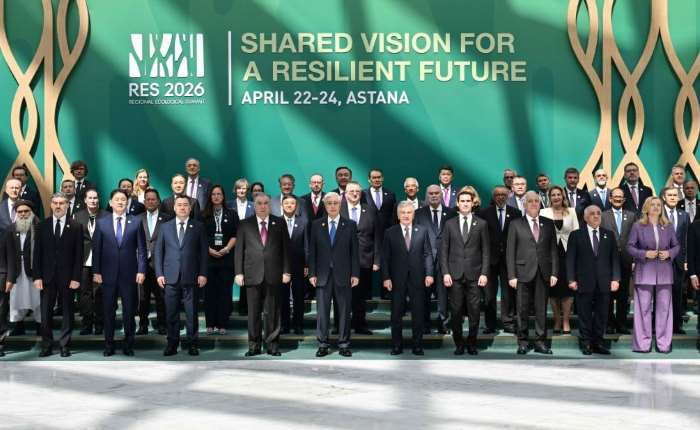
The (RES 2026) has convene heads of states from Kyrgyzstan, Tajikistan, Turkmenistan, Uzbekistan, Mongolia and Armenia, senior policymakers, international organisations, financial institutions, and experts to advance coordinated responses to environmental and climate challenges in Central Asia.
Among the participants are Mr. Sadyr Japarov, President of the Kyrgyz Republic, Mr. Shavkat Mirziyoyev, President of Uzbekistan, Mr. Emomali Rahmon, President of Tajikistan, Mr. Serdar Berdimuhamedov, President of Turkmenistan, Mr. Vahagn Khachaturyan, President of Armenia, Mr. Ukhnaagiin Khurelsukh, President of Mongolia, Mr. Mikheil Kavelashvili, President of Georgia, Mr. Ali Asadov, Prime Minister of Azerbaijan, Mr. Li Junhua, Under-Secretary-General for Economic and Social Affairs of the United Nations, Ms. Inger Andersen, Under-Secretary-General of the United Nations and Executive Director of the United Nations Environment Programme, and Ms. Tatiana Molcean, Executive Secretary of the United Nations Economic Commission for Europe.
Hosted by the Government of Kazakhstan in partnership with the United Nations and international stakeholders, the Summit is designed as a high-level platform for aligning regional priorities, strengthening cooperation, and promoting practical solutions across interconnected systems of water, energy, land, and food.
By bringing together political leadership, technical expertise, and financing partners, the Summit will focus on translating shared challenges into coordinated policies, targeted investments, and scalable cross-border initiatives.
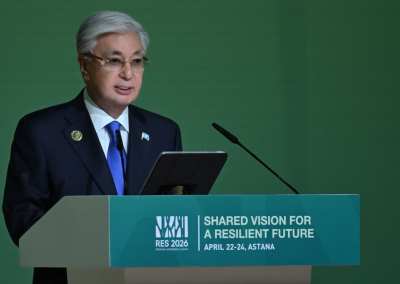 Welcoming the heads of delegations and participants of the Summit, the President emphasized the importance of this dialogue platform.He said, today, on Earth Day, we have gathered in Astana to once again reaffirm our shared responsibility to protect our planet.
This means that the countries of our region clearly recognize the relevance and exceptional importance of forming a common vision for a sustainable future.
Modern ecology is not limited to climate issues alone. It is the foundation of human existence.It concerns clean air and safe water, healthy soil and reliable food systems, the stability of communities and the well-being of future generations. It also relates to clarity of mind, social harmony and human happiness.
In this broader sense, ecology is a way of life based on a responsible attitude towards our common planet.Therefore, today’s Summit is both timely and necessary,” noted H.E. Mr. Kassym-Jomart Tokayev.
Mr. Kassym-Jomart Tokayev: “The UN Charter cannot be used as a menu from which only what is liked is selected”
“We have gathered here at a time of growing uncertainty and unpredictability.There is no need to elaborate on how deeply and negatively these factors affect global and regional stability, as well as the quality of life of millions of people.They undermine development efforts and divert resources away from addressing urgent environmental challenges.
In this context, the role of the international community becomes especially significant.
The United Nations, established eighty years ago, remains indispensable as the only universal platform for dialogue.However, since then, the world has undergone radical and profound changes. Artificial intelligence has taken a dominant place in people’s consciousness and daily lives worldwide.
Much is said about the inviolability of the UN Charter, which remains the cornerstone of international law. However, the UN Charter is not haute cuisine, and it cannot be used as a menu from which one selects only what they like.On the contrary, the UN Charter must be accepted and perceived as a single, comprehensive document in its entirety.
The Head of State: “The global transition to greener models must be fair, balanced and motivating”
“In my view, a selective approach is also unacceptable in environmental matters.
In many cases, the environmental agenda is shaped without proper consideration of the development needs of various regions and countries, particularly developing ones that are still strengthening their economic potential.
Meanwhile, developed countries have achieved their current environmental standards through a long process of industrialization.Therefore, the global transition to greener models must be fair, balanced and motivating.Our common approach should be well-founded, pragmatic and carefully thought through, so that countries can move forward based on the principles of sustainable development without jeopardizing their prospects for economic growth and progress.
Environmental cooperation must serve as a reliable instrument of unity and must not divide us.It should be based on partnership, trust and shared responsibility – without public condemnation, reproach or accusations.As partners, we must act pragmatically and responsibly in the interests of peace and sustainable development.”
The President: “Nature can exist without geopolitics, whereas geopolitics cannot exist without nature”
“Our countries share common ecosystems. We are united by rivers, landscapes and climate risks. Most importantly, we share responsibility.
Central Asia and neighboring regions face common environmental challenges, including:water scarcity and inefficient water management;desertification;glacier melting;air pollution;vulnerability of biodiversity.
I deliberately list all these major issues and challenges because I firmly believe that only through joint efforts can we achieve positive results.The time for reporting achievements has passed – now is the time to make decisions.”
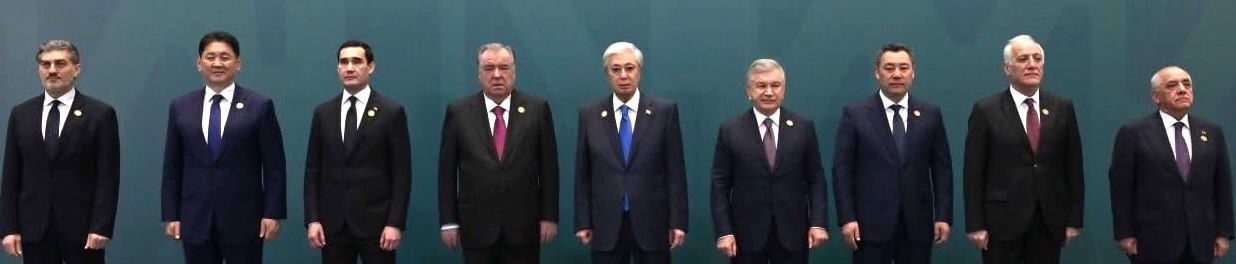 Mr. Kassym-Jomart Tokayev: “Kazakhstan pays special attention to environmental responsibility at the highest legislative level”
“Our Constitution clearly defines environmental protection as one of the fundamental principles of state policy and civic responsibility.It confirms that environmental security and prosperity are not merely technical issues. They are true values that must become an integral part of our national identity and long-term development strategies.
Kazakhstan is implementing measures aimed at:transitioning to cleaner energy;protecting biodiversity;restoring degraded lands;modernizing water management systems;promoting water-saving policies;and strengthening regional environmental cooperation.
We recognize that no country can succeed alone, therefore emphasis must be placed on joint efforts at regional and global levels.We are advancing this agenda through practical actions, the introduction of new technologies and long-term investments in resilience.”
Kazakhstan plans to increase the share of renewable energy to 15% by 2030 and reduce emissions from major energy facilities by nearly 35%
“A fair and equitable energy transition is a key priority.Currently, renewable energy accounts for more than 7% of Kazakhstan’s total electricity generation. It is expected to exceed 15% by 2030.While remaining a major producer of oil and gas, our country is committed to sustainable energy goals.
As one of the world’s leading exporters of uranium, accounting for about 40% of global supply, Kazakhstan also supports the development of carbon-free energy.We are currently developing a project to build our first nuclear power plant and modernizing coal-fired plants using clean coal technologies.As a result, emissions from major energy facilities are expected to decrease by nearly 35%.”
The President: “The Aral Sea still reminds us of the consequences of misguided policies”
“Water security is of critical importance for Kazakhstan and Central Asia as a whole.
Our future depends on rational and equitable management of this vital resource.
The Aral Sea remains a stark reminder of the consequences of misguided policies, as well as what can be achieved through decisive, science-based actions.
To date, we have restored about 36% of the Northern Aral Sea, improving water quality, increasing fish stocks and raising living standards.During today’s high-level meeting of the International Fund for Saving the Aral Sea, Kazakhstan will conclude its three-year chairmanship of the organization.”
Mr. Kassym-Jomart Tokayev called on all international stakeholders to support efforts to preserve the Caspian Sea
“Another area of concern for our country is the Caspian Sea.Its protection is essential for maintaining ecological balance, biodiversity and sustainable regional development.
Kazakhstan has initiated an interstate program to prevent further degradation of the Caspian Sea and established a Research Institute for its study.
We call on all international stakeholders to support efforts to preserve this unique natural asset.Any use of armed force in the Caspian region must be excluded.”
The first round of consultations on the establishment of the International Water Organization will be held within the Summit
“In addition to regional efforts, global cooperation in water resources remains a key priority.Last December in Ashgabat, I proposed establishing an International Water Organization as a UN agency.This initiative is particularly relevant as the UN is currently reviewing thousands of mandates, creating opportunities to enhance global governance.
I am pleased to note that the first round of consultations will take place within the framework of this Summit.”
The President shared Kazakhstan’s experience in biodiversity conservation
“Biodiversity conservation remains a key area of our environmental policy.Efforts have yielded tangible results: the saiga population has been restored, and the number of snow leopards has more than doubled to around 190 individuals.Together with international partners, we are working on reintroducing and restoring populations of rare species, including falcons, the Turanian tiger and Przewalski’s horse.Large-scale reforestation is also a priority.
Over the past five years, more than 1.5 billion trees have been planted across more than one million hectares.Kazakhstan invites partners to join the International Fund for the Conservation of Rare Species and Biodiversity.”
The Head of State: “This Summit reminds us that protecting our planet is a shared responsibility of all humanity”
“This concerns the future of all people, especially the younger generation.
It is not only an environmental task, but also a moral duty, an economic necessity and a strategic priority for peace and stability.
Our shared vision of a sustainable future should be based on:responsibility to our citizens and future generations;cooperation beyond borders and sectors;fairness in access to resources, technologies and opportunities;practical actions delivering tangible results;solidarity among countries regardless of size or level of development.
The adoption of the Astana Declaration on Environmental Solidarity in Central Asia and other agreements reached at the Summit reflect our commitment to these principles.