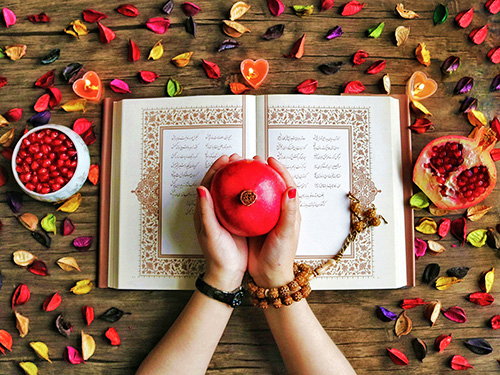
Yaldā is an ancient celebration whereby the brilliance of the sun along with the warmth of life are cherished. This event coincides with an increase in day-length in the region. The winter solstice in the Northern Hemisphere corresponds to Dey 1st (December 22nd) in the Iranian calendar. All people from Iran celebrate this ritual festivity.
However, those Iranians who, due to a variety of reasons have to live far away from their homelands, also uphold “Yaldā/Chelle” based on their homeland calendars, exactly as it is practiced by their own family members and indigenous individuals back home.
In public belief, the night of the last day of the Persian calendar month of Azar – this year it falls on December 21st – harbors the eventual victory of light over darkness. After Yaldā, the days will grow longer and the nights will fall shorter. As per tradition, Iranian families get together in the houses of their elderly relatives, most often grandfathers and grandmothers, and spend the better part of the night socializing and feasting on the occasion’s special delicacies.
ORIGINS: WHERE DOES YALDA COME
“Yaldā Night or Shab-e-Chella”, practiced in Iran and Afghanistan, and the musical instrument “Oud” have been inscribed on the UNESCO Representative List of the Intangible Cultural Heritage of Humanity. Yaldā Night or Shab-e-Chella refers to a traditional celebration of the sun and the warmth of life.
The event takes place on the last night of autumn when families gather at the houses of elders and sit around a table adorned with a series of symbolic objects and foods: a lamp to symbolize light, water to represent cleanliness, and red fruits such as pomegranates, watermelons, beetroots, jujube, and grapes to symbolize warmth.
Broth, sweets, dried fruits, and nuts that are used specifically for the occasion are also set on the table and consumed during the gathering. Activities range from reciting poetry and storytelling to playing games and music and giving gifts to new in-laws, brides, and children.
The event celebrates cultural identity, nature, respect for women, friendship, hospitality, cultural diversity, and peaceful coexistence. It is transmitted informally within families, although radio and television programs, publications, social media, and educational materials have also played an important role in transmitting the practice in recent years.
Events, conferences, training, workshops, and awareness-raising activities carried out by research centers, NGOs, cultural organizations and educational institutes have also had a significant impact on the proper transmission of the element to future generations.
What happens on Yaldā?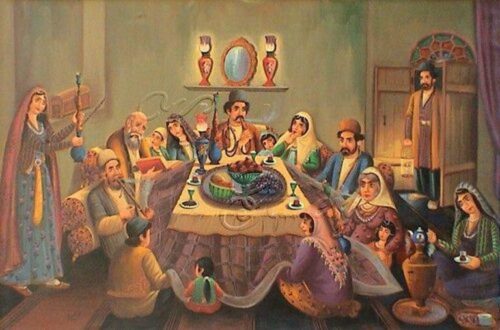 On the occasion of the last night of autumn, families get together. This family reunion often takes place at the houses of elders where people meet around a table called “Yaldā/Chelle Night Sofre”.
“Yaldā/Chelle Night Sofre” consists of a lamp that symbolizes light, water that represents cleanliness, red fruits such as pomegranates, watermelons, beetroots, jujube and red and green grapes that demonstrate warmth along with serving broth (Ash), sweets, dried fruits and nuts special to this occasion, all set on “Yaldā/Chelle Night Sofre” and consumed during the nightly gathering.
The Sofre usually comes in red and is traditionally spread on the floor or on Korsi/chairs. The red color used in various components of the Sofre refer to the reddish sky after the dusk and before the dawn. The type of activities in this celebration ranges from reciting poems, storytelling, reciting Hafiz’s poems or referring to them for pleasance omens, reciting verses from the epic poetic masterpiece of Shahnameh, listening to or playing music, singing and giving gifts to new in-laws/brides and children, indoor games and enjoying “Yaldā/Chelle Night Sofre” goodies and items.
Women play a key role in this ceremony. Children are also considered as the future bearers/practitioners of the element. The elders are valued as its bearers. While observing “Yaldā/Chelle” items such as cultural identity, attention to nature, and respect for women, friendship, hospitality, cultural diversity and peaceful coexistence are manifested and respected.
Historical backgrounds and resources
“Yaldā/Chelle” is regarded as one of the deeply-rooted and festive rituals amongst its bearers and practitioners in Iran, which depict many concepts, historical backgrounds and resources in view of its bearers and practitioners, most noticeable of which could be the following:
– Due to its nature-based characteristics, human creativity has been formed and diversified through centuries among generations.
– Respecting the diversity of expressions among communities, groups and individuals within its territory.
– Dominance of light over darkness symbolized by the rising of Sun on the day following Yaldā/Chelle, to defeat the devil (darkness).
– Yaldā/Chelle further reshapes mindset of local communities/groups and individuals in appreciating the beauty (positive aspect: Sun, light and warmth) hidden in a seemingly unpleasant condition (negative aspect: coldness of winter and darkness).
– Promoting a culture of peace, friendship, kindness and tolerance, fulfillment of promises and commitments are all celebrated in “Yaldā/Chelle” celebration.
– Solidarity in public participation in this celebration irrespective of gender, age, religion and ethnic differences.
– Promoting a culture of reading literatrary works and storytelling as well as listening to traditional music among the youth as executed by the elders.
– Paying more attention to shared rituals as ICH elements of the region, such as “Nowrouz” and Yaldā/Chelle would result in the establishment of mutual respect and peace amongst different ethnic groups, communities and individuals in the region.
– Paying attention to the spirit of the element, which enjoys abundance, light and warmth of life leads to more hope and increasing life expectancy amongst the bearers and practitioners.
– “Yaldā/Chelle” emphasizes on light, life expectancy and importance of fulfillment of commitments. These values are precisely in line with the Human Rights Declaration.
– “Yaldā/Chelle” accentuates on mutual respect among communities, groups and individuals, which will result in social justice, solidarity, equality.
– By strengthening the cultural foundations and solidarity among communities, groups and individuals, “Yaldā/Chelle” facilitates the sustainable development.
– The significant participation by women and the children alongside with their grandparents at Yaldā/Chelle ceremonies would create safe and healthy learning setting between generations to learn about their sustainable future.
– Thanks to creating cultural and ethnic solidarity, each with its own language, beliefs and customs, “Yaldā/Chelle” acts as a powerful tool to ensure respect for nature, cultural diversity, human rights, peace and sustainable development in Iran.
CUSTOMS AND TRADITIONS
Hafez-Khaani (reciting Hafez poems) on Yaldā
Shams Al-din Mohammad Hafez Shirazi is one of the most famous Iranian poets of the fourteenth century. He is highly valued and much loved by Iranians. Almost all Iranians keep a copy of Hafez’s book of poems called Divan at their homes. A significant book read on this occasion is the poetry book of Hafez, the celebrated Iranian poet of the 14th century AD. Usually, each family member makes a wish and randomly opens the book of Hafez and reads it aloud. That specific poem is known to express the interpretation of the wisher’s hopes and beliefs. This is believed to link the aesthetic side of this night to a more religious side, when people pray and hope for fruitful days in the coming winter.
Intense red color of pomegranates
Pomegranate is native to Iran and eastward up to north India. It is widely cultivated in most provinces of Iran, with different colors, sizes, and flavors. It is impressive to see the variety of pomegranates in the country. The ancient land is well-known for the quality of pomegranates and is the largest exporter of pomegranates in the world. When it comes to Persian literature, pomegranate (Anaar) is there bearing metaphor or symbol.
Some say pomegranates can be used to manifest a range of metaphors in Persian poetry due to its intense red color, round shape, and numerous seeds. Every autumn, many pomegranate growers in Iran hold festivals to thank God and celebrate the harvest season. Alongside the grape and the fig, the pomegranate has played an important role throughout the Orient since the earliest times.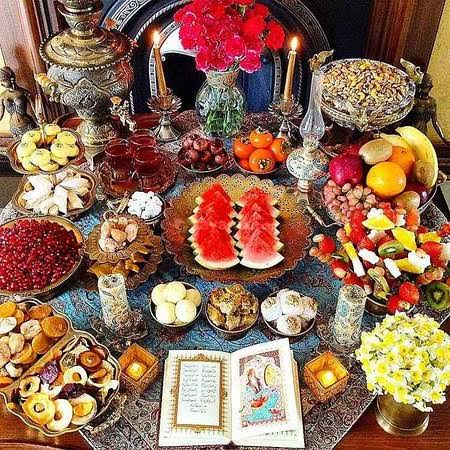
Ancient Iranians believed that the pomegranate was a sign of fertility due to its abundant seeds. It is a high pillar of festivities on Yaldā Night. Narratives say the presence of pomegranates symbolizes blessings for a new life. By tradition, Zoroastrians offer pomegranates to their daughters and sons when they get married, wishing them fertility. Moreover, they used to burn pomegranate sticks during religious rites.
Around 2000 BC, the Lur ethnic communities living in the west of Iran created amazing crafts which are known as Luristan bronzes today, and on some of the Luristan bronze objects, the pomegranate tree is recognizable. Also, the pomegranate is seen in some bas-relief carvings inside the UNESCO-designated Persepolis, which was once the ceremonial capital of the Achaemenid kings. Moreover, some Sassanid bas-reliefs depict pomegranates as a symbol of fertility and productivity.
The pomegranate has long been one of the essential ingredients for Persian cuisine to bring a kind of balance, taste, and flavor.
Yaldā and red; the color of the celebration
The dominant color of the night is red. It is not only the pomegranates or the watermelon, which are red; most of the guests are also wearing the color. Red is considered to be the color of the crimson hues of dawn and glow of life. And the celebration of Shabeh Chelle is the celebration of the victory of light over darkness. To magnify the importance of light, usually lots of candles and light decorations are used in houses and gardens on this night. In some places, the festival is held with fireworks.
Registration on UNESCO’s list of Intangible Cultural Heritage
According to the news by ECO Cultural Iran and Indian narrative, ‘Yalda/Chella’ has been added as the new inscription on UNESCO’s list of intangible cultural heritage by the suggestion of Iran and Afghanistan. Hopefully, this news adds another chapter to the age-old friendship between two ancient neighboring civilizations. The UNESCO fact sheet proudly characterizes this ancient event as a mirror of cultural identity, hospitality, peaceful coexistence friendship, and cultural diversity, highlighting its unique characteristics that have greatly and positively influenced the world’s culture.
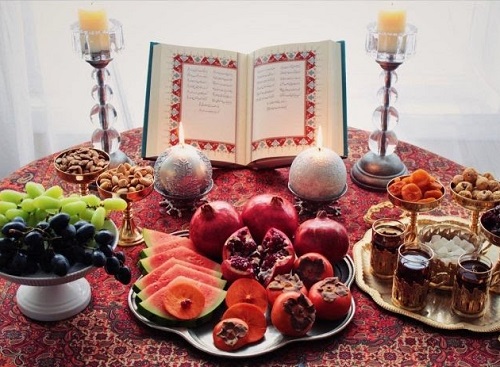 “Yalda Night” also known as “Shab-e- Chelleh,” observed in some countries specially in Iran and Afghanistan, goes on the United Nations Educational, Scientific and Cultural Organization (UNESCO) Representative List of the Intangible Cultural Heritage of Humanity.