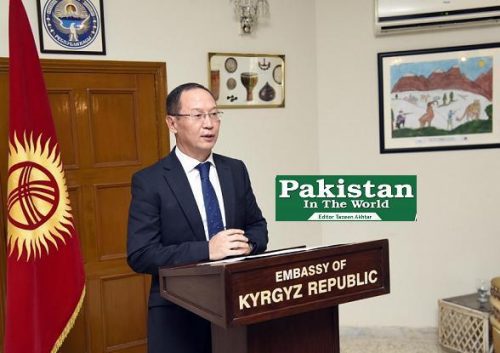
Erik Beishembiev/Ambassador of Republic of Kyrgyzstan to Pakistan
Kyrgyzstan is celebrating its 30th anniversary of Independence. Taking this opportunity let me share with you some thoughts about the historical path of my people on the way to independent state.
Although history of Kyrgyz nation dates back as early as IIIcentury B.C., when the name Kyrgyz was first mentioned in Chinese chronicles, our people passed through a long and difficult way to fulfil its dream and form its own modern state only after dissolution of Soviet Union.
On August 31, 1991, the Supreme Council of the Republic of Kyrgyzstan adopted a law on the “Declaration on State Independence of the Republic of Kyrgyzstan“.
Throughout our long history, we had periods of rising and falling, including the flourishing of the first Kyrgyz Khaganate – an ancient state in IX-X centuries, which covered vast territories from Siberia to Central Asia.
Historians distinguish five major periods of Kyrgyz statehood:
The initial stage covers period from III century b.c. till V century a.d., when Kyrgyz originally lived on the shores of the Lake Kyrgyz-Nor in Western Mongoliaand near Boro-Horo mountain range in Western China and later moved to the North to Yenisei river,which is located in Russian Siberia.
At that time, they looked different from present day Kyrgyz being initially predominantly blue eyed and red haired, but later mixed with other peoples of the Great Steppe and changed their appearance for black hair and dark eyes. Being a part of the Huns military confederation of nomadic tribes, they participated in many wars in Europe, including with Roman Empire and with China, which had to build the Great Wall to stop their movement further to its inner territory.
Second period lasted from VI to XVIII centuries a.d., during which Kyrgyz struggled for power with different Turkic and Mongolian states.
In VI-VIII centuries Kyrgyz were part of the Turkic Khaganate,which covered huge territory from Far East in Russia to the Black sea in Europe, but tried to establish their own state and fought several wars with Turks for independence. The ruler Barsbek was announced as Khagan of Kyrgyz.He exchanged letters with Chinese Emperor and sent his envoys to Beijing, Tibet and Central Asia, which resulted in a military alliance with China and Turgesh state from Central Asia against Turks.Finally, Kyrgyz army was defeated and Barsbek killed during fight.
In memory of the first Kyrgyz Khagan – Barsbek a stone stele was erected with inscription in old Kyrgyz runic letters about his achievements, which is preserved until present days. Barsbek is considered to be a national hero in Kyrgyzstan, his statue is established in Osh city and the National Bank of Kyrgyzstan issued a commemorative coin with his image.
At the beginning of IX century Turkish Khaganate was replaced by Uigur Khaganate and Kyrgyz again started war for independence, which lasted for 20 years and ended with victory for them. The first Kyrgyz Khaganate – an ancient state was formed, which covered vast territories from Siberia to Central Asia, and achieved great military and political as well as diplomatic successes by establishing alliance with China and relations with Tibet and Middle East.
This time saw the flourishing of the first Kyrgyz state, which was marked with introduction of its own system of governance, by rapid development of agriculture, crafts and metal melting for producing famous Kyrgyz weaponry, including for heavy armored cavalry, rise of culture and wide usage of runic writing.
Beginning from XI century Kyrgyz were defeated first by Kara – Kidan and later joined Chingiz Khan’s Mongol Empire.
Until XVI century Kyrgyz were part of Mogolistan in Central Asia under the rule of Chingiz Khan’s descendants, who later adopted Islam religion and Turkic language. In 1508 Kyrgyz leader Tagai Bii,who had also another name Muhammed Kyrgyz, was announced as Khan of Kyrgyz on the shores of the lake Issyk-Kul and started struggle for freedom. After several military victories, Muhammed Kyrgyz was finally defeated by Mogol rulers and sent to prison in Kashgar, where he died. Eventually ethnic Mongols were fully expelled from the territory of Mogolistan or assimilated with local Muslim people.
In late XVI until XVIII Kyrgyz resisted invasion of the last Mongolian state Dzungar Khanate.
Third period in the development of Kyrgyz statehood cover second half of XVIII century until creation of Soviet Union in 1917.
During thattime,Kokand Khanate state existed in Central Asia from 1709 till 1876, which covered parts of the territories of modern Kyrgyzstan, Uzbekistan, Tajikistan and Kazakhstan.
Northern Kyrgyz tribes sent embassies to Russian Tsar and joined Russian Empire in September 1855. After several wars Kokand Khanate was defeated by Russian troops and Kyrgyzstan became part of Russia.
The Russian period in the history of Kyrgyzstan resulted in the opening of first schools and starting of industrial production, development of culture and science, introduction of modern agricultural technology and other positive achievements.
At the same time colonial polices of Russian empire eventually led to the conflict with local Kyrgyz population and to national uprising in late 2016, which was suppressed by military troops and forced about 120 thousand Kyrgyz to escape from repressions to China.
When next year in November 2017 the Russian Empire collapsed and Soviet Union was established Kyrgyz started to return to their homes from China and positively perceived the new government.
During Soviet period on 14 October 1924 Kara-Kirgiz autonomous region was established within Russian Federation, which was transformed into Kirgiz Autonomous Soviet Socialist Republic and finally on 5 December 1936 it was withdrawn from Russian Federation and Kirgiz Soviet Socialist Republic was created. These acts laid foundation for the future independent Kyrgyz state.
Wide scale reforms in Kyrgyz Soviet Socialist Republic brought to full elimination of illiteracy, development of modern industry and agriculture, science and higher education, flourishing of national culture, literature, music and arts.
At the same time, the Soviet regime suppressed national and religious identity, restrictednational languages and traditions, attempting to create a new Soviet person.
1937-1938 were tragic years for the Kyrgyz people as 137 national leaders, including the first head of the Kyrgyz government Usup Abdrakmanov, Minister for education and poet Kasym Tynystanov, party leader and father of world famous writer Chyngyz Aitmatov, whose books are translated into to 176 languages and published in 128 countries, Torokul and others were arrested, executed and secretly buried. Nobody knew about their destiny until mass graving was found near Bishkek only in 1990.
Following its independenceon 31 August 1991, Kyrgyzstan survived two revolutions due to the authoritarian rule of the former Presidents Askar Akaev in 2005 and Kurmanbek Bakiev in 2010. Both of them fled the country after mass uprisings.
During 2010 revolution 84 people died from bullets fired by security forces and many were injured.
On the place of the mass grave of the 137 Kyrgyz first political leaders the National Ata-Beyit historical and memorial complex was built, where famous Kyrgyz writer Chyngyz Aitmatov and heroes of the 2010 revolution are also buried.
Today Kyrgyzstan is steadily and peacefully developing on the way of democracy and freedom. We always remember our historical leaders Barsbek Kagan,Muhammed Kyrgyz Khan, Usup Abdrahmanov, Kasym Tynystanov, great writer Chyngyz Aitmatov and his father Torokul, heroes of the 2010 revolution and all others, who contributed to the freedom and independence of Kyrgyzstan.
(Read on 24 June 2021 @ the launch of Marina Kabanova’s book “The Kyrgyz by Embassy of Kyrgyz Republic to Islamabad)
“The Kyrgyz” – Book on the History of Origin of the Nation Launched by Embassy in Islamabad