2022 Nord Stream gas leaks are likely to put a permanent end to both Russian projects

0
1064
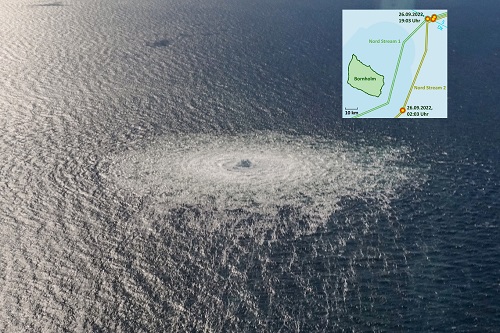
Islamabad: Monitoring Desk – The 2022 Nord Stream gas leaks were a series of explosions and subsequent gas leaks that occurred on the Nord Stream 1 and Nord Stream 2 natural gas pipelines on 26 September 2022. Both pipeline pairs were built to transport natural gas from Russia to Germany through the Baltic Sea, and are majority owned by the Russian majority state-owned gas company, Gazprom. Prior to the leaks, the pipelines had not been operating due to disputes between Russia and the European Union in the wake of the invasion of Ukraine but were filled with natural gas.

The leaks are located in international waters (not part of any nation’s territorial sea), but within the economic zones of Denmark and Sweden. Danish Prime Minister Mette Frederiksen said that the leaks were caused by deliberate action, not accidents, and specified that explosions had been recorded. Sweden’s Prime Minister Magdalena Andersson said that it likely was sabotage.
On 29 September, Kremlin spokesman Dmitry Peskov dismissed accusations of Russian sabotage as “predictable, stupid and absurd”, and Russian President Vladimir Putin called the emergency at Nord Stream “an unprecedented act of international terrorism”.
The Geological Survey of Denmark said that a seismograph on Bornholm showed two spikes on 26 September: the first at 02:03 local time (CEST) had a magnitude of 2.3 and the second at 19:03 had a magnitude of 2.1. Similar data was provided by a seismograph at Stevns, and by several seismographs in Germany, Sweden (as far away as the station in Kalix), Finland and Norway. The seismic data was characteristic of underwater explosions, not natural events, and showed that they happened near the locations where the leaks were later discovered.
On 1 October, the Danish Energy Agency reported that one of the two pipelines, Nord Stream 2, appeared to have stopped leaking gas as the pressure inside the pipe had stabilized. The following day, the same agency reported that the pressure had stabilized in both Nord Stream 1 pipelines as well, indicating that the leakage had stopped. In contrast, Swedish authorities reported on 2 October that gas continues to escape from the two leaks in their economic zone, albeit to a lesser extent than a few days ago.
According to engineers, possible methods for the repair of the pipeline include full-scale replacement of pipe segments, or clamping of damaged sections. If carried out, repairs are expected to last several months.
The day after the leaks occurred, the Swedish Police Authority opened an investigation of the incident, calling it “major sabotage”. The investigation is conducted in cooperation with other relevant authorities as well as the Swedish Security Service. A similar investigation was opened in Denmark. The two nations were in close contact, and had also been in contact with other countries in the Baltic region and NATO.
On 27 September 2022, European gas prices jumped 12 percent after news spread of the damaged pipelines, despite the fact that Nord Stream 1 had not delivered gas since August and Nord Stream 2 had never gone into service.
The Danish energy minister said that the gas leaks were likely to continue for at least a week. According to Swedish authorities, it will likely take one to two weeks before the leaks have stopped and the pipelines can be inspected safely. Nord Stream AG, the operator of Nord Stream, said on 27 September that it was impossible to estimate when the infrastructure would be repaired.
Unless rapidly repaired, German authorities stated that the three damaged lines (both lines in Nord Stream 1 and line A in Nord Stream 2) are unlikely to ever become operational again due to corrosion caused by sea water. The Washington Post reported that the incidents are likely to put a permanent end to both Nord Stream projects.
President of European Commission, Ursula von der Leyen, wrote on Twitter that “Any deliberate disruption of active European energy infrastructure is unacceptable & will lead to the strongest possible response.” After the leaks, Norwegian authorities increased the security around their gas and oil infrastructure.

LEAVE A REPLY

Please enter your comment!
Please enter your name here