On October 26, 2023, a local court in Qatar sent shockwaves through the international community by sentencing eight former Indian Navy personnel to death. These individuals, all employees of Dahra Engineering & Security Services Limited Liability Company, were found guilty of allegedly spying on a submarine program on behalf of Israel. The espionage case, which had been shrouded in secrecy, took a sudden and dramatic turn as the Qatari court delivered its verdict.
The convicted men, identified as Captain Navtej Singh Gill, Captain Birendra Kumar Verma, Captain Saurabh Vasisht, Commander Amit Nagpal, Commander Purnendu Tiwari, Commander Sugunakar Pakala, Commander Sanjeev Gupta, and Sailor Ragesh Gopakumar, had been working for Dahra Global Technologies and Consultancy Services, a private firm providing training and other services for Qatar’s armed forces. The charges brought against these Indian nationals were never made public by Qatari authorities, adding a layer of mystery to the case.
This is not the first time that the Indian deep state has deployed its intelligence assets as Naval officers, the hate, and crimes against humanity by Commander Kulbhushan Jadhav still has scars on the innocent people of Pakistan, especially the victims of the terrorist activities carried by RAW against the families of the martyred. Commander Jhadav had admitted before the court that he worked for the Indian intelligence agency Research and Analysis Wing (RAW).
He was involved in several clandestine activities to create instability in Karachi and Balochistan areas. During the trial, he was provided the services of a defending officer, as per law. Commander Jadhav was convicted for espionage, anti-state activities, his role in terror incidents, and sabotage in the country. He used his mission name as Mubarak Hussein Patel. Jadhav was taken into custody by Pakistani agencies in March 2016 from Balochistan.
The verdict from the local court in Qatar has sent shockwaves across international diplomatic circles. The Indian government has expressed its shock and dismay at the judgment, pledging to provide all necessary consular and legal assistance to the convicted individuals.
Deepak Mittal, former Indian Ambassador to Doha, met the detainees thrice during their detention by the authorities. India’s ambassador to Qatar visited the incarcerated men on October 1 after being granted consular access. Furthermore, the Chief Executive of Dahra Global made a trip to Doha, Qatar’s capital, in an attempt to secure the release of the imprisoned former naval officers.
Ambassador Mittal was already facing relationship constraints due to earlier incidents in June 2022, when the Ministry of Foreign Affairs of Qatar summoned him, and handed him the official note, expressing the disappointment of the State of Qatar and its total rejection and condemnation to the controversial remarks made by an official in the ruling party in India against Prophet Mohammed (may blessings and peace be upon him), Islam and Muslims. Qatar reaffirmed that the insulting remakes would lead to incitement of religious hatred, and offend more than two billion Muslims around the world. The government of Qatar showed serious displeasure and emphasized that the actions of the BJP leadership indicate the clear ignorance of the pivotal role that Islam has played in the development of civilizations around the world, including in India.
However, what makes this case even more intriguing is the curious connection of Mohammed Khamis Al-Ajmi, the CEO of Dahra Global Technologies, a leading US Department of Defense’s cybersecurity contractor, with the Oman Computer Emergency Response Team (CERT). The company, Al Dahara is owned by the Omani national, Khamis al-Ajmi, a retired squadron leader of the Royal Oman Air Force. This man too, was arrested along with the eight Indians, but he was released in November 2022.
The CEO, who simultaneously holds the position of Head of Digital Forensics at Oman CERT, has an extensive background in digital forensics and cybersecurity. This connection between a high-ranking executive of a private cybersecurity company and a government-operated CERT agency raises questions about potential conflicts of interest, transparency, and the safeguarding of classified information.
Mohammed Khamis Al-Ajmi is not your typical CEO. Beyond his executive responsibilities, he has a rich and diverse background that demonstrates his passion for digital forensics and cybersecurity. He stands out as a highly qualified individual with an extensive track record in this specialized domain. One of the striking aspects of Al-Ajmi’s career is his literary contribution. He has authored two books in Arabic, shedding light on critical subjects in the realm of IT and cybersecurity. These books, “شرح عملي باللغة العربية – Servers Microsoft To Guide 1-” and “The 7 Element of Digital Citizenship – في السبعة المحاور المواطنة الرقمية,” underline his sphere of influence in the digital and cyber security in the Arab world.
Charges were also framed against the Omani national Mohammad Khamis al-Ajmi, the CEO of Dahra Global. Al-Ajmi was kept in solitary confinement for a period of two months starting in October 2022 until he was granted bail. And an Omani national, who had also been detained, was released just before the beginning of the FIFA Football World Cup.
Media reports have shed some light on the activities of Dahra Global Technologies and Consultancy Services. The company was allegedly advising Qatar on a program aimed at obtaining high-tech Italian-made submarines with the capability to evade radar detection. Despite its significant role in this endeavor, Dahra Global was abruptly shut down in May 2023. Notably, the company had employed a substantial workforce, with as many as 75 Indian nationals, many of them former Navy personnel.
Al Dahra employees are deployed in various locations across the world. The highest number of employees, 8, were stationed in Qatar, primarily in the capital city of Doha, an additional 6 were spread across Qatar. Oman is another significant deployment location with 5 employees, 3 of whom are in Muscat. In India, there are 3 employees, with 1 each located in Hyderabad, Telangana, and Andhra Pradesh. Additionally, 3 employees are based in Masqat, Oman, while 2 employees are situated in Provence-Alpes-Côte d’Azur, France, and 2 more in other parts of France. Furthermore, there is a single Dahra employee in Ankara, Turkey, Salon-de-Provence, and Toulon, with another additional one each in Turkey and Telangana, India. This wide geographic distribution underscores Dahra’s global presence.
The company Al Dhara Engineering and Consulting has a web of sister companies across the GCC, US and other parts of the world, managed and led by multiple nationalities, however by majority of them having Indian origin or affiliations. The companies provide a diverse set of services, including recruitment, logistics, cybersecurity, business intelligence, defense and security solutions and a lucrative indenting business with the US Department of Defense.
The Indian Naval (veteran) officers spying case dates back to August 2022 when Qatari authorities took the former Indian naval officers into custody. For months, the nature of the charges remained undisclosed. However, the veil of secrecy was lifted when Qatari authorities revealed that these eight individuals had been involved in spying on Qatar’s classified submarine program for the benefit of Israel. Qatari officials have claimed to possess electronic evidence supporting these allegations.
The Indian government has vigorously pursued the release of its citizens but has faced resistance from Qatari authorities, who maintain that the evidence supports the claim that the former officers had passed on sensitive intelligence to Israel. The Ministry of External Affairs of India has stated that it was deeply shocked by the verdict and vowed to take up the issue with Qatari authorities, urging a reconsideration of the sentence.
The death sentences handed to the eight ex-Indian Navy officers for espionage in Qatar have sent shockwaves throughout the diplomatic and international community. The opaque nature of the charges, combined with the international implications of the case, underlines the complexities surrounding this issue. It underscores the need for transparent legal processes and the safeguarding of the rights and well-being of foreign nationals in other countries. The connection between the CEO of Dahra and Oman CERT, along with Dahra’s role as a leading US Department of Defense contractor, adds an additional layer of intrigue to this already complex case.
Dahra Global Technologies and Consultancy Services, also known as Dahra, presents itself as a highly specialized provider of support solutions in various sectors, including aerospace, security, defense, information technology, and communications. While the company highlights its certifications and memberships in organizations such as ISO 9001:2008, TRACE (Transparency International), and Aviation Supply Association (ASA), recent events have cast suspicion on its operations and activities. The eight Indian Navy officers, with distinguished service records, are facing the death penalty in Qatar, and their association with Dahra raises questions about the nature of their work and the circumstances of their arrest.
Dahra Global Technologies and Consultancy Services, now referred to as Dahra Global, is a company that specializes in providing training, logistics, and maintenance services to the Qatari Emiri Naval Force (QENF). While the company’s old website indicated its association with the QENF, its new website no longer mentions this connection, nor does it reference the involvement of the eight former Indian Navy officers who held leadership roles within the company.
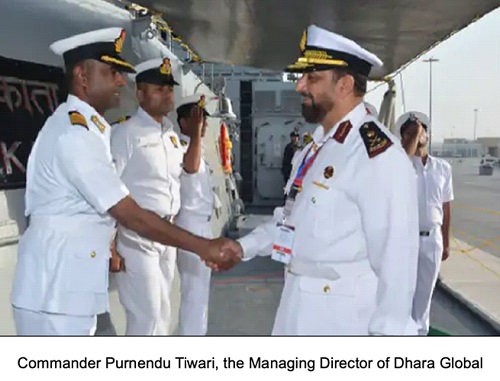
Notably, Commander Purnendu Tiwari, who was the Managing Director of Dahra Global, received the Pravasi Bharatiya Samman in 2019 for his role in strengthening the bilateral relationship between India and Qatar. This recognition reflects the company’s history of being endorsed by Indian officials for its contributions to fostering good relations between the two countries.
The Indian Navy veterans were arrested in August 2022 by the Qatari State Security Bureau, the country’s intelligence agency. The details of the charges against them were not disclosed due to security reasons, which led to various speculation about the nature of their detention.
The case presents a significant diplomatic challenge for the Indian government. India and Qatar have historically maintained friendly relations, with deep economic and defense ties. However, recent events, including the controversial remarks made by a BJP spokesperson and the arrest and sentencing of the retired Indian Navy officers, have strained this relationship.
This is not the first time that India has used its Naval officers for espionage services. Although, espionage is a shadowy world where governments and intelligence agencies deploy covert operatives to gather information for national security or strategic purposes. India has been exposed multiple times for its military and especially Navy been linked to espionage activities. The historical cases where Indian naval officers were allegedly involved in espionage sheds the light on the national insecurities surrounding the complexities India creates with its friends and foes.
The Rustom Case:
One of the most well-known cases of espionage involving an Indian naval officer is the Rustom Case. In the 1980s, Commander Rustom Pavri, an Indian Navy officer, was arrested and accused of spying for the United States. Pavri was charged with leaking sensitive information to the Central Intelligence Agency (CIA) during his posting at the Indian Embassy in Washington, D.C.
Pavri’s trial and conviction sparked a diplomatic row between India and the United States. India accused the U.S. of using its diplomatic immunity to shelter a spy. The case strained bilateral relations, raising questions about the extent of espionage activities within the Indian military and its consequences on international partnerships.
Commander Kulbhushan Jadhav:
The case of Commander Kulbhushan Jadhav, a former Indian naval officer, further highlights the Indian naval officers being involved in espionage. Jadhav was arrested by Pakistani authorities in 2016 and accused of espionage and terrorism activities in Balochistan, Pakistan. While India told the world that Jadhav was a retired naval officer with no official ties to the Indian government, Pakistan has provided documentary evidence and dossiers that prove he is a serving Indian Navy officer.
The Jadhav case became an international flashpoint, with India accusing Pakistan of a sham trial, while Pakistan alleged that Jadhav was involved in subversive activities. Pakistan has provided consular access along with family visitations on humanitarian grounds. This case underscores the complexities of espionage accusations and their impact on diplomatic relations.
The Submarine Data Leak:
In 2016, a major espionage scandal emerged involving the Scorpene-class submarines being built in India. Classified data related to the submarines was leaked, raising concerns about the compromise of national security. While the leak was not attributed to naval officers directly, it highlighted vulnerabilities in safeguarding sensitive defense information.
The cases mentioned above reflect the complex nature of espionage accusations. While some naval officers were convicted, others are facing interrogations. Espionage involvement of Indian naval officers are not uncommon in the annals of history. The Rustom Case, Commander Kulbhushan Jadhav’s terrorism activities, and the submarine data leak underscore the contentious and multifaceted nature of espionage realm of the Indian Naval officers.
The author is a global competitiveness, risk, and development expert. He leads Mishal Pakistan, the country partner institute of the Future Economic and Societies Platform at the World Economic Forum. He is a leading strategic communication specialist and an expert on Artificial Intelligence (AI) policy for technology, and governance. He is an Alumnus of the Harvard Kennedy School of Government on National and International Security. He can be reached at aj@mishal.com.pk and he tweets at @amirjahangir.

 Amir Jahangir