 Tazeen Akhtar
“Machines can not replace humans” was the sentence of essence for me in the whole discussion Academy of Letters Pakistan organized with famous novelist, dramatist and poet Jose Luis Peixoto from Portugal in which prominent writers of Pakistani languages participated.It was interesting as well as heartening to listen from an author who came from a continent where Machines were invented to bring industrial revolution in the World.
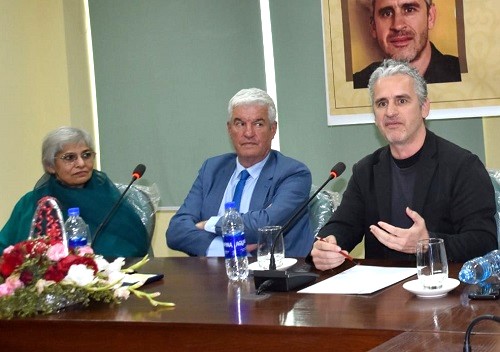
Ambassador of Portugal Mr. Frederico Silva specially participated in this meeting. It was really a great experience to listen to and share our ideas with an author of a language (Portuguese) that has its strong roots in all corners and continents of the World.
Ambassador highlighted the importance of Portuguese language and its similarities with Urdu language. Describing the recent meeting as the first brick in the field of academic literary cooperation between Pakistan and Portugal, he expressed his desire to develop relations between the two countries in the fields of science, literature and culture.
H.E Frederico Silva shared, ” Portuguese language is spoken all over the world. If we take south hemisphere, our language is the biggest here considering Brazil as the largest populated country in the South where Portuguese is official language. Other than that, Portuguese is spoken in Africa (Angola, Mozambique,West Africa Guinea Bissau). Portuguese is the official language in East Timor that was part on Indonesia formerly. Macao in China and Goa in India as well.”
Here it is worth mentioning that Portugal was first among the European nations to explore the world through navigation in the oceans. Portugal enjoy a rich history of 6 decades of navigation around the World. Therefore it is not astonishing how Portuguese language is found everywhere at the earth.
 Dr. Najiba Arif, Chair of Academy, welcomed the guests from Portugal and emphasized the importance of communication among the people of the world in the present era. She said that language and literature can be implemented at the global level for reconciliation, harmony and understanding of each other’s point of view.
Sultan Nasir, Director General, conducted the ceremony, while writer and translator Zafar Syed gave a brief introduction to Jose Luis Peixoto’s work.
Special Guest Mr. Jose Luis Peixoto shed light on his literary career from the early age of 21 to now when he is about to enter into his 50s but he has completed his Century of travels around the World. He answered the questions of the audience in the form of a dialogue. At the beginning of the conversation, he expressed his relationship with the great Portuguese writer Jose Saramago and told how he made his place in the world of literature.
Talking about translation, Mr. Jose Luis Piexoto said that all writers are at some level like translators, even if they are not adapting one language to another language, but they are adapting one situation to another.
He said that only one language is spoken in Portugal, but the diversity of languages in Pakistan is remarkable. He said that most writers in Portugal try to write in several genres instead of one only. He himself is in different genres like poetry, theater, music, media communication, magazines etc.
In response to a question, Mr. Jose Luis Peixoto said that a writer must be bold and self-confident. Similarly, a writer must have a clear justification for why a reader should drop all other commitments and spend time with his book. A writer must first believe in his writing.
In response to another question, he said that there is no black and white difference between truth and fiction, but there are many gray areas between them. He said that sometimes what we consider to be reality is based on fiction.He said that there is no such thing as “pure fiction” because the writer’s real experiences, events and memories continue to play a role in the moment of creation of the fiction.
Editor Pakistan in the World , Mr. Tazeen Akhtar asked questions about ;
1- What is the survival of writers in a world where people do not buy books. People buy shoes and clothes of thousands of rupees but do not buy a book worth few hundred rupees?
2- How a writer can earn his living when reader has everything on internet?
3- What is the future of translation when even highly placed people are using google translation and do not bother what the google has translated ?
4- In Pakistan, Journalists and Literary people remain in separate categories. Both are pen workers, writing always, but have nothing common among them. What is your take on this phenomenon?
Mr. Tazeen Akhtar also shared that literary people are sometimes disputed because they belong to different lobbies. They take shelter under the head of some big name and their grooming and promotion depends upon how they can make their group leader happy.
PORTUGUESE WRITER JOSÉ LUIS PEIXOTO IN PAKISTAN
In response, Mr. Jose Luis Peixoto said that journalism talks about the ever-changing situation, while literature talks about topics that do not change, as if freed from the constraints of time and place.
He said google internet can not be the substitute to book reading, for example if 100 thousand people are surfing on internet and only 100 are reading book, 100 are more relevant because they will be sharing the excerpts of the book, they will be referring the book to others etc.
Mr. Jose Luis Peixoto said wisdom and knowledge always have their value. Therefore the writers’ will survive in this modern age of internet and AI. He said that book readers have always been less in the world as compared to people active in other activities.
He concluded that machine can never be the alternative of human being. Google translation can not be standardized. Only a human being can transform a word in its true sense from one language to the other.
The guest writer from Portugal gifted his first book “You Died on Me”. A short story book that he authored in his early age and it is his first book. He has described his feelings about two phases of his life; 1 When his house was full with all 5 members on one table 2 When he was alone after the marriages of sisters, death of father.
The book is a translation from Portuguese to English by Robin Patterson and published in Pakistan. The authors name in Urdu can be seen on the title that is hopefully the beginning of connection between two big languages of the world. Academy can work upon more interactions and translations of literary work from both sides into both languages to further enhance the contacts both countries already had in history……………….
H.E Frederico Silva, Ambassador of Portugal ; Pakistan Can Overcome Current Crisis – Portugal Ready to Cooperate in Energy, Water & Other Sectors