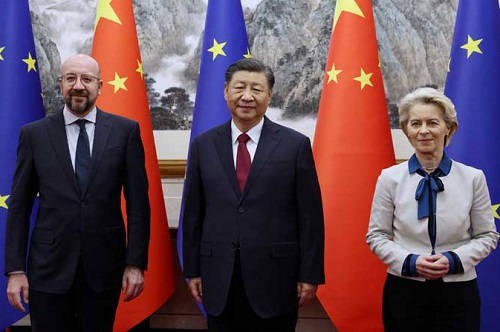
After the United States, China is the second largest trading partner of the EU for products. In 2023, mutual trade reached €739 billion. This signifies a 14% decrease in comparison to 2022. China is the third largest ally of the EU for exports, and the top for imports. The trade balance between the EU and China has been continuously in support of China. The EU lost €292 billion in 2023. In 2021, The EU totaled €223.6 billion exports to China and €515.9 billion imports from China, showing year-on-year decline of 3.1% and 18% sequentially.[3]
EU Exports to China
According to the UN’s COMTRADE DATA on global trade, the EU exports to China amounted $260.84 billion in 2021. The latest updates, historical trends, and statistics on EU exports to China were updated in March 2023. (Trading Economics, 2023a).
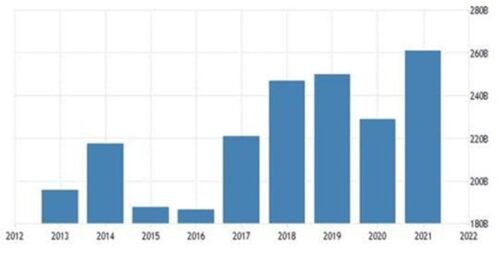 Figure 1: EU exports to China
Sources: (Trading Economic, 2023a).
Figure 1 shows the export levels from the EU to China from 2012 to 2021. This figure shows that the peak export levels were recorded in 2021, reaching $260 billion, while the lowest export levels were recorded in 2016, at just $180 billion. This shows important fluctuations in exports levels in the past years. This significant shift shows key Aspects like market access, economic conditions, and trade policies at that time. For instance, trade increased in 2021 could have been influenced by post-pandemic recovery and more demand for European goods in China. (Trading Economics, 2023a).
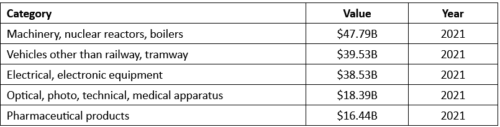
Table 1: Top 5 Products Exported by the EU to China (2021)
Sources: (Trading Economic, 2023a).
In 2021, the top 5 EU exports are shown in table 1, listed by their dollar value. Most of the EU exports fall into the first three types, like machinery, nuclear reactors, and boilers; vehicles, other than railways and tramways; and electrical and electronic equipment. It is important to remember that these positions and values could change on the country and the time period being considered.
EU’s Imports from China
According to the UN’s COMTRADE data, the EU imported goods from China worth $557.84 billion in 2021. In March 2023, the current update, historical graph, and statistics for EU imports from China were provided. (Trading Economics, 2023b).
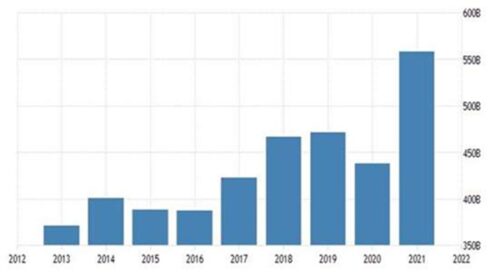 Figure 2: EU imports from China
Sources: (Trading Economic, 2023b).
Figure 2 shows the import levels from China to the EU from 2012 to 2021. In this figure, the top imports were recorded in 2021, and the lowest was in 2013. The import level surpassed $550 billion in 2021, which was the peak level of that year. The import level was recorded approximately $375 billion in 2013, which was extremely low for that year. It looks like the import level has been rising continuously. The constant increase in imports over time reflects China’s expanding influence as an important global producer, providing numerous products to Europe. Moreover, it seems that imports level were lower during the years 2013, 2015, and 2016. (Trading Economics, 2023, b).
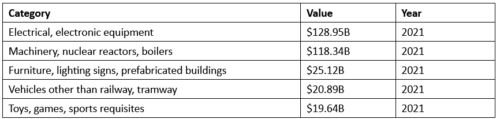 Table 2: Top 5 Products Imported by the EU from China (2021)
Sources: (Trading Economic, 2023, b).
In 2021, electrical and electronic instruments were the top EU imports from China, valued at $128.95 billion. Machinery like nuclear reactors and boilers was the second major import products valued at $118.34 billion. The third major import products was furniture, lighting signs, and prefabricated buildings, valued at $25.12 billion. Moreover, the EU imported vehicles valued at $20.89 billion and toys, games, and sports requisites worth $19.64 billion, signifying a strong market for Purchaser products from China. (Trading Economics, 2023, b).[4]
Opportunities
1. Trade and Investment
Even with some difficulties, trade between the EU and China continues to play a significant role in their economic relations. The Comprehensive Agreement on Investment (CAI) aims to improve investment opportunities by expanding market access, lowering hurdles, and ensuring equal opportunities for businesses on both sides. This agreement could enhance investment in major areas such as healthcare, automotive, and technology, capitalizing on China’s manufacturing capabilities and the EU’s innovation expertise. [5]
2. Green Economy and Sustainability
Both the EU and China are committed to promoting the green economy. The cooperation between the EU and China focuses on reducing carbon emissions, expanding green energy, and fostering sustainable practices. Initiatives involve shared research on carbon capture and green finance mechanisms to address global environmental challenges. Successful partnerships, such as Enel’s energy initiatives in China, highlight the potential of green technology collaborations. [6]
3. Technological and Digital Cooperation
The EU and China identify potential cooperation on new technologies including 5G, artificial intelligence (AI), and digital frameworks. By coordinating international standards and fostering digital governance, they can increase innovation and security. Collaborative projects in research and development have also been growing, particularly in sectors such as green energy and smart production, creating opportunities for technological integration. The cooperation between European Telecom firms and Huawei highlights the potential for technological integration, despite geopolitical challenges.[7]
Challenges
1. Market Access and Regulatory Barriers
European firms like Volkswagen and Siemens, have faced challenges with restricted market availability in China due to strict rules and control of state-owned enterprises. Even though China recently tried to open its market, EU businesses face problems like unclear rules, unfair treatment, and complicated regulations, especially in technology and finance.
2. Geopolitical and Security Concerns
Geopolitical aspects play a key role in forming the relations between the EU and China. The EU has raised its scrutiny of investment from China, especially in key industries such as essential infrastructure and technology. The increasing cooperation between China and Russia, especially in the context of Ukraine war, has increased the EU’s worries about the security consequences of stronger economic relations.[8]
3. Trade Imbalance and Subsidies
The EU has a significant trade loss with China, worsened by China’s state-subsidized sectors, especially in areas such as green technologies and electric vehicles. Chinese firms obtain a competitive advantage from these subsidies, causing the EU to start anti-subsidy investigations and consider protective trade actions. This imbalance not only pressures economic ties but also increases issues about equal competition. [9]
Recommendations
To enhance economic relations between the EU and China, both sides should emphasize expanding green technology projects, like green energy and electric vehicles, aligning with their mutual sustainable goals. Working together on digital technologies such as 5G, AI, and digital trade policies would also open innovation opportunities and help establish international standards. The EU could broaden its trade relations with ASEAN countries to decrease dependence on China, which is important in strengthening supply chain security. At the same time, resolving the trade imbalance by expanding market access and addressing issues like state subsidies, will develop equal opportunities. Regular conversation between the EU and China is important to managing challenges and maintaining a strong relationship.[10]
Conclusion
The EU and China economic relations present both key opportunities and challenges. The partnership shows opportunities in areas such as green technology and digital innovation, but regulatory barriers, trade imbalances, and geopolitical tensions pose key challenges. To strengthen their relationship, both parties must act quickly to align on sustainable growth, balance trade relations, and ensure fair competition. These measures will be essential for developing a strong and joint economic initiative that benefits both countries.
[1] ‘Economic Relations, Trade and Investment’. Delegation of the European Union to the People’s Republic of China, 12 Jan. 2023, https://www.eeas.europa.eu/
[2] Md. Sayedur Rahman, and Md. Tahosan Habib, EU-China Economic Relations in the Early 21st Century. Feb. 2024, file:///C:/Users/BT/Desktop/8.
[3] ‘EU Trade Relations with China. Facts, Figures and Latest Developments.’ European Commission , https://policy.trade.ec.
[4] Md. Sayedur Rahman, and Md. Tahosan Habib, EU-China Economic Relations in the Early 21st Century. Feb. 2024, file:///C:/Users/BT/Desktop/8.
[5] ‘EU Trade Relations with China. Facts, Figures and Latest Developments.’ European Commission , https://policy.trade.ec.
[6] ‘EU-CHINA COOPERATION ON GREEN RECOVERY AND GREEN STIMULUS’. European Union,https://climate.ec.
[7] ‘New Opportunities for China-EU Cooperation’.
[8] ‘Updating the EU Strategy on China: Co-Existence while Derisking through Partnerships’. Bruegel, https://www.bruegel.org/
[9] Treasurer, The Global. ‘How Are EU-China Trade Relations Evolving in 2024?’ The Global Treasurer, 23 May 2024, https://www.
[10] China-EU Economic, Trade, and Investment Cooperation: Status Quo, Issues, and Prospects China-CEE Institute. 3 Aug. 2024, https://china-cee.eu/2024/08/