 Middle East Monitoring Desk Islamabad
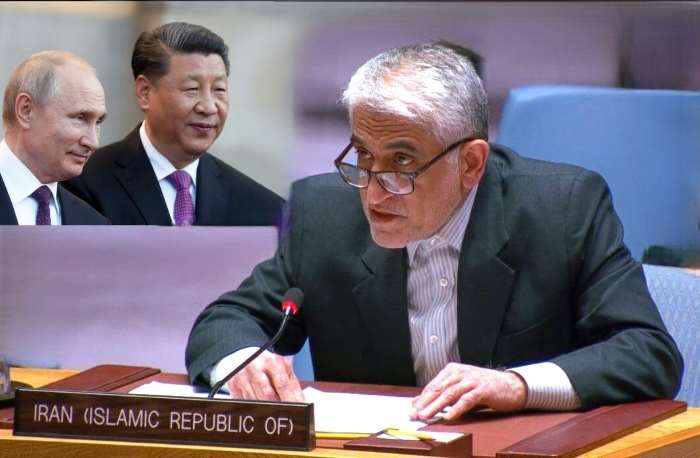
Iranian Ambassador and Permanent Representative to the United Nations in New York, Amir Saeid Iravani, has said Russia and China stood firmly on the right side of history by vetoing a Bahrain-backed Security Council draft resolution on the Strait of Hormuz, arguing their move prevented the Council from being used to legitimize aggression.
Russia and China have vetoed a United Nations Security Council (UNSC) resolution aimed at protecting commercial shipping in the Strait of Hormuz on 07 April. Russia and China said that the measure was biased against Iran.
The draft text, on which a vote was held on Tuesday, was proposed by Bahrain. Eleven of the 15 members of the UNSC voted in favour, Pakistan and Colombia abstained.
Pakistan is now the host of mediatory dialogue between the sides and Foreign Minister of Iran has appreciated the role of Pakistan for peace. Ambassador of Iran at UNSC spoke on 07 April when Pakistan abstained and therefore he did not mention about Pakistan anything.
The ambassador made the remark in a statement addressed to a Security Council meeting on Tuesday on the adoption of the resolution on the Strait of Hormuz.
The following is the full text of the statement:
The draft resolution put before the Council was flawed—factually, legally, and politically.
The draft is entirely one-sided, biased, and indefensible. It distorts the realities on the ground by falsely attributing responsibility to Iran—the victim of aggression—while deliberately ignoring the root causes of the current crisis.
The text unjustifiably and misleadingly portrays Iran’s lawful measures in the Strait of Hormuz, which have been taken in the exercise of its inherent right of self-defense in accordance with the UN Charter, as threats to international peace and security.
At the same time, the text seeks to legitimize subsequent unlawful actions by the aggressors and their allies under the pretext of safeguarding freedom of navigation and maritime safety in the Strait of Hormuz and the Persian Gulf.
Iran’s lawful actions cannot be viewed in isolation from the broader context of ongoing aggression against its territory and sovereignty. Attempts to portray them as threats to international peace and security are therefore legally unfounded and devoid of any credibility.
Amir Saeid Iravani said Mr. President, The objective of this draft is obvious: to punish the victim for defending its sovereignty and vital national interests in the Persian Gulf and the Strait of Hormuz, while providing political and legal cover for further unlawful acts by the aggressors.
Had this draft been adopted, it could have opened the door to dangerously broad and abusive interpretations that could be used to justify further uses of force and unlawful actions in clear violation of the UN Charter and international law.
It is deeply regrettable that neither Resolution 2817, nor this draft, nor the statements of certain Council members contain any reference to the initiators of the aggression, or their destabilizing conduct in the region, as well as the root causes of the current situation.
This clear omission reflects a persistent pattern of politicization and double standards within the Council. Let me be clear: this text would only embolden the United States and the Israeli regime to continue in their unlawful actions and atrocious crimes, while shielding them from accountability.
In substance, this was a United States draft—introduced under other names.
Today, the President of the United States, again, resorted to language that is not only deeply irresponsible but profoundly alarming, declaring that “the whole civilization will die tonight, never to be brought back.” Such rhetoric is unbecoming of any leader, let alone the head of a permanent member of this Council entrusted with the maintenance of international peace and security.
It is regrettable and alarming that, while in full view of international community the President of the United States shamelessly and brazenly issues threats to destroy all civilian infrastructure in Iran—including bridges, power plants, and energy facilities by setting a deadline—and openly reveals his intent to commit war crimes and crimes against humanity. Iran Ambassador’s remark ends here.
Under the resolution, affected states would have been asked to “coordinate efforts, defensive in nature, commensurate to the circumstances, to contribute to ensuring the safety and security of navigation across the Strait of Hormuz”.
Shipping through the narrow waterway, through which a fifth of global oil and gas shipments previously passed, has effectively come to a standstill after Tehran threatened to attack vessels in response to the war launched against Iran by the United States and Israel on February 28.
The blockade has sent fuel prices soaring across much of the world and led some countries, particularly in Asia, to introduce restrictions on consumption and ration supplies.
A deadline set by US President Donald Trump for Iran to reopen the water passage or else face even worse bombardment is set to expire later on Tuesday, after he repeatedly issued – and delayed – similar threats.
The US ambassador to the United Nations, Mike Waltz, condemned the Russian and Chinese vetoes, saying they marked “a new low”, as Iran’s shutting of the strait was preventing medical aid and supplies from reaching humanitarian crises in the Congo, Sudan and Gaza.
PAUSE FOR PEACE THANKS TO PAKISTAN | IRAN EXPRESSES GRATITUDE TO CIVIL MILITARY LEADERSHIP OF PK | TALKS IN ISLAMABAD PLANNED, SAYS IRAN SNSC