 Middle East Monitoring Desk Islamabad by Editor Tazeen Akhtar
 A blockade of the Strait of Hormuz, a crucial conduit for ~20% of global oil consumption severely restricts energy supplies, drives up global oil and shipping costs, and risks global recession or stagflation. The current US-led blockade has stranded tankers, triggered massive drops in regional trade, and causes estimated daily economic losses for Iran exceeding $400 million.
Over 20 million barrels of oil and significant LNG mostly from Qatar are blocked daily, disrupting global supply chains.Reduced supply is driving up oil prices (expected to raise WTI to ~$98/barrel) and accelerating inflation, potentially leading to global stagflation.
The situation has created a “competing blockade” scenario, with Iran using the waterway as a central pillar of its negotiations, insisting that any reopening is contingent on lifting Western maritime restrictions.
The United States has enforced a naval blockade targeting Iranian ports in the Strait of Hormuz, constituting a significant escalation in the ongoing 2026 U.S.-Iran war. This action is designed to stop maritime traffic entering or leaving Iranian ports. The U.S. Navy and CENTCOM are actively intercepting, boarding, and diverting ships traveling to/from Iranian ports. CENTCOM reports the blockade has “completely halted” economic trade going in and out of Iran by sea.
Iran has reported a “dual blockade,” where its energy exports are restricted, but has maintained that its oil exports continue via a “tolling” system for safe passage, which the US aims to stop. Iran has labeled the US blockade an “illegal act of war” and “piracy”. Iran has vowed that the Strait will remain closed to foreign shipping until the US blockade is lifted.
Iran is actively expanding its land routes to China and Turkey, utilizing rail and road corridors to bypass maritime blockades and enhance regional trade. Key routes include a direct rail link from China through Kazakhstan and Turkmenistan to Iran, and newly prioritized land routes via Pakistan (e.g., Karachi/Gwadar to Taftan/Gabd). These routes facilitate the transport of goods, including energy products, through a developing “East-West Corridor” connecting Central Asia, Iran, and Turkey.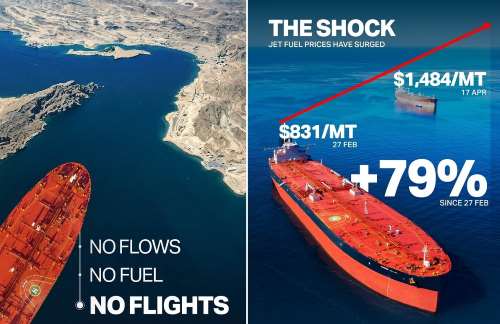
Shipping , Maritime Traffic Reduced
Maritime traffic is severely reduced, with increased insurance premiums and risks to sailors.Iran is facing severe trade disruption, with non-oil trade dropping significantly and potential to exhaust oil storage, forcing production cuts. The blockade disrupts the transport of fertilizers affecting agricultural output worldwide.
Global Impacts
The blockade directly impacts countries like China, which is the primary buyer of Iranian oil, creating tension in China-US relations. China, India and Asian countries as major buyers of Gulf oil (around 82% of exports), Asian economies face severe energy shocks and higher costs. Gulf nations,Kuwait, Iraq, Qatar, Bahrain, Oman, and the UAE face severe bottlenecks in exporting oil and gas.
Aviation, the most Severly affected Sector
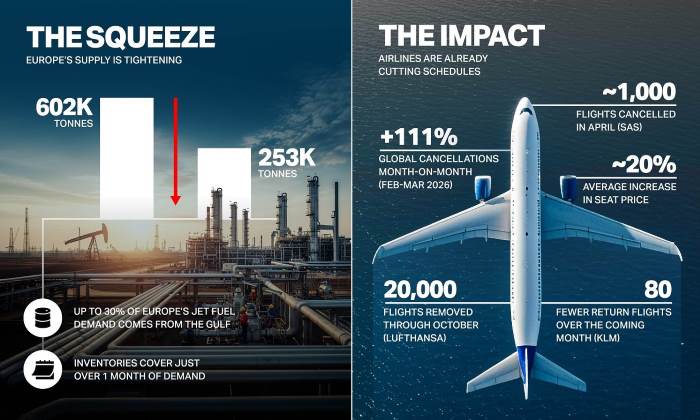
The closure of the Strait of Hormuz is moving through the aviation system fast, from rising jet fuel prices to tighter supply and growing disruption to flight schedules. At first, the system can absorb the pressure.But once inventories deplete, the consequences accelerate: flights are cut, aircraft are grounded and travel disruption spreads.
A blockade of the Strait of Hormuz causes immediate, severe damage to the global aviation industry, with daily impacts potentially exceeding $ 1 billion. The crisis forces significant flight cancellations, spikes jet fuel prices due to a 20% global oil supply disruption, and necessitates longer, costlier routes, particularly impacting European and Middle Eastern carriers.
1- The Gulf provides roughly one-fifth of global jet fuel exports. Blockade conditions have driven benchmark jet fuel prices in Europe to a record per ton, forcing airlines to cut flights and face massive cost increases.
2- Over 30,000 flights in West Asia have been cancelled, with losses exceeding billion. Airlines are forced to adopt extended routes across Central Asia or Africa, increasing flight times and operating expenses.
3- Middle Eastern airlines have been hit hardest, with flights operated by these carriers falling 50% year-on-year in March 2026. Bookings for major regional hubs have plummeted, with some reporting a drop.
4- The disruption affects global manufacturing supply chains that depend on air cargo for components. Furthermore, uncertainty over the duration of the blockade keeps energy markets strained, making planning for future fleet operations difficult.
The crisis is creating an unsustainable environment for airlines, leading to reduced bookings and profit warnings from major carriers like EasyJet and TUI. The high cost of fuel and capacity cuts threaten to drive smaller airlines toward bankruptcy.
Iran’s Position
Iran views the Hormuz as a key strategic asset and legitimate security domain, asserting control over it to combat US/Israeli “insecurity” and economic sanctions. Tehran has closed the Strait to ships from “hostile” nations, demanding an end to a US-led blockade on its ports, treating the waterway as a major bargaining chip in regional conflicts.
Iran’s Arguement
1- Iranian officials maintain that the security of the Strait is not free, asserting that if Iran’s oil exports are restricted, it will disrupt the security of transit for others.
2- Iran considers the waterway under its direct oversight, often utilizing the IRGC to block, check, or limit access to the maritime route.
3- In response to a US naval blockade on its ports, Iran has implemented a counter-blockade, closing the strait to Western vessels, though allowing some ships from other nations (e.g., China, Turkey) to pass.
4- Iran portrays the Strait as a symbol of its resistance against foreign pressure, using it to maximize economic pressure on world energy supplies until its conditions are met.
Senior Iranian officials have explicitly stated they will “never” cede control of the Strait, citing it as an inalienable right to ensure national security and regional dominance.
The US’ Position
President Trump has declared the blockade necessary to prevent Iran from selling oil, aimed at starving its energy industry and depriving the government of revenue. The strategy is described as a “reverse Uno card,” turning Iran’s own restrictions against them.
The U.S. has emphasized that it is not blockading the entire strait, but rather creating a “new passage” intended to allow ships not connected to Iran to pass freely.
The US’ Arguement
1- The blockade is a tool designed to force Iran to reach a “big deal” regarding its nuclear program and to secure the release of ships from Iran’s control.
2- The US view is that the blockade is a “reciprocal measure” against Iran’s own restrictions on shipping.
3- While enforcing a block on Iranian traffic, the US official position is that it wants the overall waterway open for neutral commercial shipping.
Trump has threatened that any Iranian ships attempting to break the blockade will be “eliminated”.
Conclusion
There is a noted gap between President Trump’s rhetoric of blocking “any and all ships” and the military’s more targeted, operational approach, leading to concerns about the blockade’s overall effectiveness and coherence. The U.S. recognizes the high risk of Iran creating a “deadly vortex” in retaliation, potentially causing a sharp spike in global oil prices and impacting American allies.
The blockade has caused significant volatility in global energy prices. This is not only about Iran and US, it is about more than half of the world and it should not be exploited by a third country from out of the region for her own designs and ambitions. It is about keeping global connectivity moving and industry working. Freedom of navigation must be restored immediately, fully and without conditions.