 Middle East Monitoring Desk Islamabad
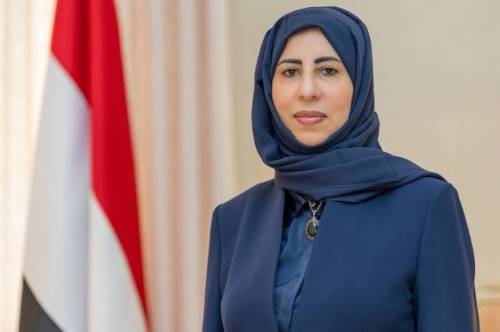
Dr. Afrah Al-Zouba, the Foreign Minister of Yemen’s internationally recognized government, has taken a firm, proactive stance on the Bab al-Mandab Strait, framing its protection as an issue of both Yemeni sovereignty and vital global security.
She has affirmed during her recent meetings with European Union representatives that enabling the legitimate state institutions to protect their coasts and territorial waters constitutes a fundamental pillar for the security of Bab al-Mandab, the Red Sea, and the safety of international navigation and trade.
She stressed that this vital passage must remain safe and open to global maritime traffic — and must never become a tool of extortion in the hands of an armed group operating outside state institutions — in a manner that serves the interests of all nations economically connected to it, including the friendly Islamic Republic of Pakistan, which shares a deep historical relationship with the Republic of Yemen.
Following escalated Houthi military actions and attacks on maritime infrastructure near the strait, Dr. Al-Zouba has actively used international diplomatic channels to highlight the strategic threats facing the region.
Her core positions and statements regarding Bab al-Mandab include:
Reclaiming State Sovereignty as a Security Prerequisite
Dr. Al-Zouba repeatedly stresses that the ultimate solution to securing international shipping routes is empowering legitimate Yemeni state institutions to protect the nation’s coastlines and territorial waters. She argues that international maritime safety cannot rely purely on foreign naval intervention; rather, upgrading the capabilities of the Yemeni Naval Forces and Coast Guard is essential to control smuggling networks and secure ports like the Port of Mokha.
Rejecting Maritime Chokepoints as Tools of Coercion
In her briefings with European Union representatives and other foreign dignitaries, Dr. Al-Zouba has warned that the Houthi militia is attempting to mirror Iran’s strategy of holding critical international shipping chokepoints hostage. She maintains that Bab al-Mandab must remain a safe, open passage for global trade and never be used as a tool for extortion or political leverage by armed non-state groups.
The Interconnectedness of Regional Security
During high-level diplomatic tours—including meetings with officials from Egypt, China, and Bahrain—she has emphasized that the security of Yemen, the Gulf, the Red Sea, and the Bab al-Mandab Strait is deeply interconnected. For instance, in discussions with Egyptian Foreign Minister Badr Abdel-Atti, she highlighted the direct strategic link between the stability of Bab al-Mandab and the economic health of the Suez Canal.
Direct Impact on Global and Regional Economies
Dr. Al-Zouba frequently underlines that disruptions in the strait carry massive economic consequences for far-reaching nations. Through the Embassy of Yemen in Islamabad, she specifically noted that safeguarding the passage directly protects the economic interests of historically connected, fraternal trading partners like Pakistan.
Humanitarian Warnings to the United Nations
In formal communications to the United Nations, Dr. Al-Zouba has connected the maritime threat directly to the suffering of Yemeni civilians. She noted that the Houthi escalation around Bab al-Mandab doubles the danger to both global navigation and civilian populations, worsening domestic displacement and triggering a renewed humanitarian crisis.
She continues to advocate for the strict implementation of UN Security Council resolutions designed to choke off the illegal flow of weapons and financing to the militia.