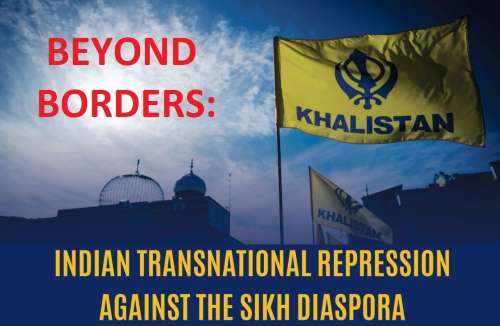
 Islamabad : The Baku Initiative Group (BIG), in collaboration with Sikh Federation International, has released a detailed report titled “Beyond Borders: Indian Transnational Repression Against the Sikh Diaspora,” highlighting allegations of transnational repression targeting Sikh communities living abroad.
According to the report, the document examines concerns regarding alleged intimidation, surveillance, and pressure tactics directed at members of the Sikh diaspora in various countries.
The report was jointly prepared by the Baku Initiative Group and Sikh Federation International.The findings were researched and drafted by Prabjot Singh, legal counsel for the Sikh Federation, with significant support from both organizations.
The report aims to draw international attention to issues relating to the rights, freedoms, and security of Sikh communities residing outside India. It also calls for greater global awareness and dialogue on the protection of diaspora communities and human rights.
The organizations stated that the publication is intended to contribute to ongoing discussions on transnational repression and the safeguarding of civil liberties across borders.
The 58-page report presents fact-based evidences of the systematic pressure mechanisms implemented by Indian Government against Sikhs and other ethnic groups abroad.
The report states that the Government of India has been a clear perpetrator of violent and coercive clandestine operations beyond its borders, targeting Sikh dissidents critical of the Indian state and advocating for Khalistan, an independent Sikh homeland.
In recent years, there is a growing body of evidence on the public record to establish that beyond covert political interference to manipulate policy and public debate in foreign countries, Indian operatives have engaged in a wide range of transnational repression activities against the Sikh people in order to curtail political dissent.
India’s growing geopolitical prominence and ongoing attacks on political dissidents demonstrate a significant threat to minorities and international order.
It is imperative that members of the international community unequivocally condemn the Government of India’s violations of international human rights obligations and take meaningful steps to hold perpetrators accountable or risk an escalation in violent attacks against minority communities.
The purpose of this report is to outline India’s violent targeting of Sikh dissidents around the world by focusing on violent or coercive clandestine operations in several jurisdictions: Canada, United States, United Kingdom, and Germany, although documented cases have emerged in many other countries including Australia, Belgium, Italy, Pakistan, Portugal, and elsewhere.
The Government of India’s hostile actions beyond various borders disclose its increasing belligerence as an aspiring global power that demonstrates a dangerous belief that it can openly violate international law with impunity thereby destabilizing the rule of law and international order.
The Government of India’s transnational campaign against political dissidents prominently features extrajudicial killings using organized crime groups but goes much further than this to include, abuse of visa access and consular services, surveillance and intimidation of critics, and attempts to manipulate mechanisms of international legal cooperation to criminalize Sikh dissidents as alleged “extremists.”
This report was formally presented on 14 March 2026 during an official press conference jointly held by the Baku Initiative Group and Sikh Federation International at the Geneva Press Club in Geneva.
The event brought together international media representatives, policy experts, and human rights stakeholders, providing a platform to highlight the report’s key findings and to raise global awareness regarding the documented patterns of transnational repression targeting Sikh communities.
The conduct documented in this report demonstrates that the Government of India’s hostile and belligerent actions violate numerous international laws, including Article 6, 9(1), 14,15, 17- 19, and 27 of the International Covenant on Civil and Political Rights (“ICCPR”). These include the prohibition on arbitrary deprivation of life; protections against arbitrary arrest and coercion; freedom of expression, association and peaceful assembly; and the protection of minority and cultural rights.
Taken together the incidents demonstrate a clear pattern of state directed activities that constitute transnational repression in which state-linked actors target Sikh dissidents through violence, intimidation, surveillance, and legal harassment.
Key Findings
1- Credible public reporting and official processes in several states indicate a pattern of cross-border threats, coercion, and violence directed at Sikh dissidents and community leaders by the Government of India.
2- Tactics described go beyond diplomacy and involve violent clandestine operations, including the alleged use of intermediaries and covert influence aimed at restricting lawful advocacy.
3- Host state responses have often been reactive and fragmented, leaving communities vulnerable to the threats they face given a lack of meaningful protections or transparency.
4- International legal cooperation mechanisms, including extradition, mutual legal assistance, and INTERPOL processes, are vulnerable to misuse when “extremism” labels are arbitrary applied at India’s request without due process safeguards.
5- International engagement is essential for prevention, accountability, and remedy, including through UN Special Procedures, treaty bodies, and multilateral action by member states.