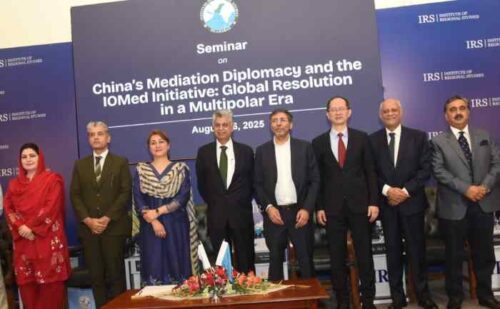
ISLAMABAD : China Program at the Institute of Regional Studies, Islamabad hosted a high-level seminar titled “China’s Mediation Diplomacy and IOMed: Global Dispute Resolution in a Multipolar Era”.
The discussion focused on the newly established International Organization for Mediation (IOMed) on 30th of May, 2025 headquartered in Hong Kong.
The experts, policymakers, legal professionals and academics lauded this initiative highlighting China’s constructive role in global governance and emphasized the growing importance of mediation in a multipolar world and its potential to offer an alternative, inclusive, and culturally relevant mechanisms for resolving global disputes, particularly where formal adjudication may be politically sensitive or diplomatically constrained.
Ms. Nabila Jaffer, Research Analyst, Lead China Program, introduced the topic and Amb. Jauhar Saleem, President IRS gave introductory remarks. Panelists included Mr. Murtaza Solangi, Mr. Ahmer Bilal Soofi, Mr. Shi Yuanqiang, Mr. Hamid Bashir, Ms. Riffat Inam Butt, and Dr. Bilal Zubair.
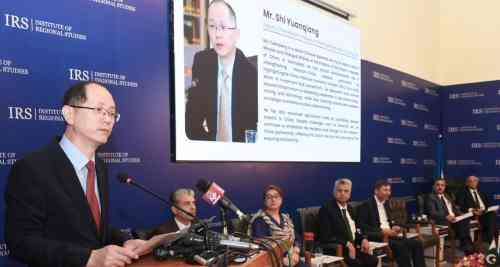
Speakers emphasized that traditional conflict resolution bodies, such as the UN Security Council and ICJ, often have limited effectiveness due to constraints in enforcement. In contrast, mediation outcomes are achieved through dialogue and mutual understanding rather than imposed rulings, making mediation a more flexible and cost-effective solution, particularly for countries in the Global South.
Unlike litigation, mediation requires the consent of all parties involved, allowing for win-win outcomes. IOMed’s focus on state-to-state and international commercial mediation, along with its development-oriented and non-adversarial approach, makes it particularly relevant for technical disputes such as water sharing, transit, and trade.
The panel highlighted Pakistan’s role as a founding member and urged policymakers to utilize IOMed for resolving regional disputes. It was noted that Chinese and South Asian cultures promote settlement before judgment.
To gain global credibility, IOMed must ensure neutrality, build trust, and align with development goals. It was concluded that IOMed should be seen as a global public good, rather than merely a Chinese initiative.