 Tazeen Akhtar | Islamabad
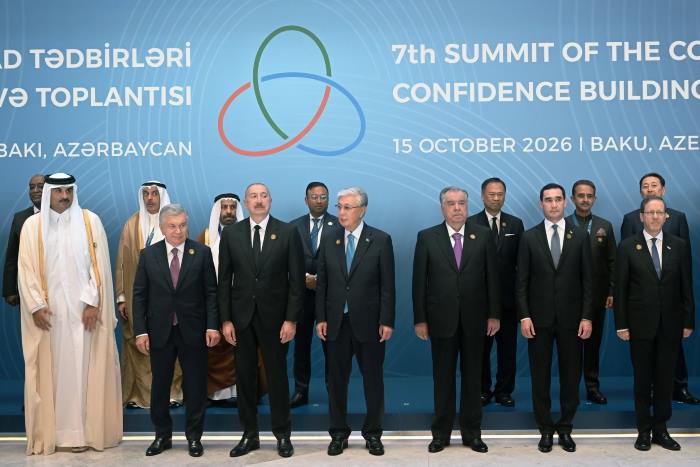
 The 7th Summit of the Conference on Interaction and Confidence Building Measures in Asia (CICA), held in Baku, Azerbaijan on October 15, 2026, aimed to strengthen regional dialogue, peace, security, and institutional development across Asia. Chaired by Azerbaijani President Ilham Aliyev, the high-level meeting gathered heads of state, ministers, and international delegations under the theme “A Stronger CICA: Connectivity, Digitalization and Sustainable Growth in Asia.” Leaders focused on artificial intelligence and digital infrastructure, with several calling for international standards to manage emerging technological risks.
The conference highlighted practical collaboration across CICA’s five core dimensions: military-political, economic, environmental, human, and new challenges/threats—with a strong emphasis on transport corridors, green tourism, and digital transformation.
Formalising the summit’s core outcomes, member states officially adopted the Baku Declaration containing 36 points, which outlined measures to counter military-political, economic and ecological risks, and called for greater intercivilizational dialogue, tolerance and educational innovation.The Declaration reinforced a collective commitment to multilateralism, regional security, transport links, and sustainable growth amidst global uncertainties.
Crucially, the declaration also establishes CICA’s first unified multilateral consensus on balancing the economic opportunities and security risks arising from artificial intelligence.
The summit concluded with a unanimous agreement to extend Azerbaijan’s CICA chairmanship for an additional two-year term covering 2026-2028, alongside the formal admission of Laos as the organisation’s newest full member state.
To address transport logistics, Kazakhstan’s Tokayev proposed drafting a CICA Transport Connectivity Strategy to link major routes, including the Belt and Road, the Middle Corridor, and the Caspian Green Energy Corridor, alongside Azerbaijan and Uzbekistan.
Azerbaijan and Kazakhstan’s presidents also officially inaugurated the Trans-Caspian fibre-optic cable line on the Caspian seabed, which will increase digital connectivity between Asia and Europe from China and Central Asia towards Europe through the Black Sea as a key component of the wider strategic Middle Corridor project.
Foreign Minister China Wang Yi called for a diplomatic settlement between the US and Iran and said that “key shipping lanes like the Strait of Hormuz and the Red Sea should stay unimpeded,” because “the complex evolution of the Middle East situation is having a profound impact on the world.”
He also called for restraint in the Yemen fighting and said that “the question of Palestine should be brought back onto the right track of the two-state solution at an early date.”
Key Purposes and Objectives
• Motto & Focus: Guided by the theme “Stronger CICA: Connectivity, Digitalization and Sustainable Growth in Asia,” the summit focused on deepening results-oriented cooperation.
• Institutional Transformation: Reviewed progress in transforming CICA from a regional dialogue forum into a full-fledged international organization (following the 2022 transformation process), and worked toward finalizing the draft CICA Charter.
• Expanding Membership: Formally admitted the Lao People’s Democratic Republic (Laos) as CICA’s 29th member state.
• Leadership Extension: Extended Azerbaijan’s CICA Chairmanship for an additional two-year term (2026–2028) and approved Ambassador Sultan Hajiyev as the new CICA Secretary-General for 2026–2030.
President Ilham Aliyev highlighted Azerbaijan’s role as a vital transit hub bridging Asia and Europe.
Key Highlights of the Address
• Accession and Leadership: Aliyev welcomed Laos as the 29th CICA member and thanked states for extending Azerbaijan’s chairmanship through 2028.
• Foreign Policy & Security: He highlighted Azerbaijan’s role as a Eurasian bridge, grounded in sovereign equality, and noted that regional peace post-Garabagh restoration remains fragile.
• CICA Priorities: Chairmanship efforts centered on connectivity, digitalization, environment, and education
Discussions focused heavily on expanding cooperation across CICA’s core operational dimensions, focusing closely on:
• Connectivity: Developing robust transport corridors, trade routes, and infrastructure links across Eurasia.
• Digitalization & Green Policy: Aligning regional economies with digital network infrastructure and eco-friendly practices, including welcoming the review of the “Circular Green Tourism” initiative.
• Institutional Expansion: Celebrating the successful establishment of the CICA Women Council and the institutionalization of the CICA Finance Summit under the current chairmanship
• Core Principles & Dimensions: Reaffirmed adherence to foundational international frameworks and the five dimensions of confidence-building measures.
• Institutional Milestones: Commended progress under Azerbaijan’s chairmanship, introduced a multilateral approach to artificial intelligence risks and opportunities, and emphasized regional connectivity.
The summit served as an active geopolitical forum. Turkish Foreign Minister Hakan Fidan used his address to urge member states to take a strong, collective stance supporting Palestinian rights and advocating for a sovereign Palestinian state. Highlighting the friction within the forum, delegations from Pakistan and other member states staged a walkout during a speech delivered by the Israeli president.
Meanwhile, high-level representatives from strategic regional organizations, such as Shanghai Cooperation Organisation (SCO) Secretary-General Nurlan Yermekbayev and UN Special Representative Kaha Imnadze, attended to bolster inter-organizational synergies for Central Asian security and counter-terrorism initiatives.
Conclusion: The conference brought rival sides under one roof, facilitating interaction and exchange of views between some of them. Palestine and Iran were there, while Israel was represented by its Head of State. The Middle East needs urgent de-escalation, as conflicts in different corners of this region have engulfed the world in a crisis, mainly in the form of energy shortages and inflation. This aspect of the conference is being appreciated, but it can certainly contribute only a little, and expecting a solution to security issues at this stage would not be wise.
The Summit was attended by:
The summit was attended by Israeli President Isaac Herzog, Iranian Deputy Foreign Minister Kazem Gharibabadi, Turkish Foreign Minister Hakan Fidan, Russian Foreign Minister Sergey Lavrov, Qatari Emir Sheikh Tamim bin Hamad Al-Thani, UAE Minister of State for Foreign Affairs Khalifa bin Shaheen Al Marar, and a Palestinian delegation led by Foreign Minister Varsen Aghabekian Shahin. They were joined by the Presidents of Uzbekistan, Kazakhstan, Kyrgyzstan and Tajikistan, as well as Chinese Foreign Minister Wang Yi and Heads of State and Government from Laos, Cambodia, Vietnam, India and Sri Lanka.