Islamabad;PR-Ms Kanwal Shauzab, Parliamentary Secretary Ministry of Planning, Development and Reform has said that history of Pakistan suggests, civil-military relations have always been in vain. The democratic governments were either evaporated or were dismantled disabling the democratic values. There has always been a conflict of interests between civil leadership and military leadership. She was addressing to the participants of a conference on Strategic Environment; Role of Leadership (2050) held by Pakistan House at Serena Hotels on 15 April 2019.
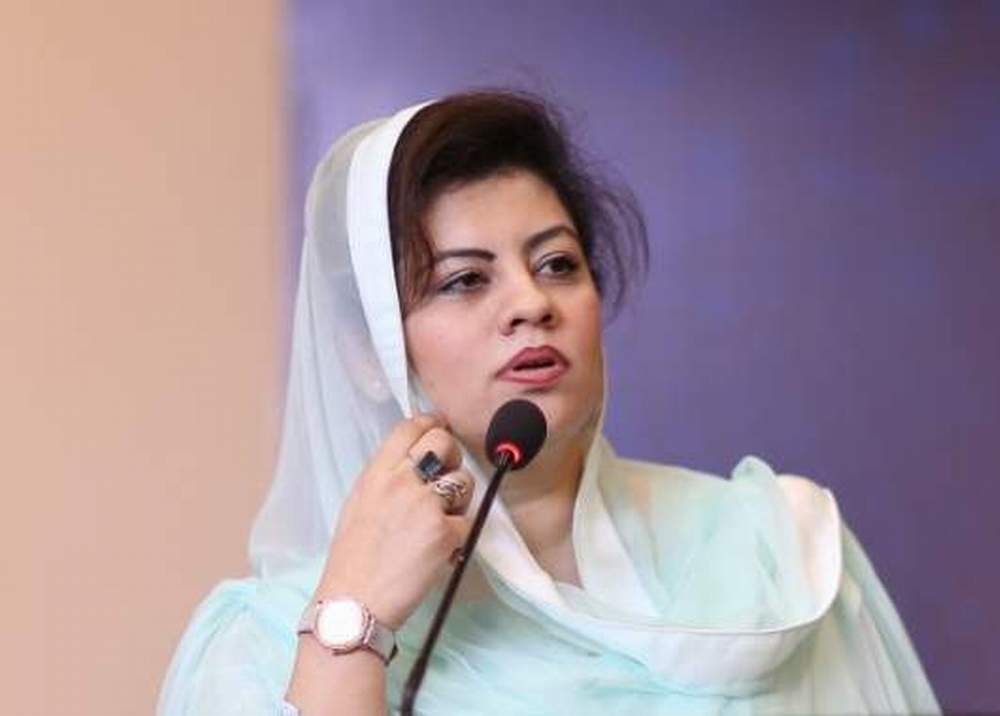 She said that leadership determines the vision and mission of the state. it improves the application of democratic principles without jeopardizing people’s safety and security. A sustainable politico-Military relation is an important aspect in the leadership arena. “As the history of Pakistan suggests, civil-military relations have always been in vain. The democratic governments were either evaporated or were dismantled disabling the democratic values. There has always been a conflict of interests between civil leadership and military leadership” she said. Rule of law, Justice and other democratic values are responsibilities of the political leadership. Unfortunately, intra-state conflicts and Pakistan’s upsetting environment have obstructed social and economic growth; in the eyes of future. Nonetheless Pakistan as an independent state has been securing its place in South-Asia as a strong nation in terms of economy and security. There needs to be clear strategies to tackle diplomatic, political and such other unconventional onslaughts. Pakistan must adopt and practice evolving political approaches and good governance. Aclarity in the prioritization of national interests, a proactive foreign policy and strategic assessment is essential for Pakistan in order to eradicate corruption and reach economic growth.
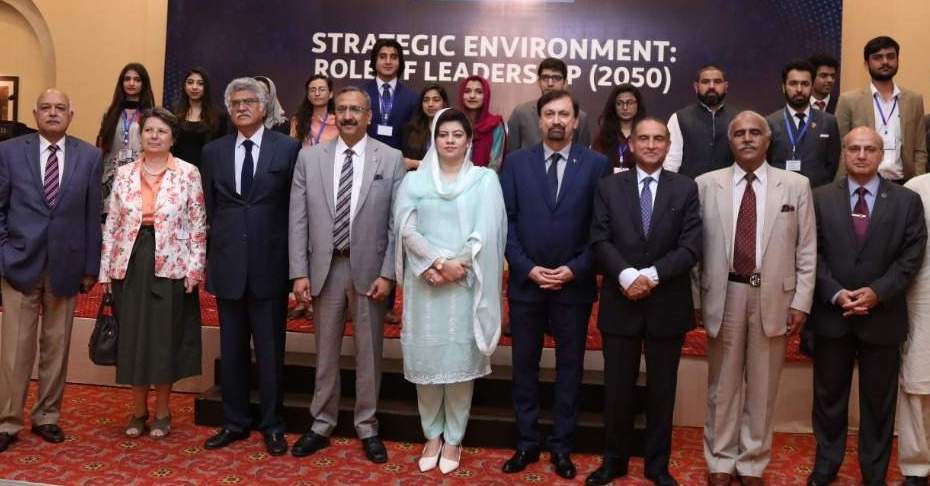 Mr. Aizaz Ahmad Chaudhry, Directr General Institute of Strategic Studies Islamabadsaid that the World order for the past seventy years has been in deep stress. It has become clear that a new world order will replace the current world order. Presently, we have seen regional conflicts; challenge to the US supremacy by China and a new balance of power. President Trump is now speaking of nationalism, whereas President Xi is more concerned about global connectivity. Pakistan’s leadership must deal with these emerging threats. In area of foreign policy, our leadership has a challenge to balance the relations with Kingdom of Saudi Arabia and Iran. And Pakistan has to find a way to deal with India. World order is in flux; itcannot be predicted exactly what qualities our leadership will require in 2050. Leadership in 2050 should be able to know the changing world politics. I believe our leadership must follow principle based approach that means Pakistan will not interfere in other countries’ sovereignty and territorial integrity. Other principle to follow is the national interest based approach; to understand there are no permanent friends and enemies in world politics. In my opinion, the challenges that we have faced if any other country had faced would have been disintegrated by now.“Foreign policy begins at home and it’s upon a state to decide how rest of the world sees it”.
Ambassador Zamir Akram (Retd), Former Pakistan’s Representative at UN Genevadiscussed Public Diplomacy and Strategic Strength. He stated that traditional diplomacy has changed but state system still exists. This environment is putting limit on the use of force. The instruments of politics are non-coercion because it is easy to use. Public diplomacy is an effort to influence public opinion in other countries directly. And soft power is a vital part of public diplomacy.Branding through cultural interaction for long term goals and advocacy to build support for immediate goals are necessary. One important aspect is to not see it as propaganda. Public diplomacy is used toinfluence the decisions of members of state organs, public, officials and media. The role of social media cannot be neglected. Indeed it must be used in public diplomacy to advance national interest. Credibility, consistency, complementarity and money are requirements for the pursuit of successful public diplomacy. There has to be clarity about strategic depth and strength. Divergence in interest has created rift between Pakistan and the US. Challenges are there but in this environment Pakistan has to look beyond in order to pursue its interests. Pakistan must engage with lobbyists and other such organizations in the US to project its positive image and as well as interest.
Dr. Kamran Azam, Associate Professor National Defence University, Islamabad said that Pakistan has challenges such as political inconsistency and destabilization, troubles with neighbors and fragile economy mainly dependent on foreign remittances. Furthermore, we have issues of poverty and higher illiteracy. Pakistan is 6th most populous country, expected to be the 4th most populous country with 300 million plus population in 2050. In circumstances like these Pakistan has to continue using soft power and peace strategies. The leadership of today and 2050 has to entail quality of selflessness, competency and high morality.
Ms. Ghazala Saifi, Member National Assembly Pakistan shed light on the role of young leadership in governance. The youth has to be educated and trained first. “Focus on young women’s empowerment in order to make Pakistan an inclusive country is very important”, she said. It is a challenge to make the younger generation to believe in themselves. They have every right to get higher education and their ideal professions. A lot of people from different educational fields are required in Pakistan’s development process; engineers and scientists are not enough. We need intellectual, writers and artists to create a civic sense. Women’s participation is important in the process of development and they must be encouraged in every way possible.
Mr. Rana Athar Javed, Director General Pakistan House said that the youth’s interaction with the social media has increased in the recent years. Pakistan has gone through many phases as far as security issue is concerned. The question is how the coming generation would contemplate the future leadership in all aspects, not just the political leadership. In Pakistan’s initial years political leadership was based on unity, faith and discipline. The leadership has transformed over the years. Leadership has to be understood in the context of development. Although Pakistan has faced and is facing many security challenges due to its strategic location, yet we must continue our struggle to develop inclusive and progressive institutions. Education and training are vital in development. We should carry out strategic assessment on how the future leadership would be selected and what would be the nature of it. “Discipline and moral values are learnt at home first and then in school and the society at later stages”, he said. There cannot be a training program for learning leadership. The motivation to become a leader is personal that comes from society.