 Middle East Monitoring Desk Islamabad
Contrary to expectations of ending of war around Strait of Hormuz and the supplies become normal, a new phase started with Irani missiles struck US warship while many drones fired at UAE by Iran setting major oil facility at Fujairah ablaze and strong reaction from the Arab state that is expecting joint US -Israel strikes on Iran in next 24 hours. Iran is standing undaunted and says US is not the only super power, Iran is super power too.
US President Donald Trump has warned that Iran would be “blown off the face of the Earth” if it attacks United States ships as tensions around the Strait of Hormuz push the truce between the two countries to the brink.
Hostilities were renewed in the region on Monday as Iran attacked the United Arab Emirates, and Trump said the US military shot down seven small Iranian boats near Hormuz. Iran’s official military source as saying that the “US claim of sinking a number of Iranian warships is false”.
Amid the tensions, Iran renewed its attacks on the UAE on Monday.The UAE Defence Ministry said the country’s forces engaged 12 ballistic missiles, three cruise missiles and four drones.
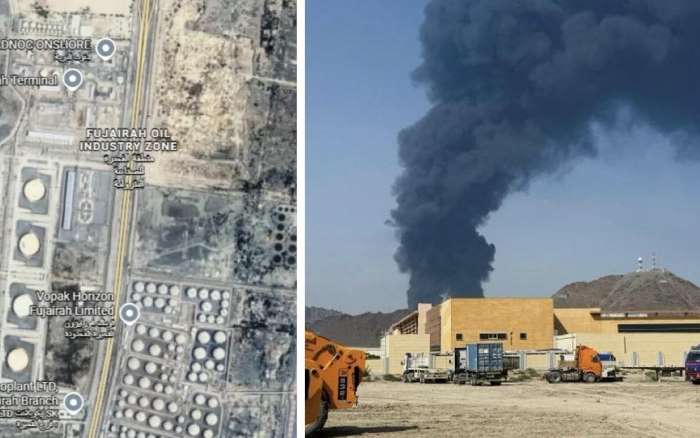
The media office in the emirate of Fujairah confirmed that an Iranian attack caused a fire in the Fujairah Petroleum Industry Zone and injured three people. UAE and several Gulf countries condemned the Iranian attacks.
“The UAE emphasised that it will not tolerate any threat to its security and sovereignty under any circumstances, and that it reserves its full and legitimate right to respond to these unprovoked attacks,” the UAE Foreign Ministry said in a statement.
Iranian drones struck the Fujairah Oil Industry Zone in the UAE, sparking a major fire at the emirate’s key oil export terminal on the Gulf of Oman. Fujairah serves as the UAE’s primary alternative export route, shipping millions of barrels daily to bypass the closed Strait of Hormuz during the US-Israel-Iran war. The attack directly targets global energy supplies and hits back at Gulf states aligned with America and Israel.
This is the latest in a string of Iranian assaults on UAE facilities since early 2026, with previous strikes at Fujairah triggering air defenses and driving up oil prices.
Earlier on Monday, Iranian media say a United States warship trying to transit the Strait of Hormuz has been hit with two missiles after ignoring warnings. The unnamed warship had to withdraw from near the Iranian port of Jask on Monday and “flee”.
The US military, in a social media statement, denied that one of its vessels had been struck.Separately, United Kingdom Maritime Trade Operations (UKMTO) said fires were reported on two ships in the area.
On Monday, Iran appeared to demonstrate its ability to still target ships near the strait.
South Korea confirmed that one of its vessels suffered from an explosion and a fire off the coast of the UAE.
Trump, who has been trying to rally international support for military plans to forcibly open Hormuz, cited the attack on the South Korean ship to urge Seoul to join his campaign.
Admiral Brad Cooper, the head of the US Central Command (CENTCOM), said vessels stranded in the area belong to 87 countries that are “innocent bystanders” in the conflict.
“Over the last 12 hours, we’ve reached out to dozens of ships and shipping companies to encourage traffic flow through the [Strait of Hormuz], consistent with the president’s intent to help guide ships safely through a narrow trade corridor,” Cooper said in a statement.
The latest tensions come as Iranian authorities mobilise supporters to prepare for a potentially lengthy conflict as they continue to exchange proposals with the US amid efforts to end the war that began on February 28 through negotiations.
The Iranian Ministry of Foreign Affairs on Monday confirmed that Tehran was reviewing the latest text from Washington relayed through Pakistan but urged a more “realistic” approach from Trump. Authorities in Tehran will speak about “nothing except for the full end to the war at this stage”, ministry spokesman Esmaeil Baghaei told reporters.
The head of Iran’s joint military command warned US forces they would be attacked if they entered the Strait of Hormuz. Major General Ali Abdollahi said in a statement that armed forces under his command will “maintain and manage security of the Strait of Hormuz with all strength” in response to US President Donald Trump’s announcement on Sunday that the US would “guide” vessels stranded by the US-Israeli war on Iran through the key waterway.
Meanwhile, armed, state-backed motorcades continue to roam the streets of Tehran and other cities at night, and government supporters hold demonstrations in major city squares and intersections where they often play religious chants from loudspeakers and wave flags while guarded by armoured vehicles.
Iran fired 2 missiles at an American patrol boat following Iran’s warning. The US patrol boat was moving near Jask Island violating security and navigation rules intending to pass through the Strait of Hormuz. The Iranian Navy issued warnings that the boat ignored, and thus got targeted by a missile attack. No further details about the extent of damage or possible casualties have been released.
Iran Army, in a statement, has announced that its Navy has prevented US-Israeli enemy destroyers from entering the Strait of Hormuz. Hours earlier on Monday, the United States destroyers attempted to approach the Strait of Hormuz after turning off their radars in the Sea of Oman, the Navy said in a statement. Immediately upon reactivating their radars, they were detected and received a radio warning from the Navy of the Iranian Army regarding the risks of violating the ceasefire.
After the US destroyers ignored the initial radio warning, the Iranian Navy issued a second warning, explicitly stating that any attempt to enter the Strait of Hormuz would be considered a violation of the ceasefire and would be met with a reaction from Iranian naval forces, the statement said.
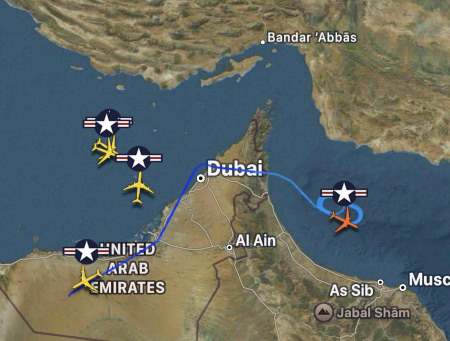
The US side is sharing a different picture from the scene
American fighter jets are actively patrolling the Strait of Hormuz while five USAF refueling tankers keep them airborne over the Persian Gulf. New rules of engagement authorize strikes on hostile threats, showing Washington has had enough of Iranian aggression.
This display of strength supports President Trump’s Project Freedom to escort stranded commercial ships through the critical waterway. Iran’s attempts to blockade energy routes are being answered with overwhelming US airpower, multiple carriers on station, and over 100 aircraft committed to protecting free navigation.
No more weakness or half-measures. With US destroyers moving through the strait and clear orders to eliminate dangers, America is restoring deterrence and keeping global oil flowing. Peace through strength is back in the region that needs it most.
U.S. naval forces now have clear authorization to engage any vessel posing an immediate threat in the critical Strait of Hormuz, according to an Axios report. Two American-flagged merchant ships just sailed through under Navy protection—the first since the operation kicked off—sending a strong message to Iran’s regime and its Revolutionary Guard speedboats.
Former Israeli Prime Minister Naftali Bennett said: “The United Arab Emirates, our strategic ally, has just been attacked by Iran. This is, in effect, a declaration of the renewal of Iran’s war against the allies of the United States and Israel across the region.”
This fits the escalating conflict that began with U.S.-Israeli strikes on Iran in late February. The Abraham Accords have forged a strong alliance between Israel and the UAE, delivering security and economic gains for moderate Arab nations. Iran despises that progress and is now using terror and intimidation to bully the Gulf states into line.