The Nagorno-Karabakh is a great human tragedy which is the bleeding wound for the Republic of Azerbaijan. It is also a “looming security” threat to South Caucasus and beyond. Azerbaijan’s successive leaders and people have been striving hard to resolve Nagorno-Karabakh conflict with Armenia. But reconciliatory efforts have not yet been succeeded due to many complicated reasons.
The Republic of Azerbaijan has had been trying its best to resolve the Nagorno-Karabakh conflict within the true spirits of international law, rule of sovereignty, respect of human rights and the last but not the least, mutual respect, showing its strong political commitment to do something meaningful for the suffering people of occupied areas under Armenia illegal occupation.
Right from the beginning, the government of Azerbaijan’s took a principled stance that “Nagorno-Karabakh is an “integral part” of it. Khojaly genocide considered to be byproduct of Armenia’s aggression, brutality and state sponsored terrorism against innocent and helpless people of Azerbaijan. On February 26, 1992, Armenia committed a war crime, killing 613 peaceful residents of Khojaly, among them 106 women and 63 children.
It was an act of barbarism. It was a crime against humanity. The Khojaly massacre is one of the most heinous and bloodiest events of the 20th century. It is still a black spot on the collective human conscious of the region and the globe as well. It is an act of barbarism and discrimination. The town of Khojaly came under intensive fire from the town of Khankendi and Askeran already occupied by Armenian armed forces February 25, 1992. According to an official report, 613 civilians were killed, including 106 women, 70 elderly and83 children, and a total of 1,000 civilians were disabled. Moreover, 1,275 innocent people were taken hostage.
Khojaly tragedy is another terrible example of the policy of ethnic cleansing and genocide against the Azerbaijani people, which is pursued by the Armenian nationalists and their patrons for a long time. The Khojaly genocide was an integral part of the occupation policy of Armenia against Azerbaijan, and this led to the massive and gross violation of the norms and principles of international law and human rights and freedoms.
Right of Azerbaijan on Nagorno-Karabakh territories is even recognized by the United Nations Security Council which adopted four resolutions 822, 853, 874 and 884 condemning the use of force against Azerbaijan and the occupation of its territories in 1993. It reaffirmed respect for the sovereignty and territorial integrity of Azerbaijan, reconfirmed that the Nagorno-Karabakh region is an integral part of Azerbaijan and demanded the immediate, full and unconditional withdrawal of the occupying forces from all the occupied territories. Moreover, it demands, including in the first place the withdrawal of the occupying forces from the occupied territories of Azerbaijan, have still not been implemented, and the mediation efforts conducted for the last 20 years within the framework of the Organization for Security and Cooperation in Europe (OSCE) have also yet to yield results. The OIC recognizes Nagorno-Karabakh as integral part of Azerbaijan. NAM respects Azerbaijan’s non-violence persuasion to liberate Nagorno-Karabakh. OSCE confirms Azerbaijan’s principal stance on Nagorno-Karabakh. National Assembly as well as Senate of Pakistan unanimously condemns Armenia policy of occupation.
Unresolved Nagorno-Karabakh Conflict’s has multiplier collateral damages. Thousands of people lost their lives and over one million people became refugees and internally displaced persons (IDPs). More than Twenty percent of Azerbaijani territory has been occupied and material damages worth billions of dollars as the whole infrastructure devastated or destroyed in the occupied regions. Armenian aggression has badly affected all sectors of its macro-economy. According to the Azerbaijan figures (February, 2017) Azerbaijan 890 cities, villages and settlements, 102 thousand dwelling houses, 7000 public buildings, 695 healthcare facilities, 693 secondary schools, 927 libraries, 310 industrial and building enterprises, 464 historical monuments and museums, 6 state theaters and concert studios have been completely destroyed in the occupied territories.
Nagorno-Karabakh’s conflict played havoc during 1990-1994 during which GDP of the Azerbaijan decreased about 63 percent in total due to agriculture output falling about 43 percent which led to massive unemployment because of loss of fertile agricultural lands. The occupied regions had quite strong progress in agricultural production and productivity growth. However, all those production facilities destroyed and remained in the occupied territories. Azerbaijan preliminary calculations show that the total damage to Azerbaijan caused by Armenian aggression estimated around $60 billion.
It is feared that Armenian persuasion of Nazi ideology may spoil the basic core and philosophy of the European Union. Its systematic and secretive ways and means to maintain “status quo” would be disastrous for the collective security of the region and beyond. Life has been stagnated under Armenian occupation. Economy has been worsened. Social life and society has been sieged and caged in all the illegally occupied territories. Moreover, climate, nature and natural resources have been polluted because of criminal psycho of Armenia. Physical infrastructure has been demolished. Cultural buildings have been flattened. Agricultural activities have also been diminished in these areas.
Armenia always pursues the path of escalation. It undertakes consistent measures to further consolidate the results of its occupation policy and to maintain unacceptable and unsustainable status quo. It undermines efforts for the peaceful resolution of the conflict through hidden activities. Holding of military drills, census, resettlement of Syrian Armenian, referendum and elections are the serious violations of international law and ceasefire agreement.
The Republic of Azerbaijan and its people are fully committed under the strategic leadership of H.E. President Ilham Aliyev to liberate all the occupied areas under Armenian occupation. Azerbaijan has proven socio-economic superiority and military might (58th globally) as compare to Armenia (93rd) so nefarious provocations could not achieve nothing but further widespread condemnation and political isolation. A series of horrible incidents of “Black January” and unresolved issue of “Nagorno-Karabakh conflict” is still the reminder of Armenia’s brutal aggression against helpless Azerbaijanis living in occupied areas.
Armenia always pursues the path of escalation. It undertakes consistent measures to consolidate the results of its occupation policy and to maintain unacceptable and unsustainable status quo. It undermines efforts for the peaceful resolution of the conflict through hidden activities. Holding of military drills, census, resettlement of Syrian Armenian, referendum and elections are the serious violations of international law and ceasefire agreement.
Armenia “the mosque destroyer” cannot be friend of any Muslim country must be rigorously projected and pursued while engaging the OIC and its all members in the future. Armenian purchases of arms from Russia or elsewhere are serious security threat to South Caucasus and Eastern Europe.
Despite Azerbaijan’s strong political commitments, 2017 has been lost due to constant negative attitude of Armenia for the settlement of Nagorno-Karabakh conflict. Too many high official meetings between presidents and foreign ministers of both the countries, still its resolution is far away to achieve. Expansion of the OSCE representative personnel in the occupied areas was the only substantial achievement during 2017.
Since Aristotle, power is balanced with superior power and “strong defense is the best deterrence”. Azerbaijan must further develop and diversify its military production facilities and defense industries in order to marginalize the ill designs of Armenia. Further strengthening of military ties with Pakistan and Turkey would be fruitful and decisive. There is great scope in the development of Azerbaijan Air Force which may be achieved by strengthening bilateral military relations with Pakistan and Turkey. Most recently formed Azerbaijan-Pakistan-Turkey Trilateral forum would bring befitting response in the region.
Continuation of status quo poses serious security threat to South Caucasus and the EU. It is the high time to resolve this frozen issue somehow otherwise collective regional peace, harmony, and greater socio-economic prosperity would be in great danger.
The Republic of Azerbaijan’s main principles and requirements in the peace process are i.e. Armenia’s withdrawal from the occupied Nagorno-Karabakh and adjacent territories, and Nagorno-Karabakh’s remaining within Azerbaijan. Azerbaijan always expresses its readiness to grant Nagorno-Karabakh the highest status under international law and practice. Armenia still controls fifth part of Azerbaijan’s territory and rejects implementing four UN Security Council resolutions on withdrawal of its armed forces from Nagorno-Karabakh and surrounding districts. Azerbaijan16 has long ago stated it is ready to settle the conflict through direct negotiations with Armenia with mediation of the OSCE Minsk Group co-chairs. However, the Armenian side is constantly trying to make up reasons to avoid a constructive dialogue and preserve the unacceptable status quo in Nagorno-Karabakh.
The Armenia has been “guilty” to provocative actions, strongly violates the ceasefire regime on the contact line of troops, breach certain agreements reached in the settlement of the conflict, thus hampering peace talks. It targets provoking Baku and keeping the status-quo, which promises “no good”. The fragile peace and current deteriorating situation in the region transmits spillover repercussions in the South Caucasus, as well as Europe, because of oil & gas security which banks close to the Karabakh front line. It is feared that Armenia prolonged and unstoppable military action may spoil region “security umbrella” of South Caucasus and that of Eastern Europe.
International community has been remained mummed and never undertook any initiative to resolve Nagorno-Karabakh conflict and seemingly it is not going to do anything to resolve it. Even role of the European Union (EU) has not been up to mark on this burning issue and declared it a “frozen conflict/issue”.
Following suggestions may be useful to achieve the desired goals in term of de-occupation of Nagorno-Karabakh and seven adjacent districts namely Kalbajar, Lachin, Qubadli, Jabrayil, Zangilan, Agdam and Fuzuli which have been under illegal occupation of Armenian, an aggressor. By following given below suggestions, the Republic of Azerbaijan may gradually but surely deescalate position at contact line, honorable return of IDPs and refugees.
It is hoped that a “holistic approach” based on these suggestions would bring greater socio-economic prosperity, energy cooperation, sustainable transport corridors and above all dreams of a “qualitative life” in the days to come.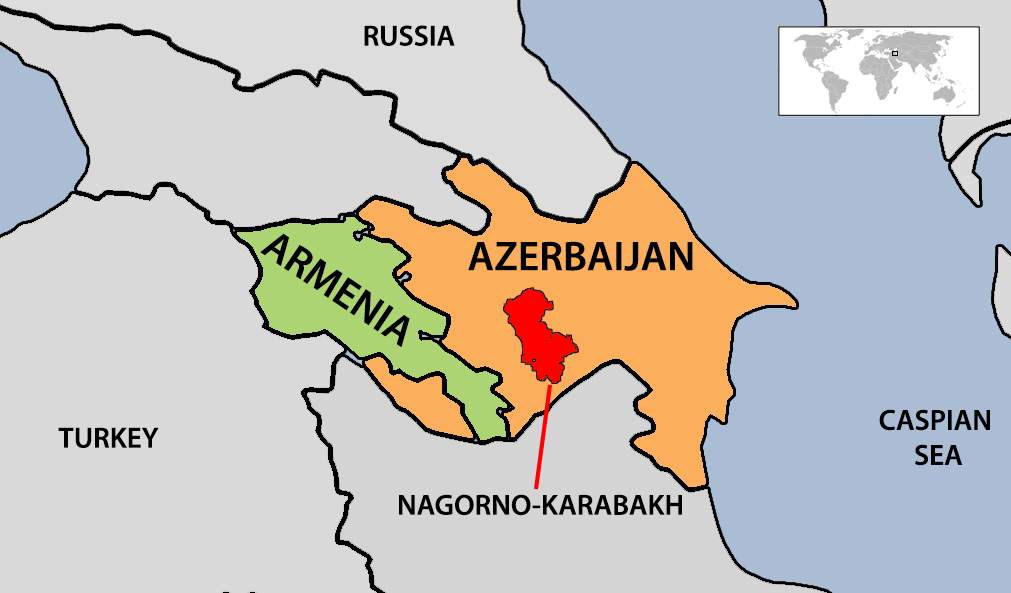
(a) Armenia “the mosque destroyer” cannot be friend of any Muslim country must be rigorously projected and pursued while engaging the OIC and its all members in the future.
(b) Armenia’s “Nazi ideology” and its functionality need to be projected especially in the EU in order to seek support for achieving a peaceful solution of Nagorno- Karabakh conflict.
(c) Armenian purchase of arms from Russia or elsewhere must be highlighted among the EU countries as “potential security threat” to region and the EU.
(d) Armenian dangerous interference with nature and natural resources are compounding serious threats of climate change should be tabled among the concerned regional as well as global organizations.
(e) Armenian is purposefully extinguishing Azerbaijan’s culture, heritage and historical places, buildings and monuments which should be brought into discussion of concerned organizations of the EU and world alike because “human’s culture and heritage” is a “common asset” to all and diversity of humanity, faith, sect, belief and political understanding must be valued and respected.
(f) Armenian nuclear program has been declared “unsecured” and “imperfect” by all the international regulatory bodies which need to be voiced at every regional and international forum.
(g) The government of Azerbaijan should seriously think to change the composition of “OSCE Minsk Group co-chair” because it has not been caring about the interest of Azerbaijan and peaceful liberalization of its occupied territories from aggressor Armenia.
(h) Rigorous “religious diplomacy” may provide essential “missing” “magic box” for lessening of human miseries and sufferings of Azerbaijani IDPS, and refugees.
(i) Proposal for removing of snipers from the contact line should be pursued for a greater safety and stability.
(j) Reliable “people diplomacy” may put an end to isolation of Azerbaijani living in Nagorno-Karabakh and its seven adjacent districts.
(k) Diplomatic request may be forwarded to all brotherly and friendly regional as well as world countries to include some “Literature/Material” in their universities about “Black January”, Khojaly genocide and Nagorno-Karabakh conflict for creating better political understanding and wining widespread human support.
(l) Policy makers of Azerbaijan must also find or exploit “conflict of interest” among the power brokers in the region to achieve some strategic cushion or space for political maneuvering on the issue of Nagorno-Karabakh conflict. In this regard, experts of international relations, political science, human psychology and philosophy must also be formed as soon as possible.
(m) Gross human right violations, violations of ceasefire, poverty, unemployment, discrimination and widening insecurity among the factions of the Armenia ought to be highlighted regionally and globally. Severe economic meltdown, bankruptcy, corruption, lack of transparency and even denial of basic necessities of life must be showcased in the international media on regular basis.
(n) Azerbaijan is blessed with natural resources of oil and gas. Its economy is smart which future prospects is also bright. It may consider using “superior economy” to make alliances against Armenian aggression and liberalization of occupied areas in the region and outer world.
(o) Azerbaijan must utilize its strong ties with Israel to win lobby in the power corridor of the US power politics against Armenia whose diaspora reportedly financed against Trump and favored Hillary Clinton in the recently held Presidential Election.
(p) Azerbaijan’s government must also extend its friendly relations with NAM so that vital support on the issue of Nagorno-Karabakh conflict may be received in the future.
(q) Azerbaijan must also have meaningful dialogue with the Organisation of African Unity (OAU) so achieving greater socio-economic connectivity and vital political support on the issue of Nagorno-Karabakh conflict.
(r) Since Aristotle, power is balanced with superior power and “strong defense is the best deterrence”. Azerbaijan must further develop and diversify its military production facilities and defense industries in order to marginalize the ill designs of Armenia. Further strengthening of military ties with Pakistan and Turkey would be fruitful and decisive. There is great scope in the development of Azerbaijan Air Force which may be achieved by strengthening bilateral military relations with Pakistan and Turkey.
(s) Inclination of Iran towards Armenia should be managed through rigorous commercial diplomacy and alternative solutions for achieving befitting propositions.
(t) Try to seek membership of Developing Eight Economic Cooperation (D-8) as soon as possible for achieving greater political support against aggressive policies of Armenia.
(u) Tourist potential of Azerbaijan needs to be mirrored in foreign countries by which, it may clinch hearts and souls of visiting tourists against Armenia.
(v) Azerbaijan may also consider “cultural diplomacy” to seek political support from the regional as well as world countries.
(w) Armenia’s participation and serious military engagement with NATO needs to be highlighted to Russia.
(x) Armenia’s rapprochement with the European Union and NATO is a new political line of Armenia which considers Russia it’s most reliable partner over the Nagorno-Karabakh conflict’s settlement, as well as the country’s main facilitator in the economic and political context. Armenia’s new search for “safe heavens” needs to be deeply studied and projected to Russia.
(y) Concerted efforts of parliaments of Eurasian countries may bring about solution to regional problems, including the Armenia-Azerbaijan Nagorno-Karabakh conflict which must be explored.
(z) Azerbaijan’s Defense Ministry has traced so many secretive activities of Armenia intelligence agencies which must be shared to all the regional as well as international countries.