 Islamabad: 24 July 2023 -The second session of the online internship program being co-hosted by Indonesian Embassy and Bahria University, Islamabad, was held on Thursday highlighting Indonesia’s transition to democracy.
The Internship Program was launched virtually by Dr. Teuku Faizasyah, Indonesian Deputy Foreign Minister on its inaugural session on July 18, at the Bahria University, Islamabad. Indonesian Ambassador Adam M. Tugio and Director General Bahria University Rear Admiral Zakaur Rehman were also present on the occasion.
The program featuring prominent experts and scholars from Indonesia provides excellent opportunity to the participants to learn various significant aspects of the modern Indonesia and explore ways to further deepen the historic ties between Indonesia and Pakistan.
The OIP which is an initiative by Ambassador Adam Tugio has been appreciated by the participants for encouraging the vital role of the academia to the strength of the bilateral relationship of the two countries.
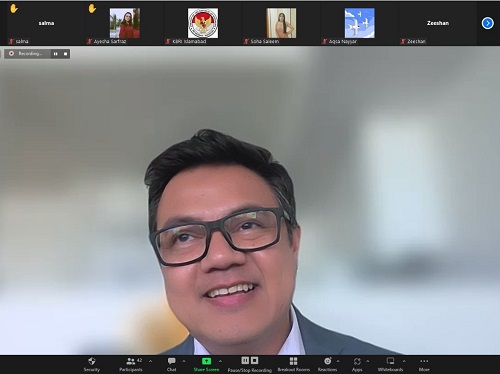
At the Session 2, the Speaker Prof. Firman Noor, the Head of the Political Research Center of the Indonesian Institute of Sciences, enlightened the participants about the Indonesia’s transition to become a full fledge and active democracy.
The Session explored Indonesia’s history of democracy, emphasizing democracy being the continuum process and the need for consistent fostering by government, political parties and all the stakeholders to function and deliver for socio-economic development.
Prof. Firman Noor argued that though constitutionally Indonesia is not an Islamic country but believes Islam and democracy are compatible and that democracy contributes to progress and prosperity.
Indonesian Embassy and Bahria University organizing International Online Internship Program
He stated that the democratic process in Indonesia has not been linear, with political experiments and reforms introduced and implemented during its transition towards the right political system for Indonesia. He mentioned that some reforms resulted in political instability that harmed the economy.
The speaker gave an overview about the 1945 Constitution highlighting the amendments to accommodate democratic development in the country. He went into detail in explaining about the liberal Democracy, Guided Democracy or Pancasila Democracy that Indonesia experimented. He also elaborated that how Pancasila being the Indonesian philosophical foundation served the nationhood and preserved Indonesia’s diversity during the testing times of political instability and transition.
He mentioned that reformation era that began in 1998 has seen democracy taking root in the society. The Reform Era is characterized by the vast growth of political parties, civil supremacy, decentralization and local autonomy, freedom of expression, free media and people electing their leaders and governments in free and fair presidential and local government elections, he elaborated.
In the Q&A session the speakers said that Indonesian Muslims accept democracy due to Islamic teachings’ guiding principles and belief in democracy as a practical government model and ideal tool for struggle. He stated that Islamic teachings inspire respect for differences, pluralism, unity, and cultural diversity, reflected in Indonesia’s national motto of Unity in Diversity.
He said that Indonesian Muslims support the state ideology of Pancasila and the democracy that should be implemented in its true spirit and reject any notion of extremism and violence.
While pointing out certain weak areas that needed more attention and improvement, he said that the future of democracy in Indonesia was bright as all the essential elements were in place for the democracy to flourish in the country.
He concluded that democracy has empowered Indonesians to develop political capacity and promote national interest and they continue to strive for the ideal goals and values of a democratic society.
OIP discusses Indonesia’s resilient recovery from multidimensional economic crises