 Islamabad; 26 July 2023 – Session III of the Online Internship Program (OIP) organized by the Indonesian Embassy and Bahria University, discussed Indonesia’s economic successes in reversing the upheavals and its rise as an emerging global economy.
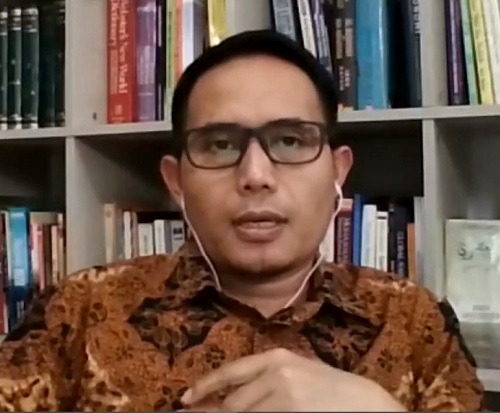
Dr. Muhammad Faisal, Executive Director of Center of Reform on Economics (CORE) Indonesia in his lecture while outlining the main features of the Indonesian economy mentioned that Indonesia is a top 15 global economy, part of the G-20 group and is expected to be one of the top 10 by 2050. He highlighted that Indonesia is a major producer of palm oil, natural rubber, oil & gas, coal and minerals but has also developed a manufacturing and processing industry, with its main industries ranging from labor-intensive to hi-tech. “Indonesia’s as a Middle power is considered an economic giant at ASEAN level, with a GDP over one trillion USD and has successfully reduced poverty rates since 1998” he added.
Dr. Muhammad Faisal, highlighted Indonesia is classified as an upper middle income economy and has reduced its poverty rate since 1998. However, he reminded that these all achievement were made possible only after the country through its resilience recovered from the several political economic crises. “The 1960 domestic severe political and economic crisis which led to hyperinflation, extreme poverty and currency redenomination. The repercussions were political turmoil that eventually led to regime change in the country”, Dr Faisal recalled.
Indonesian Embassy and Bahria University organizing International Online Internship Program
According to the speaker, President Soeharto government from 1966-1996 brought decades of stability and high economic growth to Indonesia, attracting foreign direct investment (FDI) in natural resources extraction and manufacturing sectors. Yet, he said, the 1997-1998 economic crisis hard hit Indonesia and led to high inflation again and a crisis that engulfed countries in Asia. “1997-1998 economic crisis again led to political turmoil and regime change, with an IMF intervention of USD 110 billion” Dr. Faisal explained.
The speaker further highlighted that the Reform Era that follow was marked by political reforms and stronger corruption eradication measures. He stated that during this period, the GDP grew at a lower rate until 2007 but sound economic policies reduced vulnerabilities and strengthened external balances leading to increased forex reserves, FDI, tourism and exports. “The IMF loan was fully repaid, and the Indonesian economy demonstrated resilience during the 2008-2009 global financial crisis” he added.
Internship program at Bahria University Islamabad highlights Indonesian experience of democracy