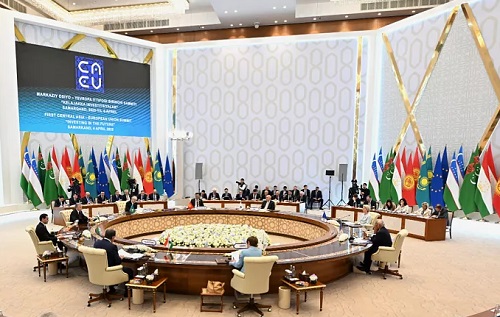
We, the Leaders of Kazakhstan, the Kyrgyz Republic, Tajikistan, Turkmenistan, Uzbekistan and of the European Union (EU), held our first EU-Central Asia Summit in Samarkand, Uzbekistan on 4 April 2025 and concluded the following:
- Reaffirming our commitment to deeper cooperation in an evolving global and regional geopolitical landscape, we decided to upgrade relations between the European Union and Central Asia to a strategic partnership. We acknowledged the significant results achieved in recent years to strengthen dialogue and cooperation between our regions.
2. The EU reconfirmed its commitment to the goals of the EU Strategy on Central Asia of 2019. The Joint Roadmap for Deepening Ties between the EU and Central Asia adopted on 23 October 2023 in Luxembourg has been useful in operationalising the Strategy. We acknowledged the role of the EU-Central Asia high-level regional meetings of the Heads of State of Central Asia and the President of the European Council, held in Astana in 2022 and Cholpon-Ata in 2023, and the EU-Central Asia Ministerial meeting in Ashgabat on 27 March 2025 in taking stock of these commitments in preparation for this Summit. We welcomed the progress achieved and underscored the importance of maintaining its momentum.
3. We are committed to cooperate for peace, security and democracy, to fully
respect international law, including the UN Charter and the fundamental principles
of respect for the independence, sovereignty and territorial integrity of all States,
within their internationally recognised borders. We emphasised the importance of
achieving as soon as possible, a comprehensive, just and lasting peace in Ukraine
in accordance with the principles of the Charter of the United Nations. We
emphasised the need to uphold the principles of the OSCE by the participating
States. We reconfirmed the obligation of all States to refrain in their international
relations from the threat or use of force, to respect international humanitarian law
and underlined the need for peaceful resolution of conflicts.
4. In the same context, we committed to respect the above principles, in particular the
sovereignty and territorial integrity of all states within the framework of all
international and regional fora, and to refrain from taking any steps that run contrary
to those principles. In the same spirit, we reaffirmed our strong commitment to the
relevant UNSC Resolution 541(1983) and 550 (1984). We emphasised that
engagement in regional cooperation frameworks should fully respect these
international principles, which remain essential to the enhancement of EU-Central
Asia relations. In this context, Turkmenistan recalls that it applies its international
commitments in strict accordance with the principles of its permanent neutrality
status.
5. In an increasingly complex world, we expressed our readiness to address common
security challenges through new possibilities of further engagement and to
strengthen cooperation at bilateral, regional and multilateral level on cybersecurity
and hybrid threats, Chemical, Biological, Radiological and Nuclear (CBRN)
threats, preventing and countering radicalisation and terrorism, strengthening
border security, and preventing drug trafficking and human trafficking. We agreed
to initiate a dedicated Dialogue on counter terrorism and violent extremism and
build societal resilience against disinformation.
6. We emphasised our strong commitment to see Afghanistan develop into a secure,
stable and prosperous State with inclusive government and governance systems that
respects the human rights and fundamental freedoms of all its citizens, including
women, girls, persons belonging to ethnic and religious groups and minorities, is at
peace with itself and its neighbours, and that respects its international obligations.
We expressed our common concern over the humanitarian situation in Afghanistan
and recognised the need to continue supporting the people of Afghanistan. We
called for full and equal access to education conforming to international standards
and participation in public life of women and girls in Afghanistan. In this regard,
we supported the continuation of regular consultations of Special Representatives
and Envoys of the Central Asian States and the EU.
7. Cooperation on preventing sanctions circumvention remains an important aspect
of our relations. In this context, we agreed to continue cooperation on this issue,
especially to avoid re-exports of common high priority items, in line with the work
of the EU Special Envoy on Sanctions.
8. Significant efforts have been made to strengthen regional cooperation within
Central Asia, overcoming challenges and fostering closer partnerships to ensure
prosperity, sustainable development and to accelerate the energy transition and
decarbonisation, strengthening stability, security, and good neighbourly relations.
In this respect, the EU welcomed strengthened regional cooperation through regular
Consultative Meetings of the Heads of State of Central Asia. The EU expressed its
readiness to support ongoing and future actions in support of further regional
integration.
SAMARKAND SUMMIT : Central Asia – European Union: Towards a Strategic Partnership
9. The Leaders welcomed the signing in Bishkek on 13 March 2025 of the Treaty on
the State Border between the Kyrgyz Republic and the Republic of Tajikistan which
will contribute to peace and prosperity in the region.
10.EU and Central Asian Leaders agreed that the deep and comprehensive cooperation
between the two regions will be based on full implementation of the current and
future bilateral Enhanced Partnership and Cooperation Agreements (EPCAs).
In this context, the Leaders welcomed the signing of the Enhanced Partnership and
Cooperation Agreement between the EU and the Kyrgyz Republic on 25 June 2024
and looked forward to the signing of the EPCAs between the EU and Uzbekistan,
and between the EU and Tajikistan. We also acknowledged the interest of the EU
and Kazakhstan to launch negotiations for a Visa Facilitation Agreement and a
Readmission Agreement when their respective internal procedures for negotiating
mandates are concluded and welcomed recent steps taken by the European
Commission in this regard.
11.Strengthening trade and investment ties between Central Asia and the European
Union is essential for economic growth, as well as developing and diversifying
regional and interregional trade. To advance this agenda, we committed to regularly
organise economic events, including the Central Asia–European Union Economic
Forum fostering strategic dialogue and sustainable economic partnerships. This
cooperation should be in line with the Global Gateway strategy, the EU’s external
investment strategy, which will be scaled up in the years to come to further unlock
the potential of our region-to-region relations.
12.Among many areas of shared interest, enhanced cooperation on critical raw
materials is of strategic importance, aimed at ensuring secure, sustainable and
diversified supply chains. We agreed that the Declaration of Intent endorsed at this
Summit will deepen cooperation in this field, strengthening economic resilience,
mutual prosperity and facilitating the transition to a green and digital economy.
13.The EU and Central Asia reaffirmed their commitment to strengthening sustainable
transport connectivity as a driver of economic growth and regional integration. The
mobilisation of EUR 10 billion in support and investments for Central Asia at the
Global Gateway Investors’ Forum (January 2024) marks a pivotal step towards
developing efficient regional transport corridors, logistics, networks, value chains
and effective mechanisms to support mutual access to our respective markets. We
additionally agreed to support the Coordination Platform for the Trans-Caspian
Transport Corridor and critical infrastructure projects along the Middle Corridor,
ensuring mutual market access and long-term cooperation. We also agreed on the
importance of peace and stability in the South Caucasus as a prerequisite to the
successful implementation of these projects.
14.With rising global temperatures, extreme weather events and environmental
degradation, protecting our planet is not just an option but a necessity, and therefore
full and effective implementation of the Paris Agreement requires our joint actions.
In line with this commitment, we agreed to step up the fight against climate change,
biodiversity loss and pollution. The EU welcomed the decision of all Central
Asian partners to join the Global Methane Pledge.
15.Water is essential for the development and prosperity of Central Asia. Ensuring its
sustainable and rational use is in the vital interest of all countries in the region. The
EU and Central Asian Leaders agreed to continue to implement innovative
approaches in water–energy cooperation to foster concrete and socially significant
actions to protect and efficiently use water resources. We also agreed to strengthen
cooperation and continue our partnership to improve the situation in the Aral Sea
region and the entire Aral Sea basin. In this context, Leaders recognised the
importance of both continuing the efforts to improve the work of IFAS to enhance
its effectiveness and of the next IFAS Summit in Kazakhstan in 2026. Leaders took
stock of preparations for the UN Ocean Conference, recognised the importance of
the Dushanbe Water Process and acknowledged international initiatives such as the
One Water Summit in 2024 as well as the UNGA Resolution on “Sustainable
Mountain Development”.
16.The EU and Central Asian Leaders reiterated that the promotion and protection of
rule of law, human rights and fundamental freedoms is a common fundamental
value. Ensuring freedom of expression and association, an enabling environment
for civil society and independent media, protection of human rights defenders as
well as the respect for the rights of women, the rights of the child and labour rights
remain at the core of EU–Central Asia relations. The EU reiterated its readiness to
support efforts in this regard at regional as well as at national level.
17.The EU and Central Asian leaders agreed that the EU–Central Asia Civil Society
Forum is a key platform for dialogue, advancing the objectives of the EU Strategy
on Central Asia in strengthening the resilience and prosperity of societies, as well
as regional cooperation through civil society engagement.
18.The role of the EU Special Representative for Central Asia was recognised to
contribute to strengthening cooperation between the EU and Central Asia and in the
region.
19.We agreed to build upon the outcomes of today’s Summit in Samarkand and the
20th EU–Central Asia Ministerial Meeting held in Ashgabat to further strengthen
our partnership and enhance cooperation across all mutually beneficial areas, as
outlined in the Annex to this Declaration.
20.We expressed our gratitude to the Government of Uzbekistan for successfully
hosting the first EU–Central Asia Summit in Samarkand.
Deliverables in Sectoral Cooperation Strengthening multilateralism
The Participants:
– Agreed to periodic assessments of the implementation of the Joint Roadmap for
Deepening Ties between the EU and Central Asia, ensuring its continued
effectiveness and alignment with regional priorities.
– Noted the importance of the UN General Assembly Resolution 72/283 of 22
June 2018 on strengthening regional and international cooperation to ensure
peace, stability and sustainable development in Central Asia adopted at the
initiative of Uzbekistan on behalf of the region.
– Welcomed the adoption of the UN General Assembly resolution that formalises
the UN Regional Centre for SDGs for Central Asia and Afghanistan in Almaty
to accelerate achievement of SDGs in the region.
– Highlighted the role of preventive diplomacy as a key instrument for conflict
prevention and resolution, in line with the mandate of the UN Regional Centre
for Preventive Diplomacy for Central Asia (UNRCCA) based in Ashgabat.
– Took note of the importance of the ‘Treaty on Friendship, Good-
Neighbourliness, and Cooperation for Development of Central Asia in XXI
Century’ signed on 21 July 2022 in Cholpon-Ata by Kazakhstan, the Kyrgyz
Republic and Uzbekistan.
– Acknowledged the UN General Assembly Resolution designating Central Asia
as a “Zone of Peace, Trust and Cooperation,” adopted by the initiative of
Turkmenistan on behalf of the region.
– Recognised Turkmenistan’s initiatives dedicated to peace, trust, and preventive
diplomacy, including its lead in advancing the designation of 2025 as the
International Year of Peace and Trust and its initiative in promoting the role of
the UNRCCA, both of which were adopted by the UN General Assembly.
– Welcomed the inclusion of the regional Transport and Logistical Hub in Termez
into the Global Supply Network of the UNHCR and noted the importance of its
use in efforts to effectively distribute humanitarian supplies to Afghanistan and
globally, contributing to regional development and creating new economic
opportunities.
– Recognised the initiatives of the Kyrgyz Republic on sustainable development of mountain regions within the framework of the UN Framework Convention on Climate Change, as well as the importance of the UNGA Resolution on “Sustainable Mountain Development”, declaring 2023-2027 as the “Five Years of Action for the Development of Mountain Regions” to enhance international cooperation on the global mountain agenda and took note of the Second Global Mountain Summit, ‘Bishkek+25’, to be held in 2027 in Kyrgyzstan.
– Recognised the importance of the Dushanbe Water Process and looked forward
to the upcoming High-Level International Conference on Glaciers’ Preservation,
which will take place in Dushanbe from May 29-31, 2025 as well as the Regional
Climate Summit in Astana in 2026.
– The concerned Participants called for increased global action and ambition,
including in the context of the Agreement on the Conservation and Sustainable
Use of Marine Biological Diversity of Areas beyond National Jurisdiction
(BBNJ Agreement).
– Acknowledged the critical importance of cryospheric sciences for sustainable
development, the Participants commended the Republic of Tajikistan and the
French Republic for their initiative in advancing the adoption of the UNGA
Resolution in August 2024, declaring the years 2025-2034 as the “Decade of
Action for Cryospheric Sciences”.
– Acknowledged the high value of ongoing regional cooperation in the area of
health, including through the support of the WHO, on health security
preparedness, digital health, universal health coverage and more.
– Noted the significance of the UN General Assembly Resolution proclaiming 5
March as the International Day for Disarmament and Non-Proliferation
Awareness and emphasised the need to strengthen global efforts in promoting
peace, security, and international stability”, adopted at the initiative of the
Kyrgyz Republic.
Addressing common security challenges
The Participants:
– Confirmed readiness to cooperate on addressing common security challenges,
including exploring new possibilities of engagement between the EU and
Central Asian countries, based on respective requests, interests and needs
including through the European Peace Facility.
– Welcomed funding for the regional response to displaced Afghans, as part of the
EU’s commitment to support Central Asian partners in the efforts to address the
security challenges arising from the situation in Afghanistan.
– Confirmed the continued work under the BOMCA programme to strengthen
border guards’ capacity and border security in Central Asian countries. In this
context, the Participants also acknowledged the Dushanbe Process on Counter-
Terrorism Cooperation and Border Security.
– Agreed to strengthen engagement on tackling disinformation and information
manipulation, including through capacity building activities.
Enhancing Economic ties, Trade and Investments
The Participants:
– Confirmed the respective commitments towards signing the EPCAs between the
EU and Uzbekistan in 2025 and between the EU and Tajikistan in 2026.
– Noted Turkmenistan’s proposal for enhancing the legal framework of its
bilateral relations with the EU emphasising the significance of further steps in
this direction.
– Agreed to continue to work towards the accession of Uzbekistan and
Turkmenistan to the World Trade Organisation (WTO).
– Recognized that stakeholders welcomed the future establishment of an EIB
Regional Representation for Central Asia, enabled by the signature of a Host
Country Agreement between Uzbekistan and the EIB, strengthening the Bank’s
presence in the region, and encouraged the establishment of EIB country offices
in Astana and other Central Asian capitals.
New Economic Prospects to Open in Samarkand On the Upcoming EU–Central Asia Summit
Engaging on energy, climate neutral economy, connectivity under the Global Gateway and cooperating on the European Green Deal
The Participants:
– Underlined the concrete follow-up to the EU Study on sustainable transport
connections between Europe and Central Asia (published in June 2023), notably
the successful holding of the Global Gateway Investors Forum for EU-Central
Asia Transport Connectivity (29-30 January 2024, Brussels) and the
establishment of a Coordination Platform in 2024, as well as the mobilisation of
EUR 10 billion from the international community in support of sustainable
transport connectivity in Central Asia.
– Announced the Trans Caspian Transport Corridor (TCTC) Investors’ Forum
and the EU-Central Asia Economic Forum to be held in Uzbekistan in 2025.
– Committed to further enhancing aviation cooperation between the two regions,
building on the work done towards the signature of the Horizontal Agreement
with Kazakhstan.
– Acknowledged the progress made in the framework of the regional Green and
Digital Team Europe Initiatives (TEIs) in Central Asia.
– Recognized the good cooperation with European Investment Bank (EIB) and
European Bank for Reconstruction and Development (EBRD) in the areas of
energy, water, connectivity, transport and critical raw materials.
– Welcomed the signature of the EU–Kazakhstan and the EU–Uzbekistan
Memoranda of Understanding on critical raw materials.
– Endorsed the EU-Central Asia Declaration of Intent on Critical Raw Materials
to confirm the willingness to a deeper cooperation with all five Central Asian
countries. Endorse the Roadmap 2025-2026 under the EU–Kazakhstan
Memorandum of Understanding on Critical Raw Materials, Batteries and Green
Hydrogen.
– Welcomed the EIB signing four MoUs with partners in Tajikistan, the Kyrgyz
Republic and Uzbekistan, as these agreements will unlock up to EUR 365
million for sustainable transport, water management, energy-efficient housing,
and climate resilience.
– Welcomed the EIB and Turkmenistan declaring the opening of negotiations for
a Framework Agreement which will enable the EIB to start operations in the
country.
– Welcomed the opening of today’s Samarkand Climate Forum with participation
of the Presidents of the European Council and of the European Commission as
well as of the five Central Asian States, which will become an important step in
supporting regional cooperation on the issues of ecological sustainability, green
economic development and climate stability.
Trilateral Meeting of the Presidents of Uzbekistan, Tajikistan and Kyrgyzstan in Khujand
Strengthening people-to-people contacts and mobility
The Participants:
– Confirmed the commitment to intensify common efforts to deepen cooperation
in the field of education, including vocational education and training/skills
development.
– Welcomed the annual meetings of Deputy Ministers of Education and
Employment under the DARYA programme in 2023 and 2024.
– Welcomed the upcoming EU-Central Asia Forum of Women Leaders in
Turkmenistan in 2025, to be organised at the initiative of the EU and
Turkmenistan, as an important platform for advancing women’s empowerment
in the region.
– Welcomed the good cooperation within the framework of the 2024 training
programme for Central Asian diplomats and pledged the EU’s continued
commitment to develop further concrete initiatives for joint learning.
– Confirmed commitment to intensify joint efforts to deepen cooperation in the
field of education and science, including using the opportunities of the
Erasmus+ and Horizon Europe programmes, and to promote the implementation
of projects to introduce advanced European educational methods and
cooperation in fundamental and applied research.
– Confirmed commitment to promote cooperation in development of sustainable
tourism, including in accordance with the UNGA Resolution 74/214 of 19
December 2019 on Sustainable Tourism and Sustainable Development in
Central Asia, adopted at the initiative of Uzbekistan.