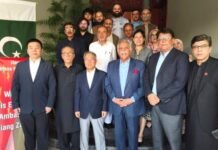
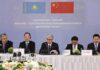
Islamabad : Pakistan–China Industrialisation Dialogue was held in Islamabad, bringing together policymakers, diplomats, business leaders, and development experts to discuss the next phase of industrial cooperation between Pakistan and China. Pakistan is placing high priority on strengthening economic ties with China, with a high-level visit expected in this month.
The session commenced with opening remarks by Mustafa Hyder Sayed, who warmly welcomed the distinguished participants and especially acknowledged the presence of the Federal Minister for Board of Investment, Qaiser Ahmed Sheikh. He commended the Minister’s proactive efforts in translating policy into tangible investment outcomes.
Highlighting the evolution of the China-Pakistan Economic Corridor (CPEC), he briefly traced its journey from Phase I—focused on infrastructure and connectivity—to Phase II, which prioritises industrialisation and business-to-business (B2B) collaboration.
The Federal Minister , while addressing the dialogue, expressed gratitude for the invitation to speak on such a critical and timely subject. Reflecting on Pakistan’s longstanding relationship with China, he described the two countries as “iron-clad friends” with a shared vision for economic progress.
The Minister noted that CPEC, initially valued at $46 billion in 2015, has grown into Pakistan’s largest-ever foreign investment initiative, with approximately $30 billion already realised and over 261,000 jobs created. He highlighted that Phase I of CPEC successfully addressed key infrastructure gaps, including the addition of over 8,000 MW of electricity to the national grid and the development of extensive road networks, which laid the foundation for industrial growth.
Dr. Shezra Mansab, Minister of State, contributed to the discussion by highlighting the climate dimension of industrial cooperation. She shared insights from her recent engagements with Chinese counterparts, particularly in areas of green development and sustainable industrial practices.
Mr. Yang Guangyuan, Chinese Counsellor , underscored the vast potential for bilateral cooperation across multiple sectors including agriculture, information technology, pharmaceuticals, and manufacturing.
Minister Investment Qaiser Ahmed Sheikh mentioned successful joint ventures such as tyre production and industrial services. He reaffirmed China’s commitment to supporting Pakistan’s industrialisation agenda under CPEC Phase II and highlighted how Pakistan’s focus should be to attract more Chinese investors.
He emphasised that Pakistan is now entering a decisive phase under CPEC 2.0, shifting focus towards industrialisation, export-led growth, and enhanced B2B partnerships.
“Pakistan has immense potential, but we must have transition from an import-driven economy to one that produces and exports value-added goods,” he remarked.
Sharing a personal reflection, the Minister mentioned his first visit to China in 1972 and observed the remarkable transformation the country has achieved, particularly in rural development and export-oriented industrialisation. He stressed that Pakistan has much to learn from China’s development model.
The Minister highlighted the government’s investor-friendly policies, especially within Special Economic Zones (SEZs), where incentives such as tax exemptions—including no income tax for up to nine years—are being offered to attract foreign and local investors. He also noted that efforts are underway to relocate Chinese industries to Pakistan, which will significantly boost exports and industrial capacity.
He further outlined the Board of Investment’s ongoing reforms to ease regulations, remove bottlenecks, and facilitate investors through initiatives such as the Business Facilitation Centre (BFC) and the “Asaan Karobar Act.”
Other notable speakers also shared valuable perspectives on enhancing industrial linkages, strengthening supply chains, and unlocking Pakistan’s manufacturing potential.
The dialogue highlighted that while China has remained Pakistan’s largest trading partner for over a decade, there is a pressing need to address the trade imbalance by increasing Pakistan’s exports through value-added manufacturing. Participants agreed that CPEC Phase II provides a strategic opportunity to achieve this objective.
The event concluded with a reaffirmation of the strong and enduring partnership between Pakistan and China, with a shared commitment to advancing industrial cooperation, economic growth, and regional connectivity.