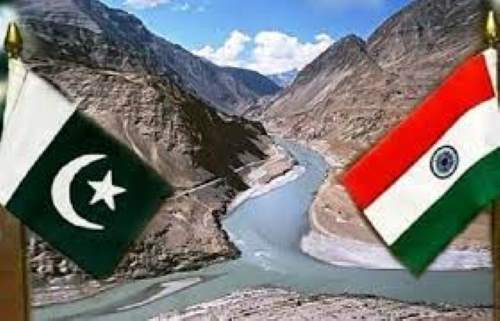
 ISLAMABAD : Monitoring Desk – Deputy Prime Minister/Foreign Minister Senator Mohammad Ishaq Dar has successfully presented and advocated the case of Water Terrorism by India against Pakistan violating Indus Water Treaty. He participated and addressed the conference “Transboundary Water Resources: A Weaponised Global Common” held at the Brussels Conference on 18 June, 2026.
The conference brought together leading European voices on climate change, water resource management, and the political dimensions surrounding these important issues. DPM commended CEPS, and the Embassy of Pakistan in Brussels, for co-organizing this important conference. Given the pressing nature of the issues at hand, this conference is timely and addresses crucial issues in international law, climate change and global peace and security.
Representing Pakistan the DPM said, As the seminar title, “Transboundary Water Resources: A Weaponised Global Common,” suggests, the governance of transboundary waters through agreements, treaties, and mutual understandings is of global importance. Shared resources require cooperative management through agreed frameworks; otherwise, competing interests can turn them into sources of conflicted and weaponization, as increasingly seen today.
As the former Secretary General of the United Nations, Mr. Kofi Annan, said:
“Fierce national competition over water resources has prompted fears that water issues contain the seeds of violent conflict. But the water crises we face are more often crises of management and governance, rather than absolute scarcity. Shared waters can be a pathway to peace and regional integration rather than a catalyst for war.”
He said, the very fact that we need to have this discussion in this day and age is, in itself, dismaying. It serves as a reminder that peaceful coexistence cannot be taken for granted. It must be sustained through respect for the treaties, agreements, and multilateral frameworks that enable states to manage differences through cooperation rather than confrontation.
Mr. Dar shared, Pakistan has consistently upheld the values enshrined in the UN Charter and has remained committed to itsprinciples and relevant UN resolutions. It was in this spirit that Pakistan signed the Indus Waters Treaty with India in 1960, establishing a framework for the utilization of the six rivers of the Indus River System.
The treaty envisages the peaceful resolution of disputes within its own framework. It is a testament to the enduring quality of the treaty that it survived three major conflicts, and several other challenges over the decades.
It is important to acknowledge that Pakistan has previously voiced concerns over certain actions by India under the Treaty. Consistent with the Treaty’s provisions, we sought settlement through international mechanisms and respected decisions even when they fell short of our expectations.
At no stage was the outright unilateral abrogation of the Treaty considered a viable course of action by either side. Responsible states act within established legal frameworks rather than abandoning them.
And yet, today, we find ourselves confronted with precisely such a challenge.
DPM Pakistan said, It is important to underscore that our concerns are not merely based on Indian statements. India has followed up its belligerent statements with illegal actions; these include projects to create reservoirs such as Sawalkot, Kirthai, Kwar etc; the expansion of existing structures such as Baglihar and Salal; and, most alarmingly, diversion projects on the Indus, Chenab and Ravi rivers. In total, at least 17 such projects that will drastically alter the river system as a whole, giving India the tools for “hydro-hegemony” that it so desires.
As you will appreciate, river systems are not merely waterways. They are lifelines. They carry profound historical significance and serve as immediate sources of sustenance and survival. One of the world’s oldest continuous human civilizations, the Indus Valley Civilization, which subsequently nurtured the Gandhara Civilization and gave rise to numerous cultural and historical developments, faces an unprecedented threat today. The stated policy of our eastern neighbour to intentionally deprive 240 million people of their rightful access to water represents a catastrophe in the making, of unparalleled magnitude.
Water must never be viewed as an instrument of coercion. It is a shared resource, a common responsibility, and ultimately a prerequisite for human dignity and sustainable development. The future of transboundary water governance must therefore be anchored in cooperation and respect for international law.
He stressed, it is important to underscore that this issue should not be viewed as one confined to South Asia. The sanctity of treaties is the bedrock of the international order. Europe itself offers compelling examples of how the faithful implementation of transboundary water agreements has enabled States to share water resources cooperatively and to promote regional stability and prosperity. Respect for treaty obligations is therefore not merely a regional concern but a global imperative.
Pakistan remains committed to resolving all issues through dialogue, diplomacy, and the mechanisms provided under international law. Our position is guided not by confrontation, but by the conviction that lasting solutions can only emerge through cooperation and respect for mutually agreed obligations.
Furthermore, Pakistan finds itself confronting this challenge at a time when it is already disproportionately affected by climate change. Despite contributing less than 1% of global greenhouse gas emissions, Pakistan remains among the most climate-vulnerable countries in the world. This is a moment that calls for enhanced international cooperation and collaboration on water-related issues.
I hope that today’s discussions will underscore the importance of cooperation in the management of transboundary water resources, using the Indus Waters Treaty as a case study while also examining other regions and river systems that may offer valuable lessons and insights.
He called upon the participants to reaffirm today that shared waters should unite nations rather than divide them, and that cooperation, not coercion, must remain the guiding principle of transboundary water governance.